

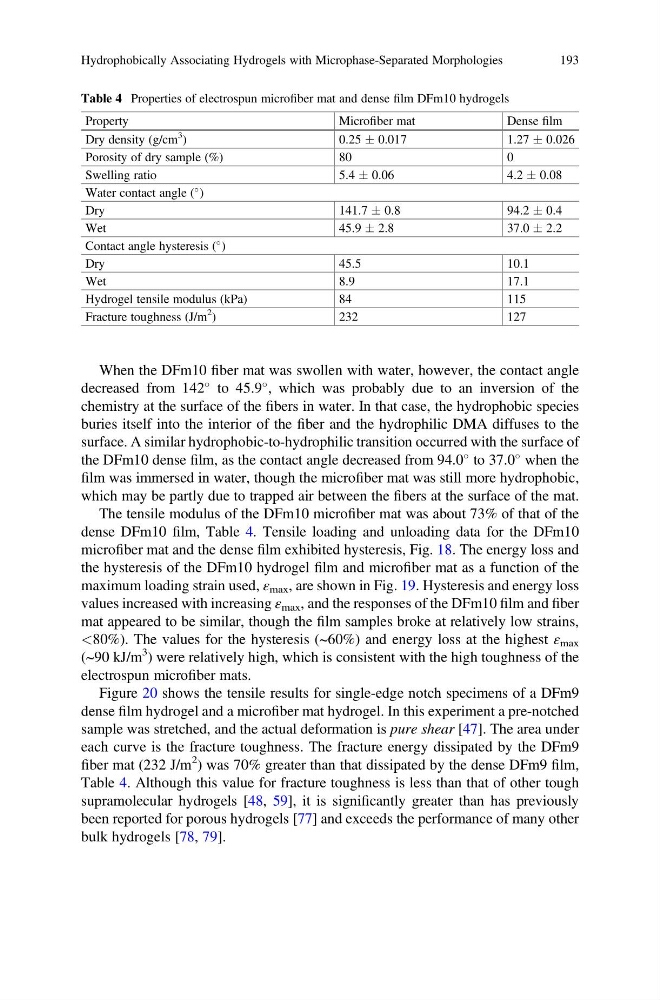
When the DFm10 fiber mat was swollen with water, however, the contact angle
decreased from 142
to 45.9
, which was probably due to an inversion of the
chemistry at the surface of the fibers in water. In that case, the hydrophobic species
buries itself into the interior of the fiber and the hydrophilic DMA diffuses to the
surface. A similar hydrophobic-to-hydrophilic transition occurred with the surface of
the DFm10 dense film, as the contact angle decreased from 94.0
to 37.0
when the
film was immersed in water, though the microfiber mat was still more hydrophobic,
which may be partly due to trapped air between the fibers at the surface of the mat.
The tensile modulus of the DFm10 microfiber mat was about 73% of that of the
dense DFm10 film, Table 4. Tensile loading and unloading data for the DFm10
microfiber mat and the dense film exhibited hysteresis, Fig. 18. The energy loss and
the hysteresis of the DFm10 hydrogel film and microfiber mat as a function of the
maximum loading strain used, ε max , are shown in Fig. 19. Hysteresis and energy loss
values increased with increasing ε max , and the responses of the DFm10 film and fiber
mat appeared to be similar, though the film samples broke at relatively low strains,
<80%). The values for the hysteresis (~60%) and energy loss at the highest ε max
(~90 kJ/m
3
) were relatively high, which is consistent with the high toughness of the
electrospun microfiber mats.
Figure 20 shows the tensile results for single-edge notch specimens of a DFm9
dense film hydrogel and a microfiber mat hydrogel. In this experiment a pre-notched
sample was stretched, and the actual deformation is pure shear [47]. The area under
each curve is the fracture toughness. The fracture energy dissipated by the DFm9
fiber mat (232 J/m
2 ) was 70% greater than that dissipated by the dense DFm9 film,
Table 4. Although this value for fracture toughness is less than that of other tough
supramolecular hydrogels [48, 59], it is significantly greater than has previously
been reported for porous hydrogels [77] and exceeds the performance of many other
bulk hydrogels [78, 79].
Table 4 Properties of electrospun microfiber mat and dense film DFm10 hydrogels
Property
Microfiber mat
Dense film
Dry density (g/cm
3
)
0.25 Æ 0.017
1.27 Æ 0.026
Porosity of dry sample (%)
80
0
Swelling ratio
5.4 Æ 0.06
4.2 Æ 0.08
Water contact angle (
)
Dry
141.7 Æ 0.8
94.2 Æ 0.4
Wet
45.9 Æ 2.8
37.0 Æ 2.2
Contact angle hysteresis (
)
Dry
45.5
10.1
Wet
8.9
17.1
Hydrogel tensile modulus (kPa)
84
115
Fracture toughness (J/m
2
)
232
127
Hydrophobically Associating Hydrogels with Microphase-Separated Morphologies
193
decreased from 142
to 45.9
, which was probably due to an inversion of the
chemistry at the surface of the fibers in water. In that case, the hydrophobic species
buries itself into the interior of the fiber and the hydrophilic DMA diffuses to the
surface. A similar hydrophobic-to-hydrophilic transition occurred with the surface of
the DFm10 dense film, as the contact angle decreased from 94.0
to 37.0
when the
film was immersed in water, though the microfiber mat was still more hydrophobic,
which may be partly due to trapped air between the fibers at the surface of the mat.
The tensile modulus of the DFm10 microfiber mat was about 73% of that of the
dense DFm10 film, Table 4. Tensile loading and unloading data for the DFm10
microfiber mat and the dense film exhibited hysteresis, Fig. 18. The energy loss and
the hysteresis of the DFm10 hydrogel film and microfiber mat as a function of the
maximum loading strain used, ε max , are shown in Fig. 19. Hysteresis and energy loss
values increased with increasing ε max , and the responses of the DFm10 film and fiber
mat appeared to be similar, though the film samples broke at relatively low strains,
<80%). The values for the hysteresis (~60%) and energy loss at the highest ε max
(~90 kJ/m
3
) were relatively high, which is consistent with the high toughness of the
electrospun microfiber mats.
Figure 20 shows the tensile results for single-edge notch specimens of a DFm9
dense film hydrogel and a microfiber mat hydrogel. In this experiment a pre-notched
sample was stretched, and the actual deformation is pure shear [47]. The area under
each curve is the fracture toughness. The fracture energy dissipated by the DFm9
fiber mat (232 J/m
2 ) was 70% greater than that dissipated by the dense DFm9 film,
Table 4. Although this value for fracture toughness is less than that of other tough
supramolecular hydrogels [48, 59], it is significantly greater than has previously
been reported for porous hydrogels [77] and exceeds the performance of many other
bulk hydrogels [78, 79].
Table 4 Properties of electrospun microfiber mat and dense film DFm10 hydrogels
Property
Microfiber mat
Dense film
Dry density (g/cm
3
)
0.25 Æ 0.017
1.27 Æ 0.026
Porosity of dry sample (%)
80
0
Swelling ratio
5.4 Æ 0.06
4.2 Æ 0.08
Water contact angle (
)
Dry
141.7 Æ 0.8
94.2 Æ 0.4
Wet
45.9 Æ 2.8
37.0 Æ 2.2
Contact angle hysteresis (
)
Dry
45.5
10.1
Wet
8.9
17.1
Hydrogel tensile modulus (kPa)
84
115
Fracture toughness (J/m
2
)
232
127
Hydrophobically Associating Hydrogels with Microphase-Separated Morphologies
193