

3 Applications
3.1 Injectable Hydrogels
Supramolecular bonds can be disrupted by a solvent capable of solvating the
physical interactions. As discussed earlier in this chapter, the hydrophobically
associating copolymers were soluble in a variety of organic solvents. Solubility of
the copolymers enables the manufacture of films by solution casting, but it also
allows for viscous flow in a capillary or syringe, allowing the application of
injectable and in situ forming hydrogels for biomedical applications such as tissue
engineering and regenerative medicine [72]. For example, a DF5 copolymer can be
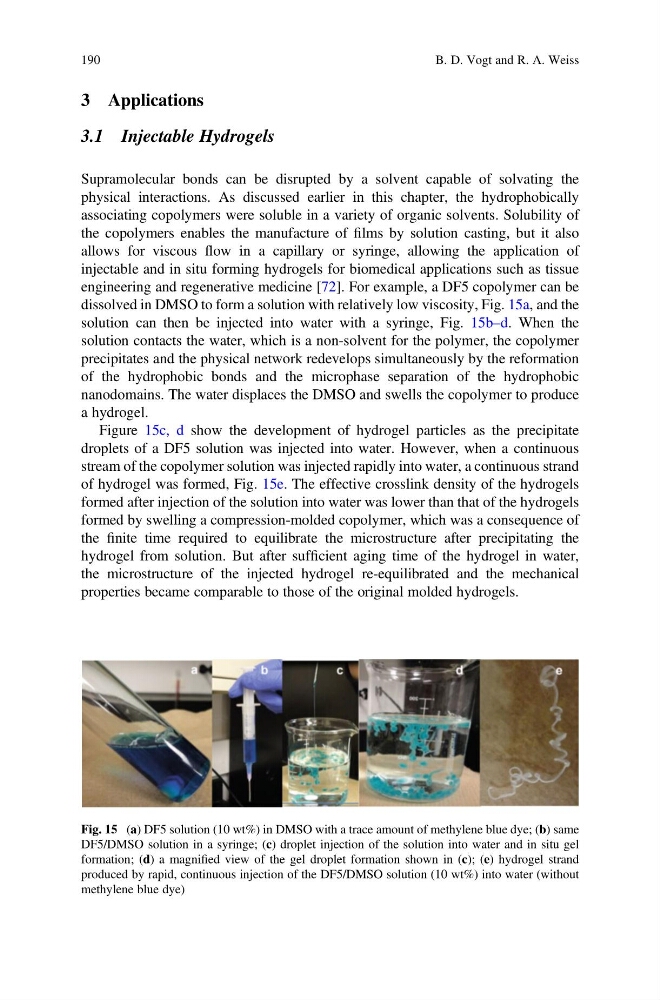
dissolved in DMSO to form a solution with relatively low viscosity, Fig. 15a, and the
solution can then be injected into water with a syringe, Fig. 15b–d. When the
solution contacts the water, which is a non-solvent for the polymer, the copolymer
precipitates and the physical network redevelops simultaneously by the reformation
of the hydrophobic bonds and the microphase separation of the hydrophobic
nanodomains. The water displaces the DMSO and swells the copolymer to produce
a hydrogel.
Figure 15c, d show the development of hydrogel particles as the precipitate
droplets of a DF5 solution was injected into water. However, when a continuous
stream of the copolymer solution was injected rapidly into water, a continuous strand
of hydrogel was formed, Fig. 15e. The effective crosslink density of the hydrogels
formed after injection of the solution into water was lower than that of the hydrogels
formed by swelling a compression-molded copolymer, which was a consequence of
the finite time required to equilibrate the microstructure after precipitating the
hydrogel from solution. But after sufficient aging time of the hydrogel in water,
the microstructure of the injected hydrogel re-equilibrated and the mechanical
properties became comparable to those of the original molded hydrogels.
Fig. 15 (a) DF5 solution (10 wt%) in DMSO with a trace amount of methylene blue dye; (b) same
DF5/DMSO solution in a syringe; (c) droplet injection of the solution into water and in situ gel
formation; (d) a magnified view of the gel droplet formation shown in (c); (e) hydrogel strand
produced by rapid, continuous injection of the DF5/DMSO solution (10 wt%) into water (without
methylene blue dye)
190
B. D. Vogt and R. A. Weiss
3.1 Injectable Hydrogels
Supramolecular bonds can be disrupted by a solvent capable of solvating the
physical interactions. As discussed earlier in this chapter, the hydrophobically
associating copolymers were soluble in a variety of organic solvents. Solubility of
the copolymers enables the manufacture of films by solution casting, but it also
allows for viscous flow in a capillary or syringe, allowing the application of
injectable and in situ forming hydrogels for biomedical applications such as tissue
engineering and regenerative medicine [72]. For example, a DF5 copolymer can be
dissolved in DMSO to form a solution with relatively low viscosity, Fig. 15a, and the
solution can then be injected into water with a syringe, Fig. 15b–d. When the
solution contacts the water, which is a non-solvent for the polymer, the copolymer
precipitates and the physical network redevelops simultaneously by the reformation
of the hydrophobic bonds and the microphase separation of the hydrophobic
nanodomains. The water displaces the DMSO and swells the copolymer to produce
a hydrogel.
Figure 15c, d show the development of hydrogel particles as the precipitate
droplets of a DF5 solution was injected into water. However, when a continuous
stream of the copolymer solution was injected rapidly into water, a continuous strand
of hydrogel was formed, Fig. 15e. The effective crosslink density of the hydrogels
formed after injection of the solution into water was lower than that of the hydrogels
formed by swelling a compression-molded copolymer, which was a consequence of
the finite time required to equilibrate the microstructure after precipitating the
hydrogel from solution. But after sufficient aging time of the hydrogel in water,
the microstructure of the injected hydrogel re-equilibrated and the mechanical
properties became comparable to those of the original molded hydrogels.
Fig. 15 (a) DF5 solution (10 wt%) in DMSO with a trace amount of methylene blue dye; (b) same
DF5/DMSO solution in a syringe; (c) droplet injection of the solution into water and in situ gel
formation; (d) a magnified view of the gel droplet formation shown in (c); (e) hydrogel strand
produced by rapid, continuous injection of the DF5/DMSO solution (10 wt%) into water (without
methylene blue dye)
190
B. D. Vogt and R. A. Weiss