

nanodomains has a diameter of ~2–3 nm and contains ~100 hydrophobic groups.
The nanodomains elongate slightly in the direction of the applied stress in a tensile
experiment [24]. The deformation of the network chains breaks physical bonds
within the nanodomain, which can rearrange by small movements within a
nanodomain. That produces a relatively small deformation of the nanodomains,
even when the macroscopic deformation of the hydrogel is large, and a high strain
amplification factor – defined as the ratio of the macroscopic strain of the hydrogel
and the microscopic strain of the nanodomains. According to Ref. [24], the amplification factor for DF10 determined by a simultaneous tensile and SAXS experiment
was ~7.5.
By the nature of the reversible physical bonds, supramolecular hydrogels are
viscoelastic, so they should exhibit creep if left under load for a significant time.
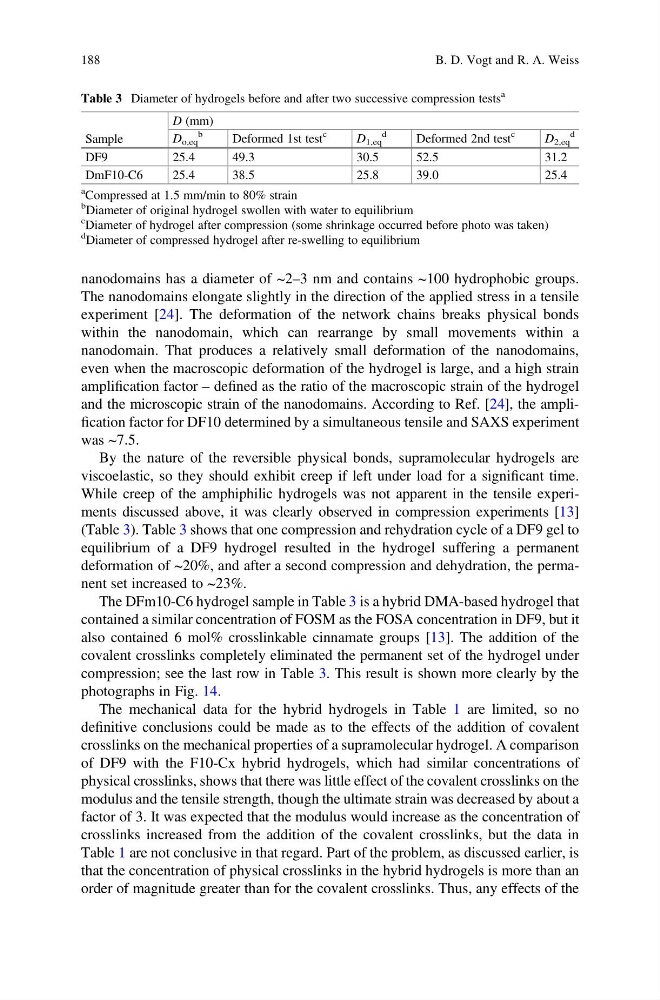
While creep of the amphiphilic hydrogels was not apparent in the tensile experiments discussed above, it was clearly observed in compression experiments [13]
(Table 3). Table 3 shows that one compression and rehydration cycle of a DF9 gel to
equilibrium of a DF9 hydrogel resulted in the hydrogel suffering a permanent
deformation of ~20%, and after a second compression and dehydration, the permanent set increased to ~23%.
The DFm10-C6 hydrogel sample in Table 3 is a hybrid DMA-based hydrogel that
contained a similar concentration of FOSM as the FOSA concentration in DF9, but it
also contained 6 mol% crosslinkable cinnamate groups [13]. The addition of the
covalent crosslinks completely eliminated the permanent set of the hydrogel under
compression; see the last row in Table 3. This result is shown more clearly by the
photographs in Fig. 14.
The mechanical data for the hybrid hydrogels in Table 1 are limited, so no
definitive conclusions could be made as to the effects of the addition of covalent
crosslinks on the mechanical properties of a supramolecular hydrogel. A comparison
of DF9 with the F10-Cx hybrid hydrogels, which had similar concentrations of
physical crosslinks, shows that there was little effect of the covalent crosslinks on the
modulus and the tensile strength, though the ultimate strain was decreased by about a
factor of 3. It was expected that the modulus would increase as the concentration of
crosslinks increased from the addition of the covalent crosslinks, but the data in
Table 1 are not conclusive in that regard. Part of the problem, as discussed earlier, is
that the concentration of physical crosslinks in the hybrid hydrogels is more than an
order of magnitude greater than for the covalent crosslinks. Thus, any effects of the
Table 3 Diameter of hydrogels before and after two successive compression tests
a
Sample
D (mm)
D o,eq
b
Deformed 1st test
c
D 1,eq
d
Deformed 2nd test
c
D 2,eq
d
DF9
25.4
49.3
30.5
52.5
31.2
DmF10-C6
25.4
38.5
25.8
39.0
25.4
a Compressed at 1.5 mm/min to 80% strain
b
Diameter of original hydrogel swollen with water to equilibrium
c Diameter of hydrogel after compression (some shrinkage occurred before photo was taken)
d
Diameter of compressed hydrogel after re-swelling to equilibrium
188
B. D. Vogt and R. A. Weiss
The nanodomains elongate slightly in the direction of the applied stress in a tensile
experiment [24]. The deformation of the network chains breaks physical bonds
within the nanodomain, which can rearrange by small movements within a
nanodomain. That produces a relatively small deformation of the nanodomains,
even when the macroscopic deformation of the hydrogel is large, and a high strain
amplification factor – defined as the ratio of the macroscopic strain of the hydrogel
and the microscopic strain of the nanodomains. According to Ref. [24], the amplification factor for DF10 determined by a simultaneous tensile and SAXS experiment
was ~7.5.
By the nature of the reversible physical bonds, supramolecular hydrogels are
viscoelastic, so they should exhibit creep if left under load for a significant time.
While creep of the amphiphilic hydrogels was not apparent in the tensile experiments discussed above, it was clearly observed in compression experiments [13]
(Table 3). Table 3 shows that one compression and rehydration cycle of a DF9 gel to
equilibrium of a DF9 hydrogel resulted in the hydrogel suffering a permanent
deformation of ~20%, and after a second compression and dehydration, the permanent set increased to ~23%.
The DFm10-C6 hydrogel sample in Table 3 is a hybrid DMA-based hydrogel that
contained a similar concentration of FOSM as the FOSA concentration in DF9, but it
also contained 6 mol% crosslinkable cinnamate groups [13]. The addition of the
covalent crosslinks completely eliminated the permanent set of the hydrogel under
compression; see the last row in Table 3. This result is shown more clearly by the
photographs in Fig. 14.
The mechanical data for the hybrid hydrogels in Table 1 are limited, so no
definitive conclusions could be made as to the effects of the addition of covalent
crosslinks on the mechanical properties of a supramolecular hydrogel. A comparison
of DF9 with the F10-Cx hybrid hydrogels, which had similar concentrations of
physical crosslinks, shows that there was little effect of the covalent crosslinks on the
modulus and the tensile strength, though the ultimate strain was decreased by about a
factor of 3. It was expected that the modulus would increase as the concentration of
crosslinks increased from the addition of the covalent crosslinks, but the data in
Table 1 are not conclusive in that regard. Part of the problem, as discussed earlier, is
that the concentration of physical crosslinks in the hybrid hydrogels is more than an
order of magnitude greater than for the covalent crosslinks. Thus, any effects of the
Table 3 Diameter of hydrogels before and after two successive compression tests
a
Sample
D (mm)
D o,eq
b
Deformed 1st test
c
D 1,eq
d
Deformed 2nd test
c
D 2,eq
d
DF9
25.4
49.3
30.5
52.5
31.2
DmF10-C6
25.4
38.5
25.8
39.0
25.4
a Compressed at 1.5 mm/min to 80% strain
b
Diameter of original hydrogel swollen with water to equilibrium
c Diameter of hydrogel after compression (some shrinkage occurred before photo was taken)
d
Diameter of compressed hydrogel after re-swelling to equilibrium
188
B. D. Vogt and R. A. Weiss