

chains formed at different instants along the loading history. These chains experience different extents of deformation and thus carry different free energies. The total
free energy is the sum of contributions from all chains. The second approach
[31, 32], referred to as the transient network theory, considers a statistical distribution of the chain end-to-end vectors, which evolves upon macroscopic deformation
and reaction of dynamic bonds. The total free energy is calculated by integrating the
single-chain free energy over the chain distribution space. Either approach can
specify how the network free energy evolves under macroscopic deformation as
well as bond dissociation and reformation. To lay the theoretical foundation, we first
review necessary concepts and equations of continuum mechanics in Sect. 2,
followed by the descriptions of the two approaches in Sects. 3 and 4, respectively.
Although both approaches can be applied to a broad class of dynamic bonds, in this
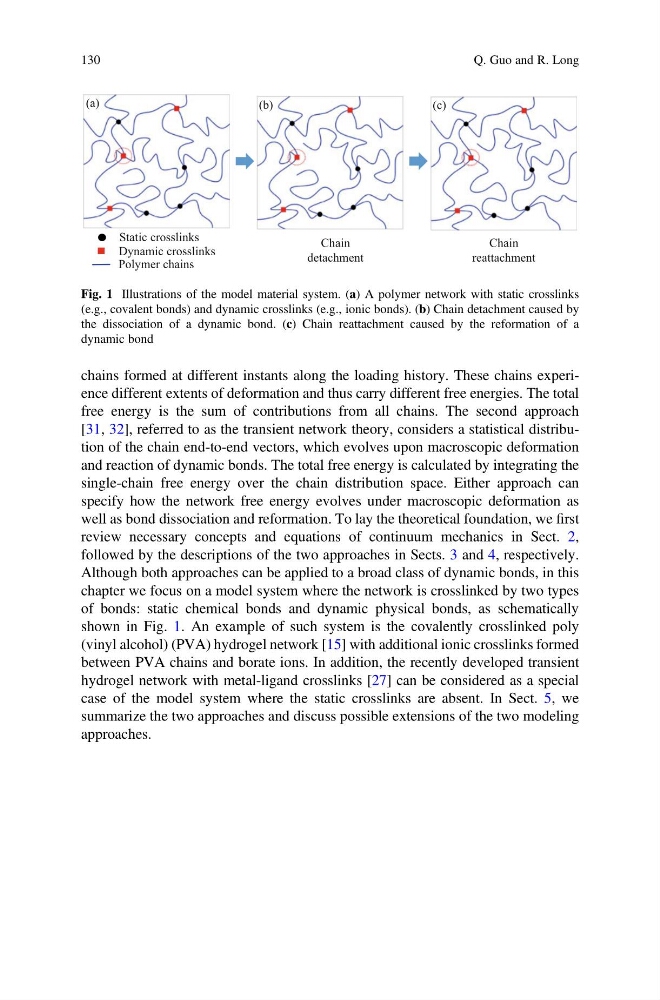
chapter we focus on a model system where the network is crosslinked by two types
of bonds: static chemical bonds and dynamic physical bonds, as schematically
shown in Fig. 1. An example of such system is the covalently crosslinked poly
(vinyl alcohol) (PVA) hydrogel network [15] with additional ionic crosslinks formed
between PVA chains and borate ions. In addition, the recently developed transient
hydrogel network with metal-ligand crosslinks [27] can be considered as a special
case of the model system where the static crosslinks are absent. In Sect. 5, we
summarize the two approaches and discuss possible extensions of the two modeling
approaches.
Chain
detachment
Chain
reattachment
Polymer chains
Dynamic crosslinks
Static crosslinks
(a)
(b)
(c)
Fig. 1 Illustrations of the model material system. (a) A polymer network with static crosslinks
(e.g., covalent bonds) and dynamic crosslinks (e.g., ionic bonds). (b) Chain detachment caused by
the dissociation of a dynamic bond. (c) Chain reattachment caused by the reformation of a
dynamic bond
130
Q. Guo and R. Long
free energy is the sum of contributions from all chains. The second approach
[31, 32], referred to as the transient network theory, considers a statistical distribution of the chain end-to-end vectors, which evolves upon macroscopic deformation
and reaction of dynamic bonds. The total free energy is calculated by integrating the
single-chain free energy over the chain distribution space. Either approach can
specify how the network free energy evolves under macroscopic deformation as
well as bond dissociation and reformation. To lay the theoretical foundation, we first
review necessary concepts and equations of continuum mechanics in Sect. 2,
followed by the descriptions of the two approaches in Sects. 3 and 4, respectively.
Although both approaches can be applied to a broad class of dynamic bonds, in this
chapter we focus on a model system where the network is crosslinked by two types
of bonds: static chemical bonds and dynamic physical bonds, as schematically
shown in Fig. 1. An example of such system is the covalently crosslinked poly
(vinyl alcohol) (PVA) hydrogel network [15] with additional ionic crosslinks formed
between PVA chains and borate ions. In addition, the recently developed transient
hydrogel network with metal-ligand crosslinks [27] can be considered as a special
case of the model system where the static crosslinks are absent. In Sect. 5, we
summarize the two approaches and discuss possible extensions of the two modeling
approaches.
Chain
detachment
Chain
reattachment
Polymer chains
Dynamic crosslinks
Static crosslinks
(a)
(b)
(c)
Fig. 1 Illustrations of the model material system. (a) A polymer network with static crosslinks
(e.g., covalent bonds) and dynamic crosslinks (e.g., ionic bonds). (b) Chain detachment caused by
the dissociation of a dynamic bond. (c) Chain reattachment caused by the reformation of a
dynamic bond
130
Q. Guo and R. Long