

the ω
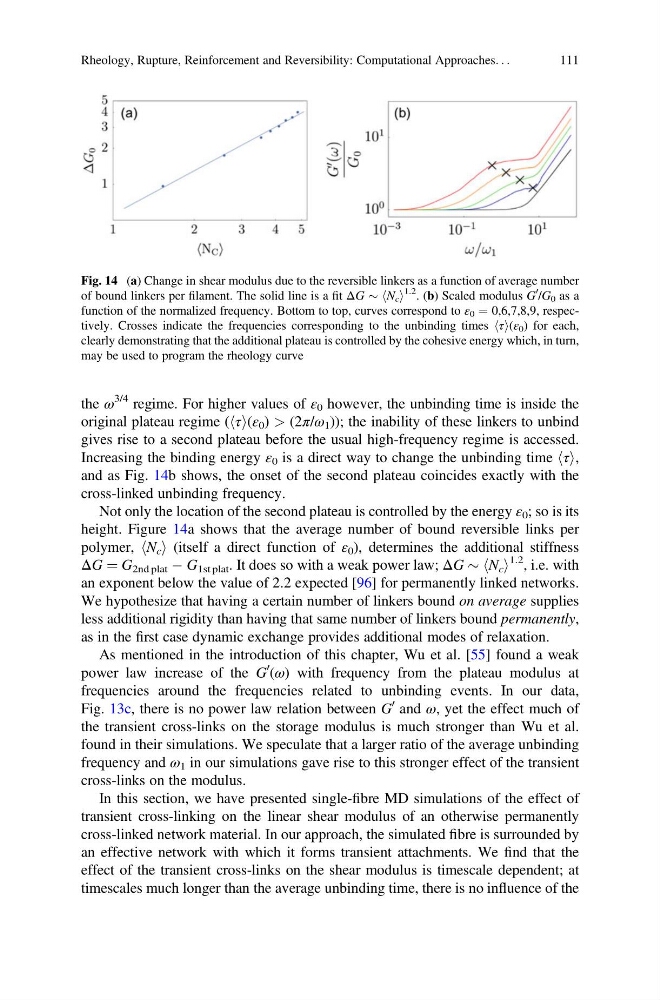
3/4 regime. For higher values of ε 0 however, the unbinding time is inside the
original plateau regime (hτi(ε 0 ) > (2π/ω 1 )); the inability of these linkers to unbind
gives rise to a second plateau before the usual high-frequency regime is accessed.
Increasing the binding energy ε 0 is a direct way to change the unbinding time hτi,
and as Fig. 14b shows, the onset of the second plateau coincides exactly with the
cross-linked unbinding frequency.
Not only the location of the second plateau is controlled by the energy ε 0 ; so is its
height. Figure 14a shows that the average number of bound reversible links per
polymer, hN c i (itself a direct function of ε 0 ), determines the additional stiffness
ΔG ¼ G 2nd plat À G 1st plat . It does so with a weak power law; ΔG $ hN c i
1.2 , i.e. with
an exponent below the value of 2.2 expected [96] for permanently linked networks.
We hypothesize that having a certain number of linkers bound on average supplies
less additional rigidity than having that same number of linkers bound permanently,
as in the first case dynamic exchange provides additional modes of relaxation.
As mentioned in the introduction of this chapter, Wu et al. [55] found a weak
power law increase of the G
0 (ω) with frequency from the plateau modulus at
frequencies around the frequencies related to unbinding events. In our data,
Fig. 13c, there is no power law relation between G
0 and ω, yet the effect much of
the transient cross-links on the storage modulus is much stronger than Wu et al.
found in their simulations. We speculate that a larger ratio of the average unbinding
frequency and ω 1 in our simulations gave rise to this stronger effect of the transient
cross-links on the modulus.
In this section, we have presented single-fibre MD simulations of the effect of
transient cross-linking on the linear shear modulus of an otherwise permanently
cross-linked network material. In our approach, the simulated fibre is surrounded by
an effective network with which it forms transient attachments. We find that the
effect of the transient cross-links on the shear modulus is timescale dependent; at
timescales much longer than the average unbinding time, there is no influence of the
Fig. 14 (a) Change in shear modulus due to the reversible linkers as a function of average number
of bound linkers per filament. The solid line is a fit ΔG $ hN c i
1.2 . (b) Scaled modulus G
0
/G 0 as a
function of the normalized frequency. Bottom to top, curves correspond to ε 0 ¼ 0,6,7,8,9, respectively. Crosses indicate the frequencies corresponding to the unbinding times hτi(ε 0 ) for each,
clearly demonstrating that the additional plateau is controlled by the cohesive energy which, in turn,
may be used to program the rheology curve
Rheology, Rupture, Reinforcement and Reversibility: Computational Approaches. . .
111
3/4 regime. For higher values of ε 0 however, the unbinding time is inside the
original plateau regime (hτi(ε 0 ) > (2π/ω 1 )); the inability of these linkers to unbind
gives rise to a second plateau before the usual high-frequency regime is accessed.
Increasing the binding energy ε 0 is a direct way to change the unbinding time hτi,
and as Fig. 14b shows, the onset of the second plateau coincides exactly with the
cross-linked unbinding frequency.
Not only the location of the second plateau is controlled by the energy ε 0 ; so is its
height. Figure 14a shows that the average number of bound reversible links per
polymer, hN c i (itself a direct function of ε 0 ), determines the additional stiffness
ΔG ¼ G 2nd plat À G 1st plat . It does so with a weak power law; ΔG $ hN c i
1.2 , i.e. with
an exponent below the value of 2.2 expected [96] for permanently linked networks.
We hypothesize that having a certain number of linkers bound on average supplies
less additional rigidity than having that same number of linkers bound permanently,
as in the first case dynamic exchange provides additional modes of relaxation.
As mentioned in the introduction of this chapter, Wu et al. [55] found a weak
power law increase of the G
0 (ω) with frequency from the plateau modulus at
frequencies around the frequencies related to unbinding events. In our data,
Fig. 13c, there is no power law relation between G
0 and ω, yet the effect much of
the transient cross-links on the storage modulus is much stronger than Wu et al.
found in their simulations. We speculate that a larger ratio of the average unbinding
frequency and ω 1 in our simulations gave rise to this stronger effect of the transient
cross-links on the modulus.
In this section, we have presented single-fibre MD simulations of the effect of
transient cross-linking on the linear shear modulus of an otherwise permanently
cross-linked network material. In our approach, the simulated fibre is surrounded by
an effective network with which it forms transient attachments. We find that the
effect of the transient cross-links on the shear modulus is timescale dependent; at
timescales much longer than the average unbinding time, there is no influence of the
Fig. 14 (a) Change in shear modulus due to the reversible linkers as a function of average number
of bound linkers per filament. The solid line is a fit ΔG $ hN c i
1.2 . (b) Scaled modulus G
0
/G 0 as a
function of the normalized frequency. Bottom to top, curves correspond to ε 0 ¼ 0,6,7,8,9, respectively. Crosses indicate the frequencies corresponding to the unbinding times hτi(ε 0 ) for each,
clearly demonstrating that the additional plateau is controlled by the cohesive energy which, in turn,
may be used to program the rheology curve
Rheology, Rupture, Reinforcement and Reversibility: Computational Approaches. . .
111