

Prior to strain in Fig. 8c, we see as in Fig. 8a that the local density of bridging
reversible links is maximized very near permanent cross-links. For both E rev ¼ 10k B T
and 15k B T, the local density at the maximum is enhanced by a factor of %4
compared to the bulk average. This enhancement factor grows remarkably larger
at equilibrium after strain, in Fig. 8d. For example, in the E rev ¼ 10k B T system, the
local density of bridging reversible links at the maximum is just over 29 times larger
than the bulk average number of bridges, and for E rev ¼ 15k B T, it is around 27 times
larger.
This enormous degree of clustering of bridging reversible cross-links around the
permanent cross-links in the strained system is due to an extremely strong ΔG poly
contribution to their binding free energy, when attempting to bind far from a
permanent link. In strained networks, polymer chains are often stretched to large
end-to-end lengths (see the strained simulation snapshot in Fig. 5b for an example).
The configurational entropy penalty to link such chains together by a reversible bond
can grow very sharply when attempting to form the bond far from an existing crosslink.
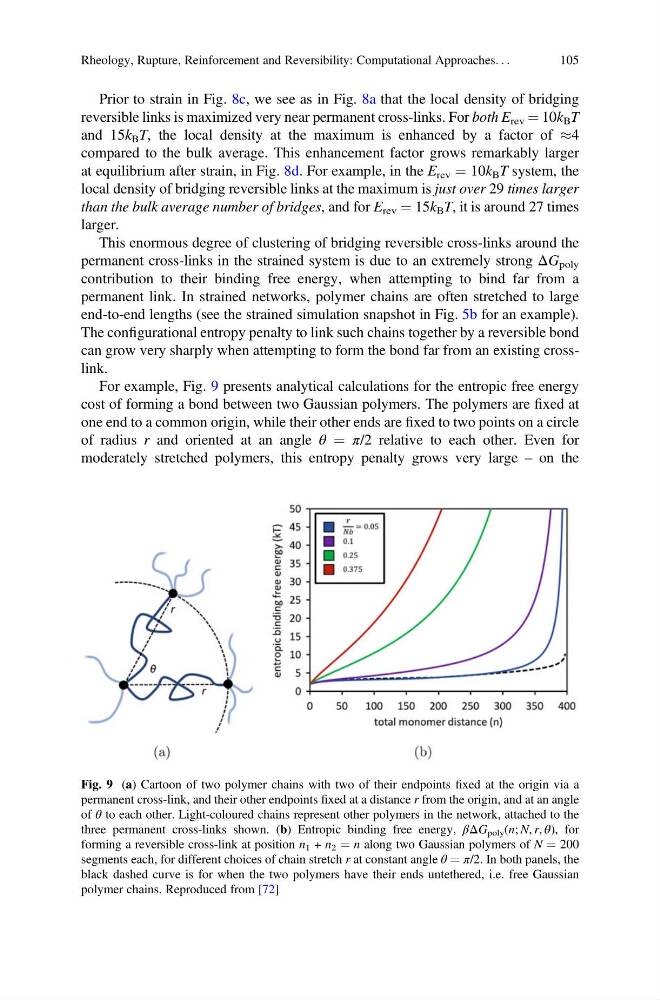
For example, Fig. 9 presents analytical calculations for the entropic free energy
cost of forming a bond between two Gaussian polymers. The polymers are fixed at
one end to a common origin, while their other ends are fixed to two points on a circle
of radius r and oriented at an angle θ ¼ π/2 relative to each other. Even for
moderately stretched polymers, this entropy penalty grows very large – on the
Fig. 9 (a) Cartoon of two polymer chains with two of their endpoints fixed at the origin via a
permanent cross-link, and their other endpoints fixed at a distance r from the origin, and at an angle
of θ to each other. Light-coloured chains represent other polymers in the network, attached to the
three permanent cross-links shown. (b) Entropic binding free energy, βΔG poly (n; N, r, θ), for
forming a reversible cross-link at position n 1 + n 2 ¼ n along two Gaussian polymers of N ¼ 200
segments each, for different choices of chain stretch r at constant angle θ ¼ π/2. In both panels, the
black dashed curve is for when the two polymers have their ends untethered, i.e. free Gaussian
polymer chains. Reproduced from [72]
Rheology, Rupture, Reinforcement and Reversibility: Computational Approaches. . .
105
reversible links is maximized very near permanent cross-links. For both E rev ¼ 10k B T
and 15k B T, the local density at the maximum is enhanced by a factor of %4
compared to the bulk average. This enhancement factor grows remarkably larger
at equilibrium after strain, in Fig. 8d. For example, in the E rev ¼ 10k B T system, the
local density of bridging reversible links at the maximum is just over 29 times larger
than the bulk average number of bridges, and for E rev ¼ 15k B T, it is around 27 times
larger.
This enormous degree of clustering of bridging reversible cross-links around the
permanent cross-links in the strained system is due to an extremely strong ΔG poly
contribution to their binding free energy, when attempting to bind far from a
permanent link. In strained networks, polymer chains are often stretched to large
end-to-end lengths (see the strained simulation snapshot in Fig. 5b for an example).
The configurational entropy penalty to link such chains together by a reversible bond
can grow very sharply when attempting to form the bond far from an existing crosslink.
For example, Fig. 9 presents analytical calculations for the entropic free energy
cost of forming a bond between two Gaussian polymers. The polymers are fixed at
one end to a common origin, while their other ends are fixed to two points on a circle
of radius r and oriented at an angle θ ¼ π/2 relative to each other. Even for
moderately stretched polymers, this entropy penalty grows very large – on the
Fig. 9 (a) Cartoon of two polymer chains with two of their endpoints fixed at the origin via a
permanent cross-link, and their other endpoints fixed at a distance r from the origin, and at an angle
of θ to each other. Light-coloured chains represent other polymers in the network, attached to the
three permanent cross-links shown. (b) Entropic binding free energy, βΔG poly (n; N, r, θ), for
forming a reversible cross-link at position n 1 + n 2 ¼ n along two Gaussian polymers of N ¼ 200
segments each, for different choices of chain stretch r at constant angle θ ¼ π/2. In both panels, the
black dashed curve is for when the two polymers have their ends untethered, i.e. free Gaussian
polymer chains. Reproduced from [72]
Rheology, Rupture, Reinforcement and Reversibility: Computational Approaches. . .
105