

4.1.5 Strain Response
Bound reversible cross-links have an influence on the pressure of the system at
equilibrium and during/after strain. Pressure is a direct proxy to the stress, i.e. the
force per unit area along a given surface of the sample. Since strain is being done
isotropically on the simulated sample, then the xx, yy and zz stress tensor elements
are thermodynamically on average identical and equal to the average total pressure,
having units of E=D
3 in the simulation.
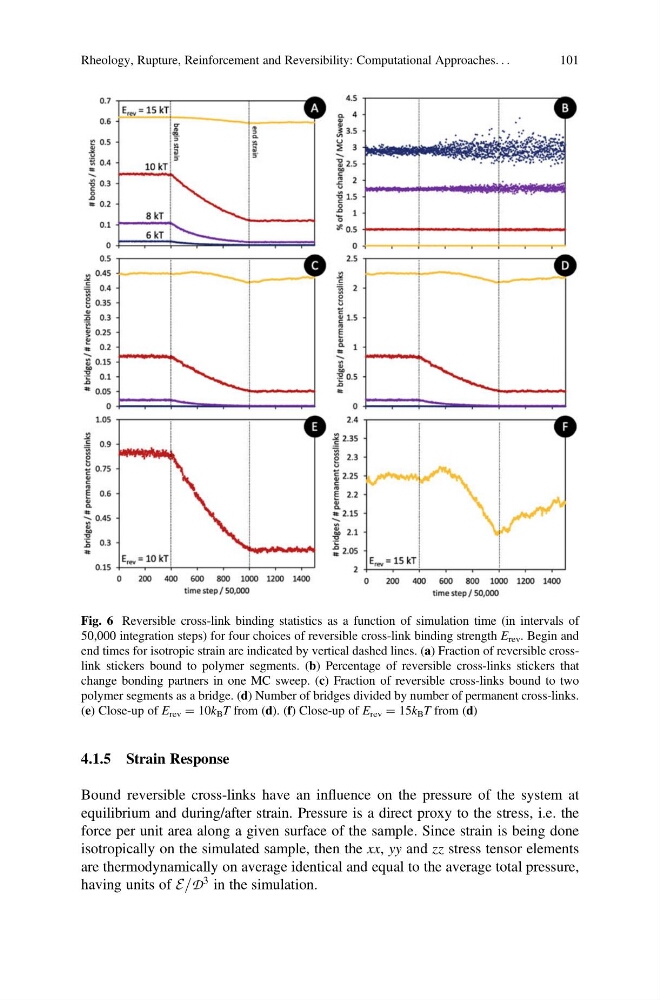
Fig. 6 Reversible cross-link binding statistics as a function of simulation time (in intervals of
50,000 integration steps) for four choices of reversible cross-link binding strength E rev . Begin and
end times for isotropic strain are indicated by vertical dashed lines. (a) Fraction of reversible crosslink stickers bound to polymer segments. (b) Percentage of reversible cross-links stickers that
change bonding partners in one MC sweep. (c) Fraction of reversible cross-links bound to two
polymer segments as a bridge. (d) Number of bridges divided by number of permanent cross-links.
(e) Close-up of E rev ¼ 10k B T from (d). (f) Close-up of E rev ¼ 15k B T from (d)
Rheology, Rupture, Reinforcement and Reversibility: Computational Approaches. . .
101
Bound reversible cross-links have an influence on the pressure of the system at
equilibrium and during/after strain. Pressure is a direct proxy to the stress, i.e. the
force per unit area along a given surface of the sample. Since strain is being done
isotropically on the simulated sample, then the xx, yy and zz stress tensor elements
are thermodynamically on average identical and equal to the average total pressure,
having units of E=D
3 in the simulation.
Fig. 6 Reversible cross-link binding statistics as a function of simulation time (in intervals of
50,000 integration steps) for four choices of reversible cross-link binding strength E rev . Begin and
end times for isotropic strain are indicated by vertical dashed lines. (a) Fraction of reversible crosslink stickers bound to polymer segments. (b) Percentage of reversible cross-links stickers that
change bonding partners in one MC sweep. (c) Fraction of reversible cross-links bound to two
polymer segments as a bridge. (d) Number of bridges divided by number of permanent cross-links.
(e) Close-up of E rev ¼ 10k B T from (d). (f) Close-up of E rev ¼ 15k B T from (d)
Rheology, Rupture, Reinforcement and Reversibility: Computational Approaches. . .
101