

New Symmetry-Adapted ab initio Approach to Nuclear Reactions
77
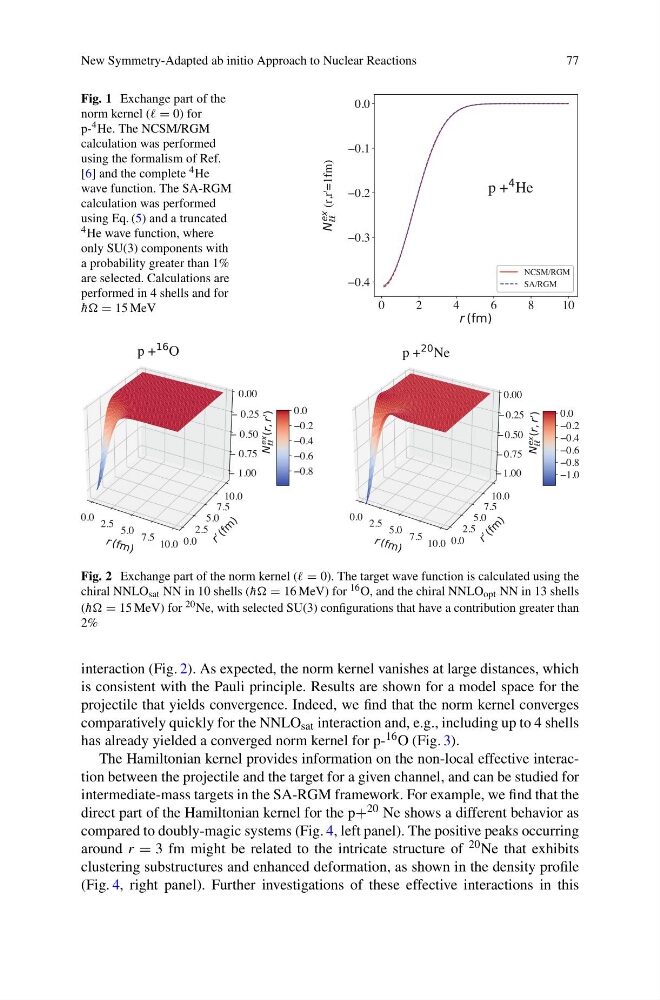
Fig. 1 Exchange part of the
norm kernel ( = 0) for
p- 4 He. The NCSM/RGM
calculation was performed
using the formalism of Ref.
[6] and the complete 4 He
wave function. The SA-RGM
calculation was performed
using Eq. (5) and a truncated
4 He wave function, where
only SU(3) components with
a probability greater than 1%
are selected. Calculations are
performed in 4 shells and for
¯
hh = 15 MeV
Fig. 2 Exchange part of the norm kernel ( = 0). The target wave function is calculated using the
chiral NNLO sat NN in 10 shells ( ¯
hh = 16 MeV) for 16 O, and the chiral NNLO opt NN in 13 shells
( ¯
hh = 15 MeV) for 20 Ne, with selected SU(3) configurations that have a contribution greater than
2%
interaction (Fig. 2). As expected, the norm kernel vanishes at large distances, which
is consistent with the Pauli principle. Results are shown for a model space for the
projectile that yields convergence. Indeed, we find that the norm kernel converges
comparatively quickly for the NNLO sat interaction and, e.g., including up to 4 shells
has already yielded a converged norm kernel for p- 16 O (Fig. 3).
The Hamiltonian kernel provides information on the non-local effective interaction between the projectile and the target for a given channel, and can be studied for
intermediate-mass targets in the SA-RGM framework. For example, we find that the
direct part of the Hamiltonian kernel for the p+ 20 Ne shows a different behavior as
compared to doubly-magic systems (Fig. 4, left panel). The positive peaks occurring
around r = 3 fm might be related to the intricate structure of 20 Ne that exhibits
clustering substructures and enhanced deformation, as shown in the density profile
(Fig. 4, right panel). Further investigations of these effective interactions in this
77
Fig. 1 Exchange part of the
norm kernel ( = 0) for
p- 4 He. The NCSM/RGM
calculation was performed
using the formalism of Ref.
[6] and the complete 4 He
wave function. The SA-RGM
calculation was performed
using Eq. (5) and a truncated
4 He wave function, where
only SU(3) components with
a probability greater than 1%
are selected. Calculations are
performed in 4 shells and for
¯
hh = 15 MeV
Fig. 2 Exchange part of the norm kernel ( = 0). The target wave function is calculated using the
chiral NNLO sat NN in 10 shells ( ¯
hh = 16 MeV) for 16 O, and the chiral NNLO opt NN in 13 shells
( ¯
hh = 15 MeV) for 20 Ne, with selected SU(3) configurations that have a contribution greater than
2%
interaction (Fig. 2). As expected, the norm kernel vanishes at large distances, which
is consistent with the Pauli principle. Results are shown for a model space for the
projectile that yields convergence. Indeed, we find that the norm kernel converges
comparatively quickly for the NNLO sat interaction and, e.g., including up to 4 shells
has already yielded a converged norm kernel for p- 16 O (Fig. 3).
The Hamiltonian kernel provides information on the non-local effective interaction between the projectile and the target for a given channel, and can be studied for
intermediate-mass targets in the SA-RGM framework. For example, we find that the
direct part of the Hamiltonian kernel for the p+ 20 Ne shows a different behavior as
compared to doubly-magic systems (Fig. 4, left panel). The positive peaks occurring
around r = 3 fm might be related to the intricate structure of 20 Ne that exhibits
clustering substructures and enhanced deformation, as shown in the density profile
(Fig. 4, right panel). Further investigations of these effective interactions in this