

76
A. Mercenne et al.
orbital momentum, which is introduced at the very last step of the calculation, for
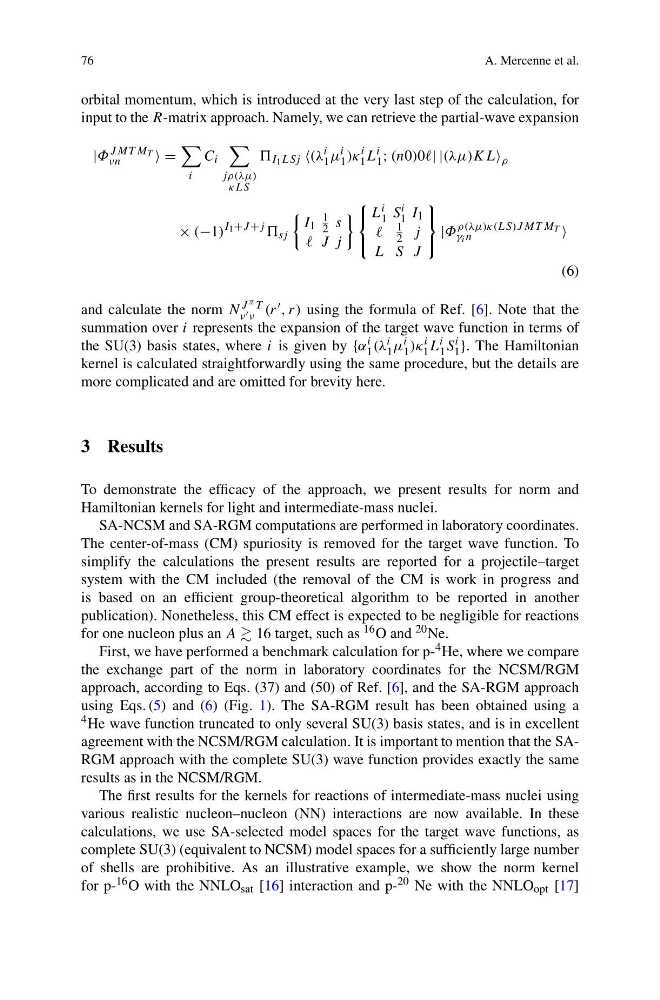
input to the R-matrix approach. Namely, we can retrieve the partial-wave expansion
|Φ
J MT M T
νn
=
i
C i
jρ(λμ)
κLS
I 1 LSj (λ
i
1 μ
i
1 )κ
i
1 L
i
1 ; (n0)0| |(λμ)KL ρ
× (−1)
I 1 +J +j sj
I 1
1
2 s
J j
⎧
⎨
⎩
L i
1 S i
1 I 1
1
2 j
L S J
⎫
⎬
⎭
|Φ
ρ(λμ)κ(LS)J MT M T
γ i n
(6)
and calculate the norm N J π T
ν ν (r , r) using the formula of Ref. [6]. Note that the
summation over i represents the expansion of the target wave function in terms of
the SU(3) basis states, where i is given by {α i
1 (λ i
1 μ i
1 )κ i
1 L i
1 S i
1 }. The Hamiltonian
kernel is calculated straightforwardly using the same procedure, but the details are
more complicated and are omitted for brevity here.
3 Results
To demonstrate the efficacy of the approach, we present results for norm and
Hamiltonian kernels for light and intermediate-mass nuclei.
SA-NCSM and SA-RGM computations are performed in laboratory coordinates.
The center-of-mass (CM) spuriosity is removed for the target wave function. To
simplify the calculations the present results are reported for a projectile–target
system with the CM included (the removal of the CM is work in progress and
is based on an efficient group-theoretical algorithm to be reported in another
publication). Nonetheless, this CM effect is expected to be negligible for reactions
for one nucleon plus an A 16 target, such as 16 O and 20 Ne.
First, we have performed a benchmark calculation for p- 4 He, where we compare
the exchange part of the norm in laboratory coordinates for the NCSM/RGM
approach, according to Eqs. (37) and (50) of Ref. [6], and the SA-RGM approach
using Eqs. (5) and (6) (Fig. 1). The SA-RGM result has been obtained using a
4 He wave function truncated to only several SU(3) basis states, and is in excellent
agreement with the NCSM/RGM calculation. It is important to mention that the SARGM approach with the complete SU(3) wave function provides exactly the same
results as in the NCSM/RGM.
The first results for the kernels for reactions of intermediate-mass nuclei using
various realistic nucleon–nucleon (NN) interactions are now available. In these
calculations, we use SA-selected model spaces for the target wave functions, as
complete SU(3) (equivalent to NCSM) model spaces for a sufficiently large number
of shells are prohibitive. As an illustrative example, we show the norm kernel
for p- 16 O with the NNLO sat [16] interaction and p- 20 Ne with the NNLO opt [17]
A. Mercenne et al.
orbital momentum, which is introduced at the very last step of the calculation, for
input to the R-matrix approach. Namely, we can retrieve the partial-wave expansion
|Φ
J MT M T
νn
=
i
C i
jρ(λμ)
κLS
I 1 LSj (λ
i
1 μ
i
1 )κ
i
1 L
i
1 ; (n0)0| |(λμ)KL ρ
× (−1)
I 1 +J +j sj
I 1
1
2 s
J j
⎧
⎨
⎩
L i
1 S i
1 I 1
1
2 j
L S J
⎫
⎬
⎭
|Φ
ρ(λμ)κ(LS)J MT M T
γ i n
(6)
and calculate the norm N J π T
ν ν (r , r) using the formula of Ref. [6]. Note that the
summation over i represents the expansion of the target wave function in terms of
the SU(3) basis states, where i is given by {α i
1 (λ i
1 μ i
1 )κ i
1 L i
1 S i
1 }. The Hamiltonian
kernel is calculated straightforwardly using the same procedure, but the details are
more complicated and are omitted for brevity here.
3 Results
To demonstrate the efficacy of the approach, we present results for norm and
Hamiltonian kernels for light and intermediate-mass nuclei.
SA-NCSM and SA-RGM computations are performed in laboratory coordinates.
The center-of-mass (CM) spuriosity is removed for the target wave function. To
simplify the calculations the present results are reported for a projectile–target
system with the CM included (the removal of the CM is work in progress and
is based on an efficient group-theoretical algorithm to be reported in another
publication). Nonetheless, this CM effect is expected to be negligible for reactions
for one nucleon plus an A 16 target, such as 16 O and 20 Ne.
First, we have performed a benchmark calculation for p- 4 He, where we compare
the exchange part of the norm in laboratory coordinates for the NCSM/RGM
approach, according to Eqs. (37) and (50) of Ref. [6], and the SA-RGM approach
using Eqs. (5) and (6) (Fig. 1). The SA-RGM result has been obtained using a
4 He wave function truncated to only several SU(3) basis states, and is in excellent
agreement with the NCSM/RGM calculation. It is important to mention that the SARGM approach with the complete SU(3) wave function provides exactly the same
results as in the NCSM/RGM.
The first results for the kernels for reactions of intermediate-mass nuclei using
various realistic nucleon–nucleon (NN) interactions are now available. In these
calculations, we use SA-selected model spaces for the target wave functions, as
complete SU(3) (equivalent to NCSM) model spaces for a sufficiently large number
of shells are prohibitive. As an illustrative example, we show the norm kernel
for p- 16 O with the NNLO sat [16] interaction and p- 20 Ne with the NNLO opt [17]