

Late Gamma Rays from Neutron-Induced Fission and Capture from 235 U
325
1000
−
0 1000 2000 3000 4000 5000
1
10
2
10
3
10
(delay-prompt) events / 5ns
Time since fission (ns)
0.0
0.5
1.0
1.5
2.0
4
−
10
3
−
10
2
−
10
1
−
10
1
10
CGMF
DANCE
rays/fission/bin
γ
Number of
(MeV)
γ
E
s
μ
< 2
t
50 ns <
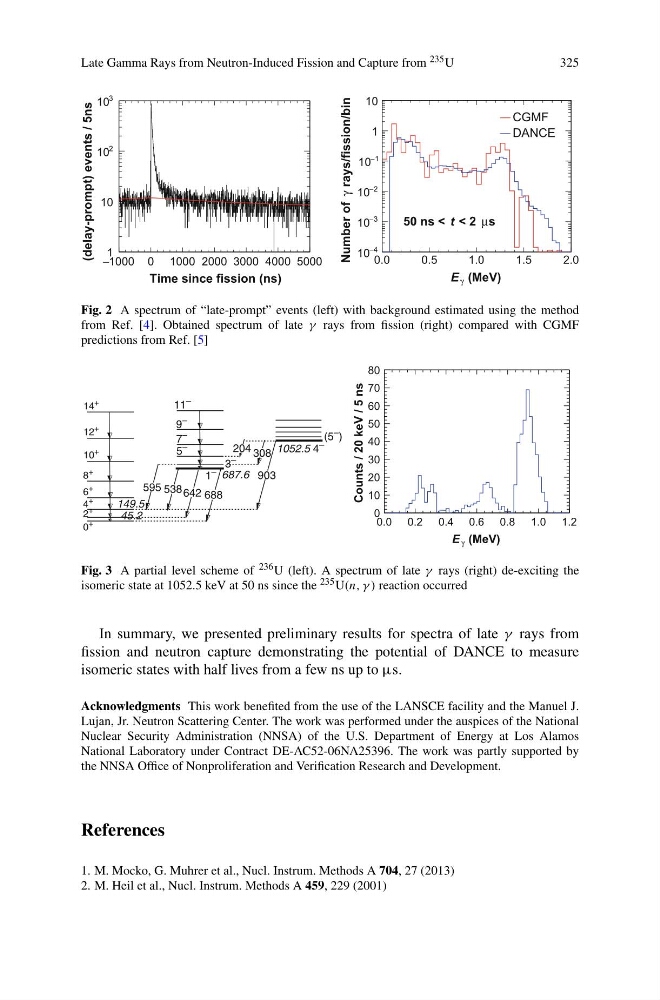
Fig. 2 A spectrum of “late-prompt” events (left) with background estimated using the method
from Ref. [4]. Obtained spectrum of late γ rays from fission (right) compared with CGMF
predictions from Ref. [5]
0.0 0.2 0.4 0.6 0.8 1.0 1.2
0
(5
– )
1052.5 4
–
149.5
45.2
687.6
3
–
11
–
9
–
7
–
5
–
1
–
595 538 642 688
903
204 308
14
+
12
+
10
+
8
+
6
+
4
+
2 +
0
+
10
20
30
40
50
60
70
80
Counts / 20 keV / 5 ns
(MeV)
γ
E
Fig. 3 A partial level scheme of 236 U (left). A spectrum of late γ rays (right) de-exciting the
isomeric state at 1052.5 keV at 50 ns since the 235 U(n, γ ) reaction occurred
In summary, we presented preliminary results for spectra of late γ rays from
fission and neutron capture demonstrating the potential of DANCE to measure
isomeric states with half lives from a few ns up to μs.
Acknowledgments This work benefited from the use of the LANSCE facility and the Manuel J.
Lujan, Jr. Neutron Scattering Center. The work was performed under the auspices of the National
Nuclear Security Administration (NNSA) of the U.S. Department of Energy at Los Alamos
National Laboratory under Contract DE-AC52-06NA25396. The work was partly supported by
the NNSA Office of Nonproliferation and Verification Research and Development.
References
1. M. Mocko, G. Muhrer et al., Nucl. Instrum. Methods A 704, 27 (2013)
2. M. Heil et al., Nucl. Instrum. Methods A 459, 229 (2001)
325
1000
−
0 1000 2000 3000 4000 5000
1
10
2
10
3
10
(delay-prompt) events / 5ns
Time since fission (ns)
0.0
0.5
1.0
1.5
2.0
4
−
10
3
−
10
2
−
10
1
−
10
1
10
CGMF
DANCE
rays/fission/bin
γ
Number of
(MeV)
γ
E
s
μ
< 2
t
50 ns <
Fig. 2 A spectrum of “late-prompt” events (left) with background estimated using the method
from Ref. [4]. Obtained spectrum of late γ rays from fission (right) compared with CGMF
predictions from Ref. [5]
0.0 0.2 0.4 0.6 0.8 1.0 1.2
0
(5
– )
1052.5 4
–
149.5
45.2
687.6
3
–
11
–
9
–
7
–
5
–
1
–
595 538 642 688
903
204 308
14
+
12
+
10
+
8
+
6
+
4
+
2 +
0
+
10
20
30
40
50
60
70
80
Counts / 20 keV / 5 ns
(MeV)
γ
E
Fig. 3 A partial level scheme of 236 U (left). A spectrum of late γ rays (right) de-exciting the
isomeric state at 1052.5 keV at 50 ns since the 235 U(n, γ ) reaction occurred
In summary, we presented preliminary results for spectra of late γ rays from
fission and neutron capture demonstrating the potential of DANCE to measure
isomeric states with half lives from a few ns up to μs.
Acknowledgments This work benefited from the use of the LANSCE facility and the Manuel J.
Lujan, Jr. Neutron Scattering Center. The work was performed under the auspices of the National
Nuclear Security Administration (NNSA) of the U.S. Department of Energy at Los Alamos
National Laboratory under Contract DE-AC52-06NA25396. The work was partly supported by
the NNSA Office of Nonproliferation and Verification Research and Development.
References
1. M. Mocko, G. Muhrer et al., Nucl. Instrum. Methods A 704, 27 (2013)
2. M. Heil et al., Nucl. Instrum. Methods A 459, 229 (2001)