

324
G. Rusev et al.
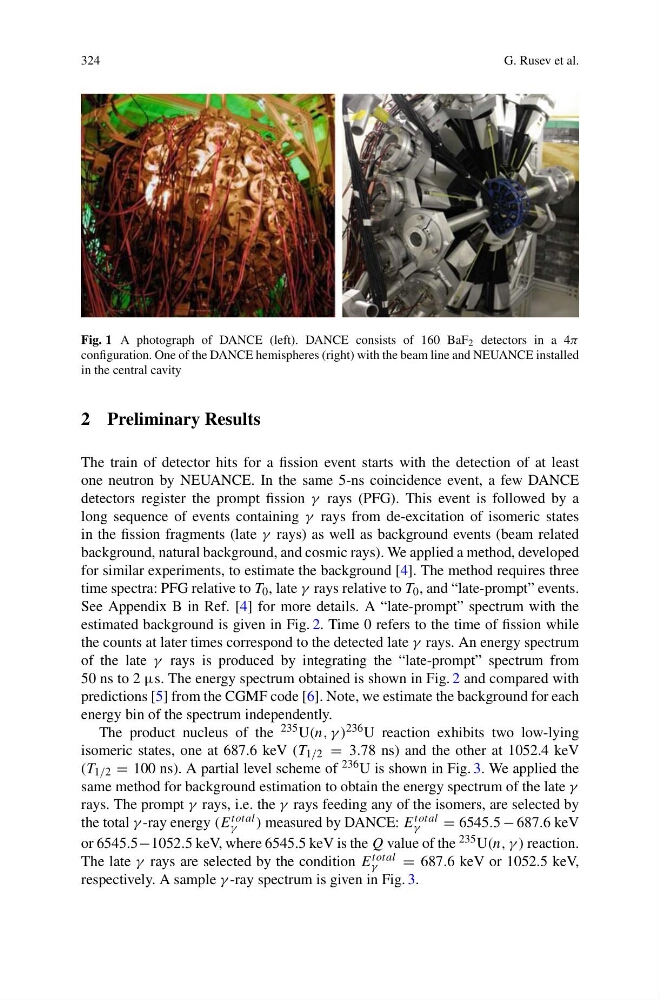
Fig. 1 A photograph of DANCE (left). DANCE consists of 160 BaF 2 detectors in a 4π
configuration. One of the DANCE hemispheres (right) with the beam line and NEUANCE installed
in the central cavity
2 Preliminary Results
The train of detector hits for a fission event starts with the detection of at least
one neutron by NEUANCE. In the same 5-ns coincidence event, a few DANCE
detectors register the prompt fission γ rays (PFG). This event is followed by a
long sequence of events containing γ rays from de-excitation of isomeric states
in the fission fragments (late γ rays) as well as background events (beam related
background, natural background, and cosmic rays). We applied a method, developed
for similar experiments, to estimate the background [4]. The method requires three
time spectra: PFG relative to T 0 , late γ rays relative to T 0 , and “late-prompt” events.
See Appendix B in Ref. [4] for more details. A “late-prompt” spectrum with the
estimated background is given in Fig. 2. Time 0 refers to the time of fission while
the counts at later times correspond to the detected late γ rays. An energy spectrum
of the late γ rays is produced by integrating the “late-prompt” spectrum from
50 ns to 2 μs. The energy spectrum obtained is shown in Fig. 2 and compared with
predictions [5] from the CGMF code [6]. Note, we estimate the background for each
energy bin of the spectrum independently.
The product nucleus of the 235 U(n, γ ) 236 U reaction exhibits two low-lying
isomeric states, one at 687.6 keV (T 1/2 = 3.78 ns) and the other at 1052.4 keV
(T 1/2 = 100 ns). A partial level scheme of 236 U is shown in Fig. 3. We applied the
same method for background estimation to obtain the energy spectrum of the late γ
rays. The prompt γ rays, i.e. the γ rays feeding any of the isomers, are selected by
the total γ -ray energy (E total
γ
) measured by DANCE: E total
γ
= 6545.5 − 687.6 keV
or 6545.5−1052.5 keV, where 6545.5 keV is the Q value of the 235 U(n, γ ) reaction.
The late γ rays are selected by the condition E total
γ
= 687.6 keV or 1052.5 keV,
respectively. A sample γ -ray spectrum is given in Fig. 3.
G. Rusev et al.
Fig. 1 A photograph of DANCE (left). DANCE consists of 160 BaF 2 detectors in a 4π
configuration. One of the DANCE hemispheres (right) with the beam line and NEUANCE installed
in the central cavity
2 Preliminary Results
The train of detector hits for a fission event starts with the detection of at least
one neutron by NEUANCE. In the same 5-ns coincidence event, a few DANCE
detectors register the prompt fission γ rays (PFG). This event is followed by a
long sequence of events containing γ rays from de-excitation of isomeric states
in the fission fragments (late γ rays) as well as background events (beam related
background, natural background, and cosmic rays). We applied a method, developed
for similar experiments, to estimate the background [4]. The method requires three
time spectra: PFG relative to T 0 , late γ rays relative to T 0 , and “late-prompt” events.
See Appendix B in Ref. [4] for more details. A “late-prompt” spectrum with the
estimated background is given in Fig. 2. Time 0 refers to the time of fission while
the counts at later times correspond to the detected late γ rays. An energy spectrum
of the late γ rays is produced by integrating the “late-prompt” spectrum from
50 ns to 2 μs. The energy spectrum obtained is shown in Fig. 2 and compared with
predictions [5] from the CGMF code [6]. Note, we estimate the background for each
energy bin of the spectrum independently.
The product nucleus of the 235 U(n, γ ) 236 U reaction exhibits two low-lying
isomeric states, one at 687.6 keV (T 1/2 = 3.78 ns) and the other at 1052.4 keV
(T 1/2 = 100 ns). A partial level scheme of 236 U is shown in Fig. 3. We applied the
same method for background estimation to obtain the energy spectrum of the late γ
rays. The prompt γ rays, i.e. the γ rays feeding any of the isomers, are selected by
the total γ -ray energy (E total
γ
) measured by DANCE: E total
γ
= 6545.5 − 687.6 keV
or 6545.5−1052.5 keV, where 6545.5 keV is the Q value of the 235 U(n, γ ) reaction.
The late γ rays are selected by the condition E total
γ
= 687.6 keV or 1052.5 keV,
respectively. A sample γ -ray spectrum is given in Fig. 3.