

Capabilities of the NIFFTE FissionTPC
305
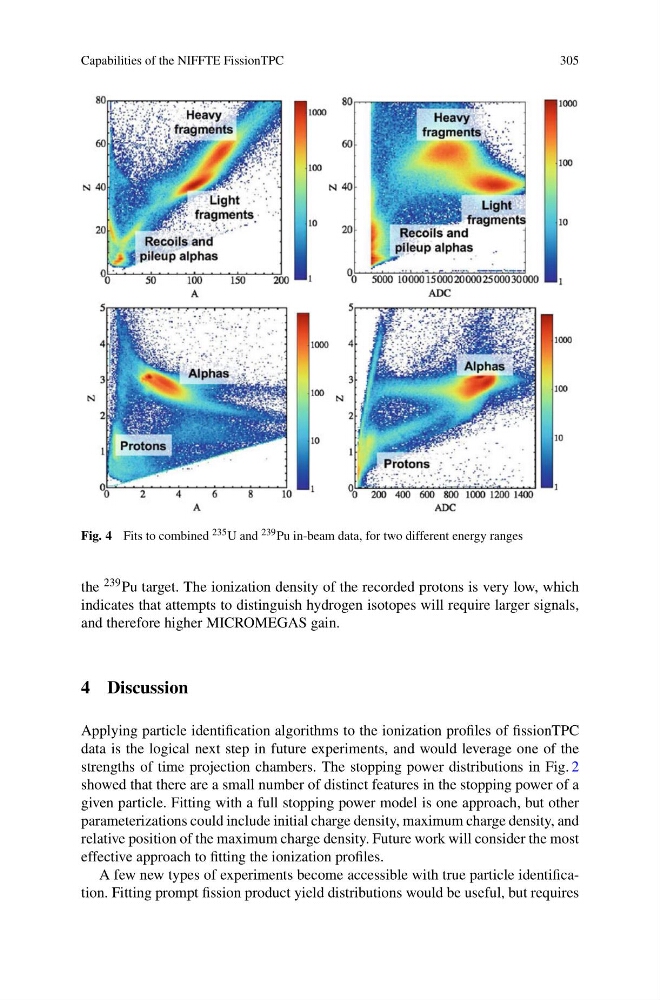
Fig. 4 Fits to combined 235 U and 239 Pu in-beam data, for two different energy ranges
the 239 Pu target. The ionization density of the recorded protons is very low, which
indicates that attempts to distinguish hydrogen isotopes will require larger signals,
and therefore higher MICROMEGAS gain.
4 Discussion
Applying particle identification algorithms to the ionization profiles of fissionTPC
data is the logical next step in future experiments, and would leverage one of the
strengths of time projection chambers. The stopping power distributions in Fig. 2
showed that there are a small number of distinct features in the stopping power of a
given particle. Fitting with a full stopping power model is one approach, but other
parameterizations could include initial charge density, maximum charge density, and
relative position of the maximum charge density. Future work will consider the most
effective approach to fitting the ionization profiles.
A few new types of experiments become accessible with true particle identification. Fitting prompt fission product yield distributions would be useful, but requires
305
Fig. 4 Fits to combined 235 U and 239 Pu in-beam data, for two different energy ranges
the 239 Pu target. The ionization density of the recorded protons is very low, which
indicates that attempts to distinguish hydrogen isotopes will require larger signals,
and therefore higher MICROMEGAS gain.
4 Discussion
Applying particle identification algorithms to the ionization profiles of fissionTPC
data is the logical next step in future experiments, and would leverage one of the
strengths of time projection chambers. The stopping power distributions in Fig. 2
showed that there are a small number of distinct features in the stopping power of a
given particle. Fitting with a full stopping power model is one approach, but other
parameterizations could include initial charge density, maximum charge density, and
relative position of the maximum charge density. Future work will consider the most
effective approach to fitting the ionization profiles.
A few new types of experiments become accessible with true particle identification. Fitting prompt fission product yield distributions would be useful, but requires