

Surrogate Reactions Approach
225
9
10
11
E ex [MeV]
0
0.02
0.04
0.06
0.08
0.1
0.12
Probability
a) 141 keV
9
10
11
E ex [MeV]
b) 420 keV
9
E ex [MeV]
c) 561 keV
9
E ex [MeV]
d) 890 keV
9
10
11
10
11
10
11
E ex [MeV]
e) 1129 keV
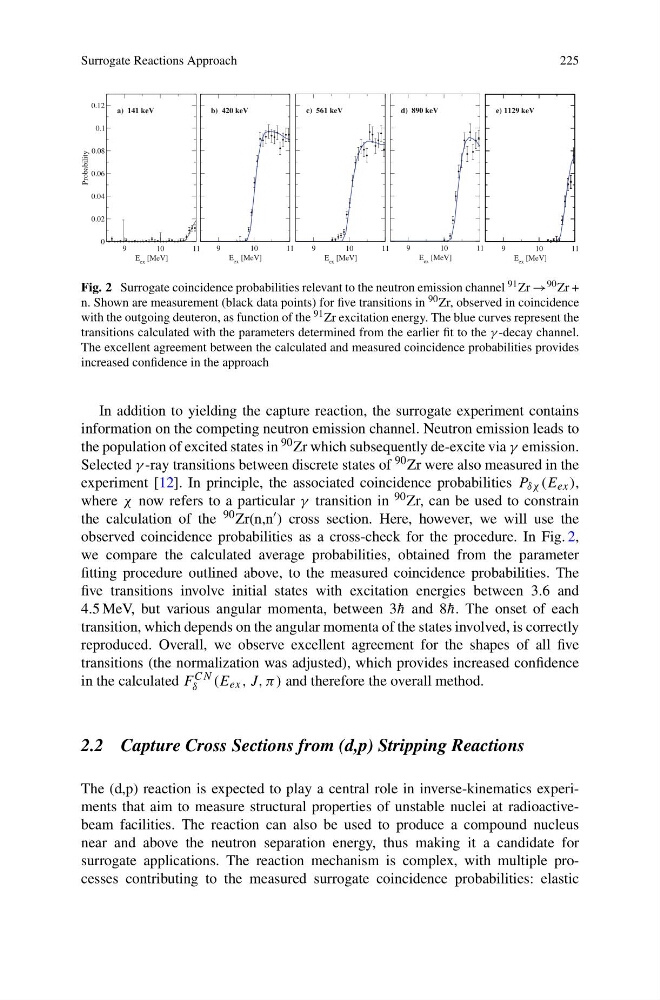
Fig. 2 Surrogate coincidence probabilities relevant to the neutron emission channel 91 Zr → 90 Zr +
n. Shown are measurement (black data points) for five transitions in 90 Zr, observed in coincidence
with the outgoing deuteron, as function of the 91 Zr excitation energy. The blue curves represent the
transitions calculated with the parameters determined from the earlier fit to the γ -decay channel.
The excellent agreement between the calculated and measured coincidence probabilities provides
increased confidence in the approach
In addition to yielding the capture reaction, the surrogate experiment contains
information on the competing neutron emission channel. Neutron emission leads to
the population of excited states in 90 Zr which subsequently de-excite via γ emission.
Selected γ -ray transitions between discrete states of 90 Zr were also measured in the
experiment [12]. In principle, the associated coincidence probabilities P δχ (E ex ),
where χ now refers to a particular γ transition in 90 Zr, can be used to constrain
the calculation of the 90 Zr(n,n ) cross section. Here, however, we will use the
observed coincidence probabilities as a cross-check for the procedure. In Fig. 2,
we compare the calculated average probabilities, obtained from the parameter
fitting procedure outlined above, to the measured coincidence probabilities. The
five transitions involve initial states with excitation energies between 3.6 and
4.5 MeV, but various angular momenta, between 3 ¯
h and 8 ¯
h. The onset of each
transition, which depends on the angular momenta of the states involved, is correctly
reproduced. Overall, we observe excellent agreement for the shapes of all five
transitions (the normalization was adjusted), which provides increased confidence
in the calculated F CN
δ (E ex , J, π) and therefore the overall method.
2.2 Capture Cross Sections from (d,p) Stripping Reactions
The (d,p) reaction is expected to play a central role in inverse-kinematics experiments that aim to measure structural properties of unstable nuclei at radioactivebeam facilities. The reaction can also be used to produce a compound nucleus
near and above the neutron separation energy, thus making it a candidate for
surrogate applications. The reaction mechanism is complex, with multiple processes contributing to the measured surrogate coincidence probabilities: elastic
225
9
10
11
E ex [MeV]
0
0.02
0.04
0.06
0.08
0.1
0.12
Probability
a) 141 keV
9
10
11
E ex [MeV]
b) 420 keV
9
E ex [MeV]
c) 561 keV
9
E ex [MeV]
d) 890 keV
9
10
11
10
11
10
11
E ex [MeV]
e) 1129 keV
Fig. 2 Surrogate coincidence probabilities relevant to the neutron emission channel 91 Zr → 90 Zr +
n. Shown are measurement (black data points) for five transitions in 90 Zr, observed in coincidence
with the outgoing deuteron, as function of the 91 Zr excitation energy. The blue curves represent the
transitions calculated with the parameters determined from the earlier fit to the γ -decay channel.
The excellent agreement between the calculated and measured coincidence probabilities provides
increased confidence in the approach
In addition to yielding the capture reaction, the surrogate experiment contains
information on the competing neutron emission channel. Neutron emission leads to
the population of excited states in 90 Zr which subsequently de-excite via γ emission.
Selected γ -ray transitions between discrete states of 90 Zr were also measured in the
experiment [12]. In principle, the associated coincidence probabilities P δχ (E ex ),
where χ now refers to a particular γ transition in 90 Zr, can be used to constrain
the calculation of the 90 Zr(n,n ) cross section. Here, however, we will use the
observed coincidence probabilities as a cross-check for the procedure. In Fig. 2,
we compare the calculated average probabilities, obtained from the parameter
fitting procedure outlined above, to the measured coincidence probabilities. The
five transitions involve initial states with excitation energies between 3.6 and
4.5 MeV, but various angular momenta, between 3 ¯
h and 8 ¯
h. The onset of each
transition, which depends on the angular momenta of the states involved, is correctly
reproduced. Overall, we observe excellent agreement for the shapes of all five
transitions (the normalization was adjusted), which provides increased confidence
in the calculated F CN
δ (E ex , J, π) and therefore the overall method.
2.2 Capture Cross Sections from (d,p) Stripping Reactions
The (d,p) reaction is expected to play a central role in inverse-kinematics experiments that aim to measure structural properties of unstable nuclei at radioactivebeam facilities. The reaction can also be used to produce a compound nucleus
near and above the neutron separation energy, thus making it a candidate for
surrogate applications. The reaction mechanism is complex, with multiple processes contributing to the measured surrogate coincidence probabilities: elastic