

224
J. E. Escher et al.
E top
CN
populated
CN
reached by
n emission
S n
p
d
Surrogate
(p,d) reaction
γ
n
n+ 90 Zr
92 Zr
91 Zr
E ex
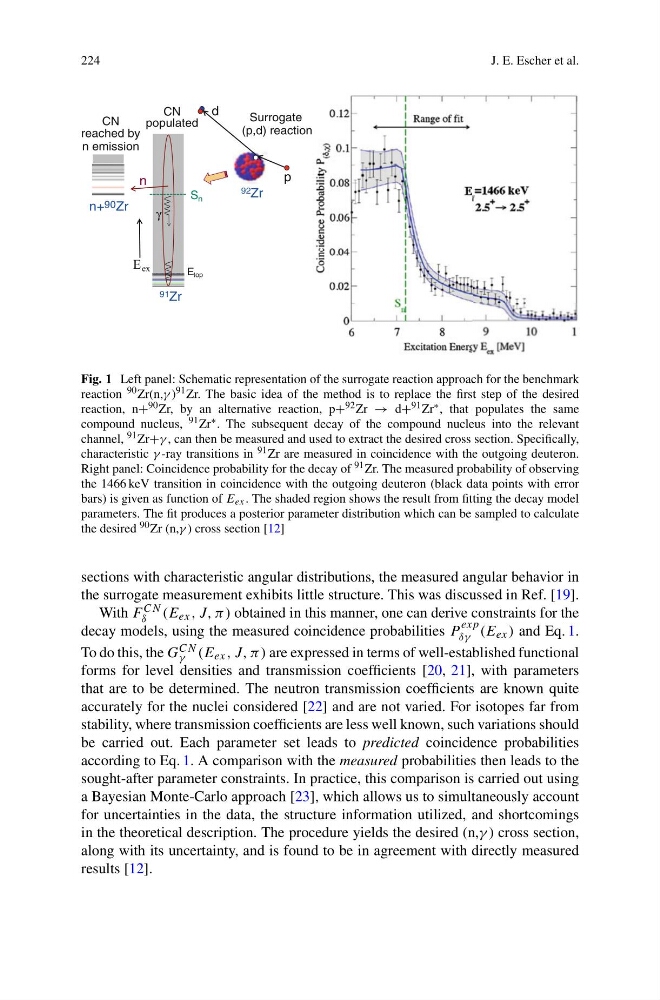
Fig. 1 Left panel: Schematic representation of the surrogate reaction approach for the benchmark
reaction 90 Zr(n,γ ) 91 Zr. The basic idea of the method is to replace the first step of the desired
reaction, n+ 90 Zr, by an alternative reaction, p+ 92 Zr → d+ 91 Zr ∗ , that populates the same
compound nucleus, 91 Zr ∗ . The subsequent decay of the compound nucleus into the relevant
channel, 91 Zr+γ , can then be measured and used to extract the desired cross section. Specifically,
characteristic γ -ray transitions in 91 Zr are measured in coincidence with the outgoing deuteron.
Right panel: Coincidence probability for the decay of 91 Zr. The measured probability of observing
the 1466 keV transition in coincidence with the outgoing deuteron (black data points with error
bars) is given as function of E ex . The shaded region shows the result from fitting the decay model
parameters. The fit produces a posterior parameter distribution which can be sampled to calculate
the desired 90 Zr (n,γ ) cross section [12]
sections with characteristic angular distributions, the measured angular behavior in
the surrogate measurement exhibits little structure. This was discussed in Ref. [19].
With F CN
δ (E ex , J, π) obtained in this manner, one can derive constraints for the
decay models, using the measured coincidence probabilities P
exp
δγ (E ex ) and Eq. 1.
To do this, the G CN
γ (E ex , J, π) are expressed in terms of well-established functional
forms for level densities and transmission coefficients [20, 21], with parameters
that are to be determined. The neutron transmission coefficients are known quite
accurately for the nuclei considered [22] and are not varied. For isotopes far from
stability, where transmission coefficients are less well known, such variations should
be carried out. Each parameter set leads to predicted coincidence probabilities
according to Eq. 1. A comparison with the measured probabilities then leads to the
sought-after parameter constraints. In practice, this comparison is carried out using
a Bayesian Monte-Carlo approach [23], which allows us to simultaneously account
for uncertainties in the data, the structure information utilized, and shortcomings
in the theoretical description. The procedure yields the desired (n,γ ) cross section,
along with its uncertainty, and is found to be in agreement with directly measured
results [12].
J. E. Escher et al.
E top
CN
populated
CN
reached by
n emission
S n
p
d
Surrogate
(p,d) reaction
γ
n
n+ 90 Zr
92 Zr
91 Zr
E ex
Fig. 1 Left panel: Schematic representation of the surrogate reaction approach for the benchmark
reaction 90 Zr(n,γ ) 91 Zr. The basic idea of the method is to replace the first step of the desired
reaction, n+ 90 Zr, by an alternative reaction, p+ 92 Zr → d+ 91 Zr ∗ , that populates the same
compound nucleus, 91 Zr ∗ . The subsequent decay of the compound nucleus into the relevant
channel, 91 Zr+γ , can then be measured and used to extract the desired cross section. Specifically,
characteristic γ -ray transitions in 91 Zr are measured in coincidence with the outgoing deuteron.
Right panel: Coincidence probability for the decay of 91 Zr. The measured probability of observing
the 1466 keV transition in coincidence with the outgoing deuteron (black data points with error
bars) is given as function of E ex . The shaded region shows the result from fitting the decay model
parameters. The fit produces a posterior parameter distribution which can be sampled to calculate
the desired 90 Zr (n,γ ) cross section [12]
sections with characteristic angular distributions, the measured angular behavior in
the surrogate measurement exhibits little structure. This was discussed in Ref. [19].
With F CN
δ (E ex , J, π) obtained in this manner, one can derive constraints for the
decay models, using the measured coincidence probabilities P
exp
δγ (E ex ) and Eq. 1.
To do this, the G CN
γ (E ex , J, π) are expressed in terms of well-established functional
forms for level densities and transmission coefficients [20, 21], with parameters
that are to be determined. The neutron transmission coefficients are known quite
accurately for the nuclei considered [22] and are not varied. For isotopes far from
stability, where transmission coefficients are less well known, such variations should
be carried out. Each parameter set leads to predicted coincidence probabilities
according to Eq. 1. A comparison with the measured probabilities then leads to the
sought-after parameter constraints. In practice, this comparison is carried out using
a Bayesian Monte-Carlo approach [23], which allows us to simultaneously account
for uncertainties in the data, the structure information utilized, and shortcomings
in the theoretical description. The procedure yields the desired (n,γ ) cross section,
along with its uncertainty, and is found to be in agreement with directly measured
results [12].