

198
F. Zeiser et al.
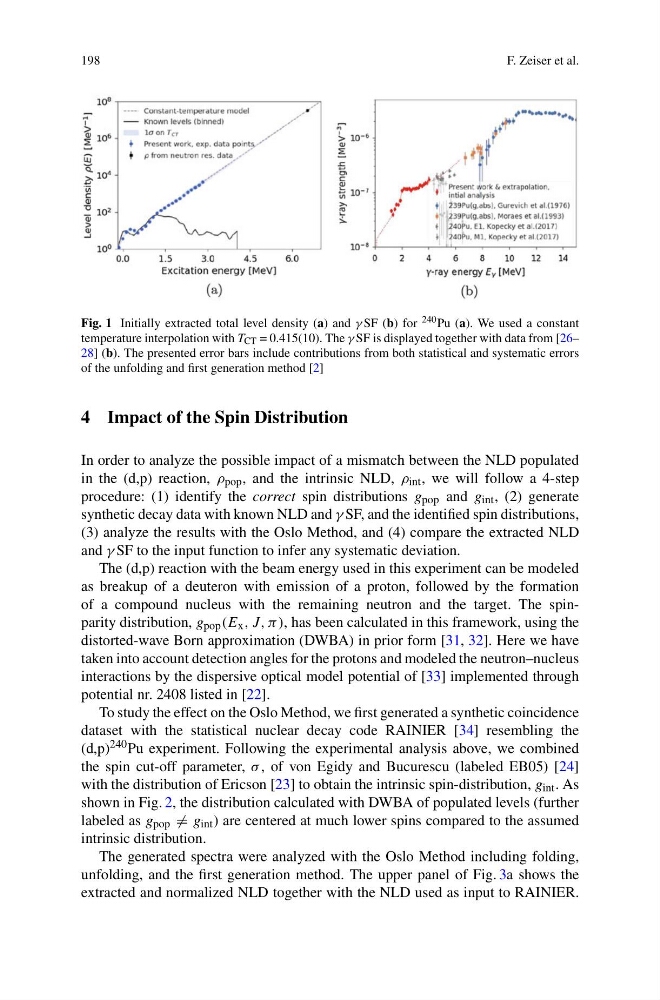
Fig. 1 Initially extracted total level density (a) and γ SF (b) for 240 Pu (a). We used a constant
temperature interpolation with T CT = 0.415(10). The γ SF is displayed together with data from [26–
28] (b). The presented error bars include contributions from both statistical and systematic errors
of the unfolding and first generation method [2]
4 Impact of the Spin Distribution
In order to analyze the possible impact of a mismatch between the NLD populated
in the (d,p) reaction, ρ pop , and the intrinsic NLD, ρ int , we will follow a 4-step
procedure: (1) identify the correct spin distributions g pop and g int , (2) generate
synthetic decay data with known NLD and γ SF, and the identified spin distributions,
(3) analyze the results with the Oslo Method, and (4) compare the extracted NLD
and γ SF to the input function to infer any systematic deviation.
The (d,p) reaction with the beam energy used in this experiment can be modeled
as breakup of a deuteron with emission of a proton, followed by the formation
of a compound nucleus with the remaining neutron and the target. The spinparity distribution, g pop (E x , J, π), has been calculated in this framework, using the
distorted-wave Born approximation (DWBA) in prior form [31, 32]. Here we have
taken into account detection angles for the protons and modeled the neutron–nucleus
interactions by the dispersive optical model potential of [33] implemented through
potential nr. 2408 listed in [22].
To study the effect on the Oslo Method, we first generated a synthetic coincidence
dataset with the statistical nuclear decay code RAINIER [34] resembling the
(d,p) 240 Pu experiment. Following the experimental analysis above, we combined
the spin cut-off parameter, σ , of von Egidy and Bucurescu (labeled EB05) [24]
with the distribution of Ericson [23] to obtain the intrinsic spin-distribution, g int . As
shown in Fig. 2, the distribution calculated with DWBA of populated levels (further
labeled as g pop = g int ) are centered at much lower spins compared to the assumed
intrinsic distribution.
The generated spectra were analyzed with the Oslo Method including folding,
unfolding, and the first generation method. The upper panel of Fig. 3a shows the
extracted and normalized NLD together with the NLD used as input to RAINIER.
F. Zeiser et al.
Fig. 1 Initially extracted total level density (a) and γ SF (b) for 240 Pu (a). We used a constant
temperature interpolation with T CT = 0.415(10). The γ SF is displayed together with data from [26–
28] (b). The presented error bars include contributions from both statistical and systematic errors
of the unfolding and first generation method [2]
4 Impact of the Spin Distribution
In order to analyze the possible impact of a mismatch between the NLD populated
in the (d,p) reaction, ρ pop , and the intrinsic NLD, ρ int , we will follow a 4-step
procedure: (1) identify the correct spin distributions g pop and g int , (2) generate
synthetic decay data with known NLD and γ SF, and the identified spin distributions,
(3) analyze the results with the Oslo Method, and (4) compare the extracted NLD
and γ SF to the input function to infer any systematic deviation.
The (d,p) reaction with the beam energy used in this experiment can be modeled
as breakup of a deuteron with emission of a proton, followed by the formation
of a compound nucleus with the remaining neutron and the target. The spinparity distribution, g pop (E x , J, π), has been calculated in this framework, using the
distorted-wave Born approximation (DWBA) in prior form [31, 32]. Here we have
taken into account detection angles for the protons and modeled the neutron–nucleus
interactions by the dispersive optical model potential of [33] implemented through
potential nr. 2408 listed in [22].
To study the effect on the Oslo Method, we first generated a synthetic coincidence
dataset with the statistical nuclear decay code RAINIER [34] resembling the
(d,p) 240 Pu experiment. Following the experimental analysis above, we combined
the spin cut-off parameter, σ , of von Egidy and Bucurescu (labeled EB05) [24]
with the distribution of Ericson [23] to obtain the intrinsic spin-distribution, g int . As
shown in Fig. 2, the distribution calculated with DWBA of populated levels (further
labeled as g pop = g int ) are centered at much lower spins compared to the assumed
intrinsic distribution.
The generated spectra were analyzed with the Oslo Method including folding,
unfolding, and the first generation method. The upper panel of Fig. 3a shows the
extracted and normalized NLD together with the NLD used as input to RAINIER.