

188
P. Koehler et al.
As DICER is being developed, we are making test measurements with smaller
and smaller samples. One of the first tests used a 197 Au sample which was 0.00169
at/b thick. A collimator 6 mm in diameter defined the neutron beam at the sample,
30 m from the neutron-production target. Neutrons were detected with a 6 Li-glass
scintillator 64.4 m from the neutron-production target. Separate measurements with
no sample and with thick Bi, Cu, and Tm samples were made with the same
apparatus to be able to calculate the total cross section and to measure and subtract
small backgrounds.
Initial comparison of our new DICER data to the latest ENDF evaluation [8]
revealed several differences. Therefore, a new R-matrix analysis of our data as well
as the most recent neutron total [5] and capture [6] data was undertaken.
The R-matrix program SAMMY [9] was used to perform a simultaneous analysis
of the three data sets. Resonances spins (1 + or 2 + ) were taken from Ref. [10]. In
total, 281 resonances were fitted between 4.9 eV and 5 keV. Good fits were obtained
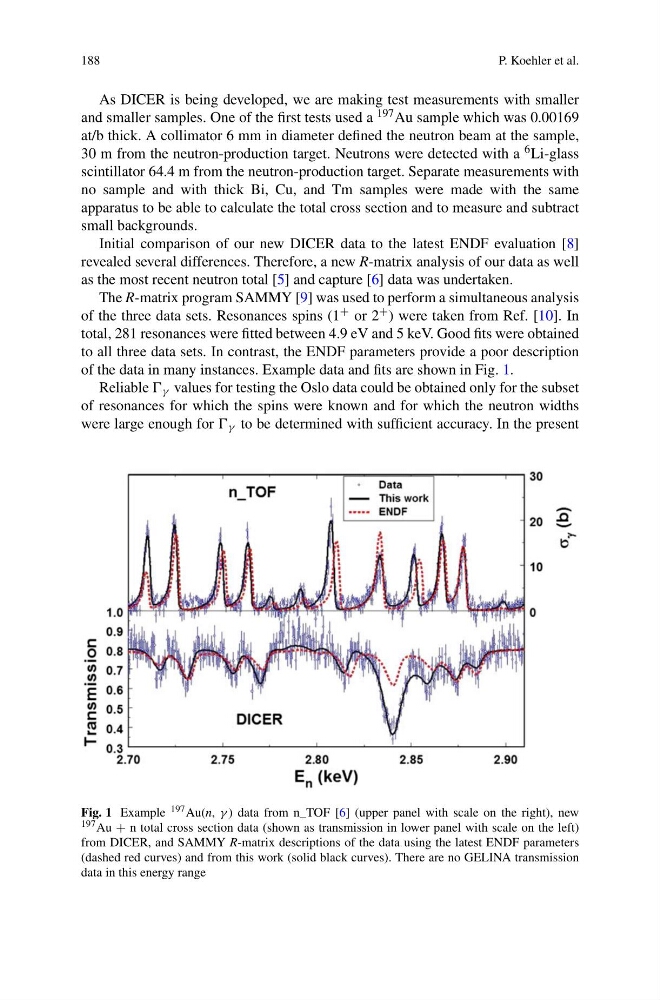
to all three data sets. In contrast, the ENDF parameters provide a poor description
of the data in many instances. Example data and fits are shown in Fig. 1.
Reliable γ values for testing the Oslo data could be obtained only for the subset
of resonances for which the spins were known and for which the neutron widths
were large enough for γ to be determined with sufficient accuracy. In the present
Fig. 1 Example 197 Au(n, γ ) data from n_TOF [6] (upper panel with scale on the right), new
197 Au + n total cross section data (shown as transmission in lower panel with scale on the left)
from DICER, and SAMMY R-matrix descriptions of the data using the latest ENDF parameters
(dashed red curves) and from this work (solid black curves). There are no GELINA transmission
data in this energy range
P. Koehler et al.
As DICER is being developed, we are making test measurements with smaller
and smaller samples. One of the first tests used a 197 Au sample which was 0.00169
at/b thick. A collimator 6 mm in diameter defined the neutron beam at the sample,
30 m from the neutron-production target. Neutrons were detected with a 6 Li-glass
scintillator 64.4 m from the neutron-production target. Separate measurements with
no sample and with thick Bi, Cu, and Tm samples were made with the same
apparatus to be able to calculate the total cross section and to measure and subtract
small backgrounds.
Initial comparison of our new DICER data to the latest ENDF evaluation [8]
revealed several differences. Therefore, a new R-matrix analysis of our data as well
as the most recent neutron total [5] and capture [6] data was undertaken.
The R-matrix program SAMMY [9] was used to perform a simultaneous analysis
of the three data sets. Resonances spins (1 + or 2 + ) were taken from Ref. [10]. In
total, 281 resonances were fitted between 4.9 eV and 5 keV. Good fits were obtained
to all three data sets. In contrast, the ENDF parameters provide a poor description
of the data in many instances. Example data and fits are shown in Fig. 1.
Reliable γ values for testing the Oslo data could be obtained only for the subset
of resonances for which the spins were known and for which the neutron widths
were large enough for γ to be determined with sufficient accuracy. In the present
Fig. 1 Example 197 Au(n, γ ) data from n_TOF [6] (upper panel with scale on the right), new
197 Au + n total cross section data (shown as transmission in lower panel with scale on the left)
from DICER, and SAMMY R-matrix descriptions of the data using the latest ENDF parameters
(dashed red curves) and from this work (solid black curves). There are no GELINA transmission
data in this energy range