

Towards More Predictive Nuclear Reaction Modelling
5
projectile takes to cross the nucleus. For low outgoing energies, a typical evaporation
spectrum is observed. In this case, it is usually assumed that the projectile has been
absorbed in the target with which it has shared all its energy to form a compound
system. This process, described by the so-called compound nucleus (CN) model,
assumes to the first order of approximation, that the formation and decay of the CN
are independent processes. This assumption explains that the emission spectrum
looks very similar whatever the angle of emission is: the compound nucleus has lost
memory of the way it has been created! This feature is characterized by angular
distribution of emitted particle symmetric around 90 ◦ . Between these two extreme
situations, one finds, if the projectile energy is high enough, an intermediate process
whose frontiers are less well defined: the so-called pre-equilibrium process. This
last process has been historically less studied than the two others (mainly because
contrary to the two previous ones, it can be neglected for low incident energies) and,
therefore, the formalism which is employed to describe it is still subject to important
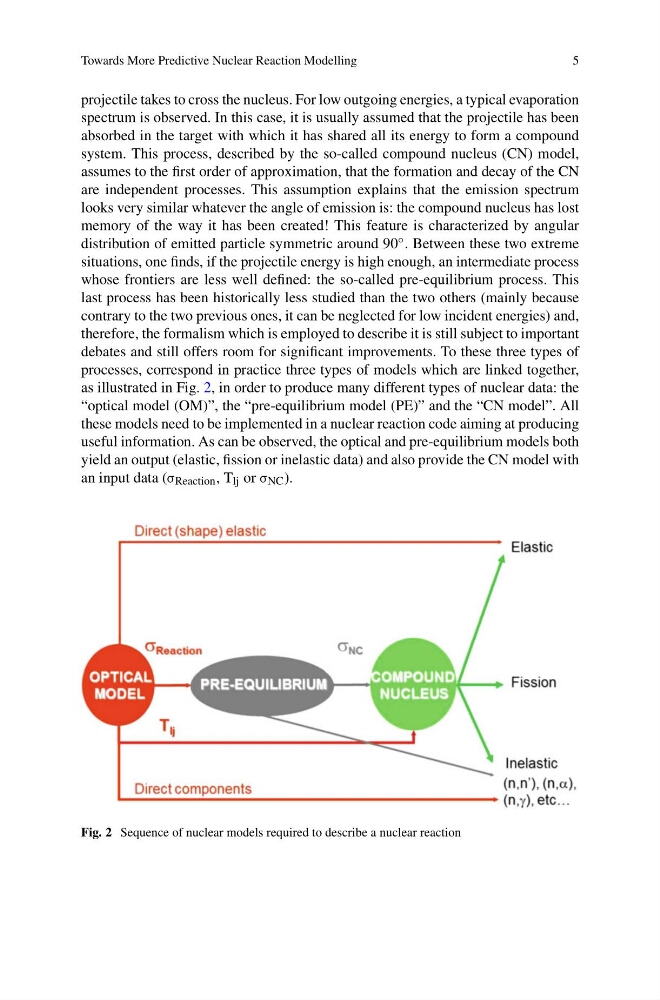
debates and still offers room for significant improvements. To these three types of
processes, correspond in practice three types of models which are linked together,
as illustrated in Fig. 2, in order to produce many different types of nuclear data: the
“optical model (OM)”, the “pre-equilibrium model (PE)” and the “CN model”. All
these models need to be implemented in a nuclear reaction code aiming at producing
useful information. As can be observed, the optical and pre-equilibrium models both
yield an output (elastic, fission or inelastic data) and also provide the CN model with
an input data (σ Reaction , T lj or σ NC ).
Fig. 2 Sequence of nuclear models required to describe a nuclear reaction
5
projectile takes to cross the nucleus. For low outgoing energies, a typical evaporation
spectrum is observed. In this case, it is usually assumed that the projectile has been
absorbed in the target with which it has shared all its energy to form a compound
system. This process, described by the so-called compound nucleus (CN) model,
assumes to the first order of approximation, that the formation and decay of the CN
are independent processes. This assumption explains that the emission spectrum
looks very similar whatever the angle of emission is: the compound nucleus has lost
memory of the way it has been created! This feature is characterized by angular
distribution of emitted particle symmetric around 90 ◦ . Between these two extreme
situations, one finds, if the projectile energy is high enough, an intermediate process
whose frontiers are less well defined: the so-called pre-equilibrium process. This
last process has been historically less studied than the two others (mainly because
contrary to the two previous ones, it can be neglected for low incident energies) and,
therefore, the formalism which is employed to describe it is still subject to important
debates and still offers room for significant improvements. To these three types of
processes, correspond in practice three types of models which are linked together,
as illustrated in Fig. 2, in order to produce many different types of nuclear data: the
“optical model (OM)”, the “pre-equilibrium model (PE)” and the “CN model”. All
these models need to be implemented in a nuclear reaction code aiming at producing
useful information. As can be observed, the optical and pre-equilibrium models both
yield an output (elastic, fission or inelastic data) and also provide the CN model with
an input data (σ Reaction , T lj or σ NC ).
Fig. 2 Sequence of nuclear models required to describe a nuclear reaction