

4
S. Hilaire and S. Goriely
into play. We will first describe in Sect. 2, general features observed when a
nuclear reaction occurs at energies below 200 MeV, features that have motivated
the introduction of several models that will be discussed in Sect. 3. In Sect. 4, we
will discuss current developments on specific ingredients required by the reaction
models as those related to fission, for instance. Finally, Sect. 5 will draw conclusions
and prospects.
2 General Features About Nuclear Reactions
For incident projectiles with energy between a few keV and 200 MeV impinging
on a target nucleus, the typical outgoing particle spectrum displays three main
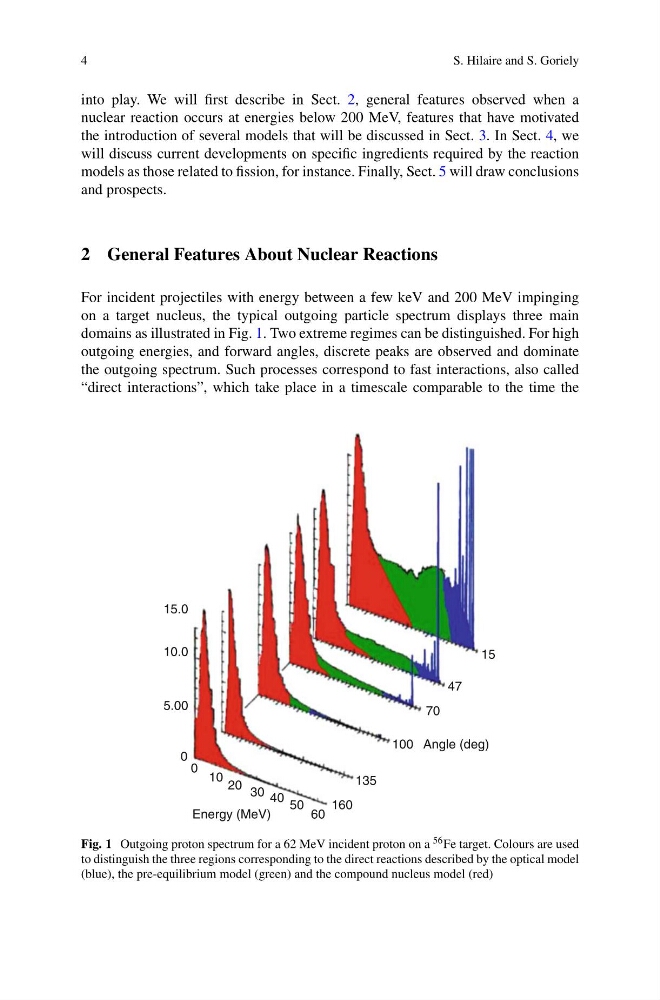
domains as illustrated in Fig. 1. Two extreme regimes can be distinguished. For high
outgoing energies, and forward angles, discrete peaks are observed and dominate
the outgoing spectrum. Such processes correspond to fast interactions, also called
“direct interactions”, which take place in a timescale comparable to the time the
15.0
10.0
5.00
0
0 10 20 30 40 50
60
160
135
100
70
47
15
Angle (deg)
Energy (MeV)
Fig. 1 Outgoing proton spectrum for a 62 MeV incident proton on a 56 Fe target. Colours are used
to distinguish the three regions corresponding to the direct reactions described by the optical model
(blue), the pre-equilibrium model (green) and the compound nucleus model (red)
S. Hilaire and S. Goriely
into play. We will first describe in Sect. 2, general features observed when a
nuclear reaction occurs at energies below 200 MeV, features that have motivated
the introduction of several models that will be discussed in Sect. 3. In Sect. 4, we
will discuss current developments on specific ingredients required by the reaction
models as those related to fission, for instance. Finally, Sect. 5 will draw conclusions
and prospects.
2 General Features About Nuclear Reactions
For incident projectiles with energy between a few keV and 200 MeV impinging
on a target nucleus, the typical outgoing particle spectrum displays three main
domains as illustrated in Fig. 1. Two extreme regimes can be distinguished. For high
outgoing energies, and forward angles, discrete peaks are observed and dominate
the outgoing spectrum. Such processes correspond to fast interactions, also called
“direct interactions”, which take place in a timescale comparable to the time the
15.0
10.0
5.00
0
0 10 20 30 40 50
60
160
135
100
70
47
15
Angle (deg)
Energy (MeV)
Fig. 1 Outgoing proton spectrum for a 62 MeV incident proton on a 56 Fe target. Colours are used
to distinguish the three regions corresponding to the direct reactions described by the optical model
(blue), the pre-equilibrium model (green) and the compound nucleus model (red)