

170
H. Utsunomiya et al.
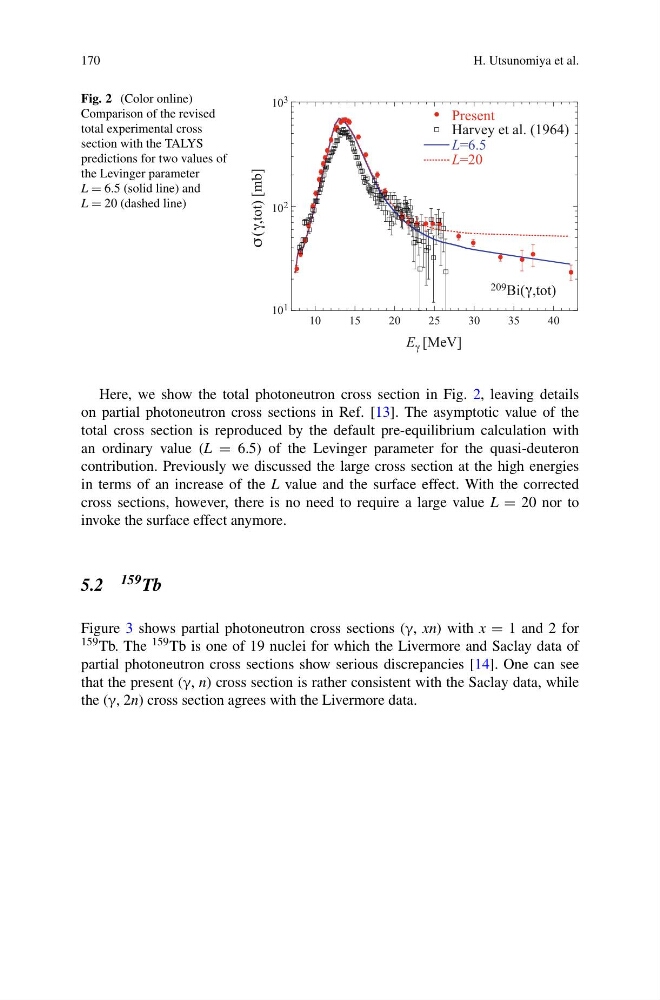
Fig. 2 (Color online)
Comparison of the revised
total experimental cross
section with the TALYS
predictions for two values of
the Levinger parameter
L = 6.5 (solid line) and
L = 20 (dashed line)
Present
Harvey et al. (1964)
209 Bi( ,tot)
( ,tot) [mb]
E [MeV]
L=6.5
L=20
10 1
10
15
20
25
30
35
40
10 2
10 3
Here, we show the total photoneutron cross section in Fig. 2, leaving details
on partial photoneutron cross sections in Ref. [13]. The asymptotic value of the
total cross section is reproduced by the default pre-equilibrium calculation with
an ordinary value (L = 6.5) of the Levinger parameter for the quasi-deuteron
contribution. Previously we discussed the large cross section at the high energies
in terms of an increase of the L value and the surface effect. With the corrected
cross sections, however, there is no need to require a large value L = 20 nor to
invoke the surface effect anymore.
5.2 159 Tb
Figure 3 shows partial photoneutron cross sections (γ, xn) with x = 1 and 2 for
159 Tb. The 159 Tb is one of 19 nuclei for which the Livermore and Saclay data of
partial photoneutron cross sections show serious discrepancies [14]. One can see
that the present (γ, n) cross section is rather consistent with the Saclay data, while
the (γ, 2n) cross section agrees with the Livermore data.
H. Utsunomiya et al.
Fig. 2 (Color online)
Comparison of the revised
total experimental cross
section with the TALYS
predictions for two values of
the Levinger parameter
L = 6.5 (solid line) and
L = 20 (dashed line)
Present
Harvey et al. (1964)
209 Bi( ,tot)
( ,tot) [mb]
E [MeV]
L=6.5
L=20
10 1
10
15
20
25
30
35
40
10 2
10 3
Here, we show the total photoneutron cross section in Fig. 2, leaving details
on partial photoneutron cross sections in Ref. [13]. The asymptotic value of the
total cross section is reproduced by the default pre-equilibrium calculation with
an ordinary value (L = 6.5) of the Levinger parameter for the quasi-deuteron
contribution. Previously we discussed the large cross section at the high energies
in terms of an increase of the L value and the surface effect. With the corrected
cross sections, however, there is no need to require a large value L = 20 nor to
invoke the surface effect anymore.
5.2 159 Tb
Figure 3 shows partial photoneutron cross sections (γ, xn) with x = 1 and 2 for
159 Tb. The 159 Tb is one of 19 nuclei for which the Livermore and Saclay data of
partial photoneutron cross sections show serious discrepancies [14]. One can see
that the present (γ, n) cross section is rather consistent with the Saclay data, while
the (γ, 2n) cross section agrees with the Livermore data.