

γ-Ray Strength Functions and GDR Cross Sections in the IAEA Photonuclear. . .
169
Oslo (low)
Oslo (high)
D1M+QRPA: E1
D1M+QRPA+0lim (C=10 -7 )
D1M+QRPA+0lim (C=3x10 -8 )
(a)
(b)
(c)
(d)
(e)
10 -8
10 -9
10 -7
10 -6
0
5
10
15
20
25
59
Ni
60
Ni
61
Ni
65
Ni
64
Ni
f
1
[MeV
-3
]
10 -8
10 -9
10 -7
10 -6
0
5
10
15
20
25
f
1
[MeV
-3
]
10 -8
10 -9
10 -7
10 -6
0
5
10
15
20
25
f
1
[MeV
-3
]
10 -8
10 -9
10 -7
10 -6
0
5
10
15
20
25
f
1
[MeV
-3
]
10 -8
10 -9
10 -7
10 -6
0
5
10
15
20
25
f
1
[MeV
-3
]
E g
[MeV]
Oslo (low)
Oslo (high)
NewSUBARU
Oslo (low)
Oslo (high)
Fultz et al. (1974)
NewSUBARU
Oslo (low)
Oslo (high)
NewSUBARU
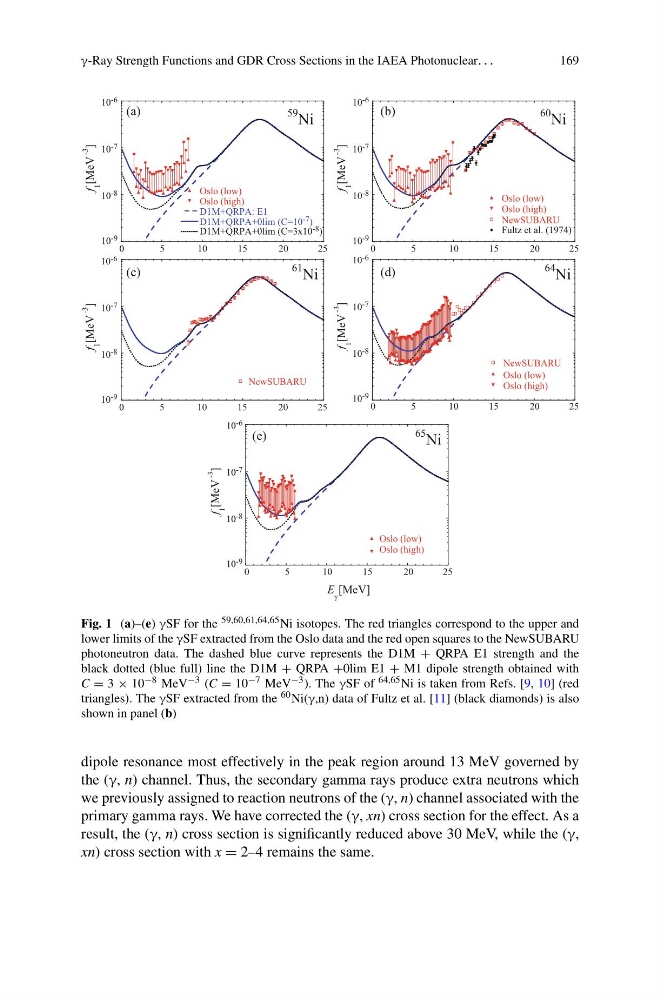
Fig. 1 (a)–(e) γSF for the 59,60,61,64,65 Ni isotopes. The red triangles correspond to the upper and
lower limits of the γSF extracted from the Oslo data and the red open squares to the NewSUBARU
photoneutron data. The dashed blue curve represents the D1M + QRPA E1 strength and the
black dotted (blue full) line the D1M + QRPA +0lim E1 + M1 dipole strength obtained with
C = 3 × 10 −8 MeV −3 (C = 10 −7 MeV −3 ). The γSF of 64,65 Ni is taken from Refs. [9, 10] (red
triangles). The γSF extracted from the 60 Ni(γ,n) data of Fultz et al. [11] (black diamonds) is also
shown in panel (b)
dipole resonance most effectively in the peak region around 13 MeV governed by
the (γ, n) channel. Thus, the secondary gamma rays produce extra neutrons which
we previously assigned to reaction neutrons of the (γ, n) channel associated with the
primary gamma rays. We have corrected the (γ, xn) cross section for the effect. As a
result, the (γ, n) cross section is significantly reduced above 30 MeV, while the (γ,
xn) cross section with x = 2–4 remains the same.
169
Oslo (low)
Oslo (high)
D1M+QRPA: E1
D1M+QRPA+0lim (C=10 -7 )
D1M+QRPA+0lim (C=3x10 -8 )
(a)
(b)
(c)
(d)
(e)
10 -8
10 -9
10 -7
10 -6
0
5
10
15
20
25
59
Ni
60
Ni
61
Ni
65
Ni
64
Ni
f
1
[MeV
-3
]
10 -8
10 -9
10 -7
10 -6
0
5
10
15
20
25
f
1
[MeV
-3
]
10 -8
10 -9
10 -7
10 -6
0
5
10
15
20
25
f
1
[MeV
-3
]
10 -8
10 -9
10 -7
10 -6
0
5
10
15
20
25
f
1
[MeV
-3
]
10 -8
10 -9
10 -7
10 -6
0
5
10
15
20
25
f
1
[MeV
-3
]
E g
[MeV]
Oslo (low)
Oslo (high)
NewSUBARU
Oslo (low)
Oslo (high)
Fultz et al. (1974)
NewSUBARU
Oslo (low)
Oslo (high)
NewSUBARU
Fig. 1 (a)–(e) γSF for the 59,60,61,64,65 Ni isotopes. The red triangles correspond to the upper and
lower limits of the γSF extracted from the Oslo data and the red open squares to the NewSUBARU
photoneutron data. The dashed blue curve represents the D1M + QRPA E1 strength and the
black dotted (blue full) line the D1M + QRPA +0lim E1 + M1 dipole strength obtained with
C = 3 × 10 −8 MeV −3 (C = 10 −7 MeV −3 ). The γSF of 64,65 Ni is taken from Refs. [9, 10] (red
triangles). The γSF extracted from the 60 Ni(γ,n) data of Fultz et al. [11] (black diamonds) is also
shown in panel (b)
dipole resonance most effectively in the peak region around 13 MeV governed by
the (γ, n) channel. Thus, the secondary gamma rays produce extra neutrons which
we previously assigned to reaction neutrons of the (γ, n) channel associated with the
primary gamma rays. We have corrected the (γ, xn) cross section for the effect. As a
result, the (γ, n) cross section is significantly reduced above 30 MeV, while the (γ,
xn) cross section with x = 2–4 remains the same.