

146
M. A. A. Mamun et al.
E =
k
k
1 −
k − λ
E k
tanh
E k
2T
−
Δ 2
G
−
Δ
2
− ΔT
∂Δ
∂T
G
(3)
S = 2
k
ln
1 + exp
−
E k
T
+
E k /T
1 + exp(E k /T )
−
Δ
T
λ
T
∂Δ
∂α
− T
∂Δ
∂T
G .
(4)
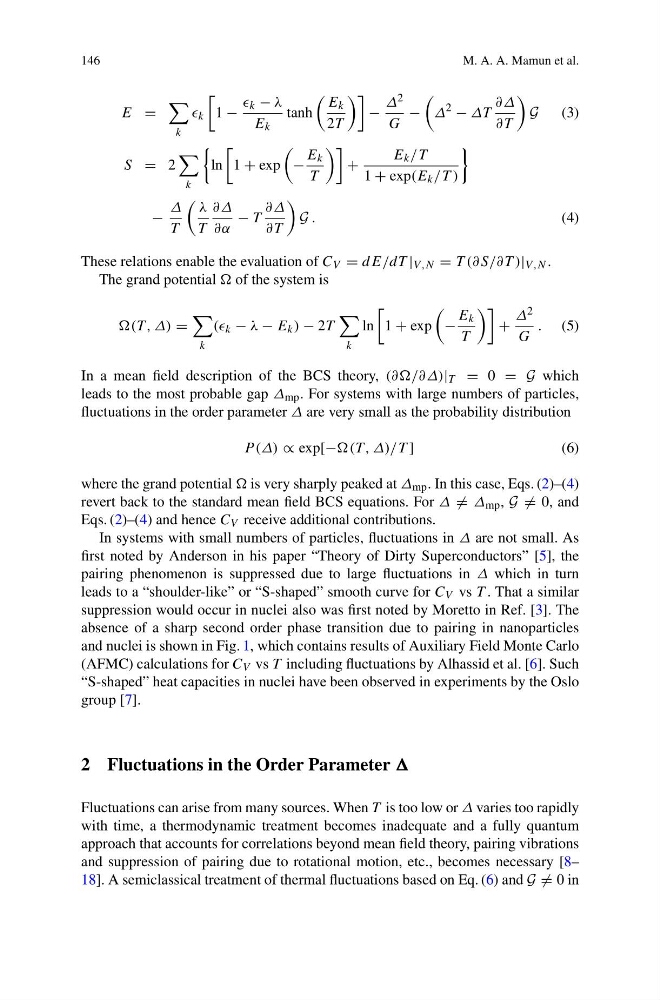
These relations enable the evaluation of C V = dE/dT | V ,N = T (∂S/∂T )| V ,N .
The grand potential of the system is
(T , Δ) =
k
(( k − λ − E k ) − 2T
k
ln
1 + exp
−
E k
T
+
Δ 2
G
. (5)
In a mean field description of the BCS theory, (∂∂/∂Δ)| T = 0 = G which
leads to the most probable gap Δ mp . For systems with large numbers of particles,
fluctuations in the order parameter Δ are very small as the probability distribution
P (Δ) ∝ exp[− , Δ)/T ]
(6)
where the grand potential is very sharply peaked at Δ mp . In this case, Eqs. (2)–(4)
revert back to the standard mean field BCS equations. For Δ = Δ mp , G = 0, and
Eqs. (2)–(4) and hence C V receive additional contributions.
In systems with small numbers of particles, fluctuations in Δ are not small. As
first noted by Anderson in his paper “Theory of Dirty Superconductors” [5], the
pairing phenomenon is suppressed due to large fluctuations in Δ which in turn
leads to a “shoulder-like” or “S-shaped” smooth curve for C V vs T . That a similar
suppression would occur in nuclei also was first noted by Moretto in Ref. [3]. The
absence of a sharp second order phase transition due to pairing in nanoparticles
and nuclei is shown in Fig. 1, which contains results of Auxiliary Field Monte Carlo
(AFMC) calculations for C V vs T including fluctuations by Alhassid et al. [6]. Such
“S-shaped” heat capacities in nuclei have been observed in experiments by the Oslo
group [7].
2 Fluctuations in the Order Parameter
Fluctuations can arise from many sources. When T is too low or Δ varies too rapidly
with time, a thermodynamic treatment becomes inadequate and a fully quantum
approach that accounts for correlations beyond mean field theory, pairing vibrations
and suppression of pairing due to rotational motion, etc., becomes necessary [8–
18]. A semiclassical treatment of thermal fluctuations based on Eq. (6) and G = 0 in
M. A. A. Mamun et al.
E =
k
k
1 −
k − λ
E k
tanh
E k
2T
−
Δ 2
G
−
Δ
2
− ΔT
∂Δ
∂T
G
(3)
S = 2
k
ln
1 + exp
−
E k
T
+
E k /T
1 + exp(E k /T )
−
Δ
T
λ
T
∂Δ
∂α
− T
∂Δ
∂T
G .
(4)
These relations enable the evaluation of C V = dE/dT | V ,N = T (∂S/∂T )| V ,N .
The grand potential of the system is
(T , Δ) =
k
(( k − λ − E k ) − 2T
k
ln
1 + exp
−
E k
T
+
Δ 2
G
. (5)
In a mean field description of the BCS theory, (∂∂/∂Δ)| T = 0 = G which
leads to the most probable gap Δ mp . For systems with large numbers of particles,
fluctuations in the order parameter Δ are very small as the probability distribution
P (Δ) ∝ exp[− , Δ)/T ]
(6)
where the grand potential is very sharply peaked at Δ mp . In this case, Eqs. (2)–(4)
revert back to the standard mean field BCS equations. For Δ = Δ mp , G = 0, and
Eqs. (2)–(4) and hence C V receive additional contributions.
In systems with small numbers of particles, fluctuations in Δ are not small. As
first noted by Anderson in his paper “Theory of Dirty Superconductors” [5], the
pairing phenomenon is suppressed due to large fluctuations in Δ which in turn
leads to a “shoulder-like” or “S-shaped” smooth curve for C V vs T . That a similar
suppression would occur in nuclei also was first noted by Moretto in Ref. [3]. The
absence of a sharp second order phase transition due to pairing in nanoparticles
and nuclei is shown in Fig. 1, which contains results of Auxiliary Field Monte Carlo
(AFMC) calculations for C V vs T including fluctuations by Alhassid et al. [6]. Such
“S-shaped” heat capacities in nuclei have been observed in experiments by the Oslo
group [7].
2 Fluctuations in the Order Parameter
Fluctuations can arise from many sources. When T is too low or Δ varies too rapidly
with time, a thermodynamic treatment becomes inadequate and a fully quantum
approach that accounts for correlations beyond mean field theory, pairing vibrations
and suppression of pairing due to rotational motion, etc., becomes necessary [8–
18]. A semiclassical treatment of thermal fluctuations based on Eq. (6) and G = 0 in