

Nuclear Shell Model and Level Density
129
continuous process of chaotization of dynamics (partly, indeed, due to the relaxation
of pairing correlations) and establishing of properties similar to the GOE.
The parameter T changes in a regular way from nucleus to nucleus, Fig. 4. The
minimum value, and therefore the fastest rate of chaotization of dynamics, belongs
to the even-even isotope 28
14 Si 14 where all interactions with various isospin values
of pairs are present. Similarly, for the odd-A nuclei, the minimum T belongs to the
closest nucleus, N = Z ± 1 [24]. Excluding the spin-orbit coupling, one can also
noticeably decrease the parameter T as all perturbative interactions become stronger
for degenerate orbitals leading to faster onset of chaos.
Interesting physics is related to the collective motion. Long ago the collective
enhancement of low-energy level density was predicted due to the excess of soft
phonons and rotational bands [25]. Varying the shell-model Hamiltonian one can
induce the onset of the deformation [26]. For the quadrupole deformation, the main
microscopic role is played by the two-body collisions when one of the particles has
a change = ±2 of its orbital momentum. This can be easily model in the shell
model. Then we see the corresponding increase of the low-lying level density [27]
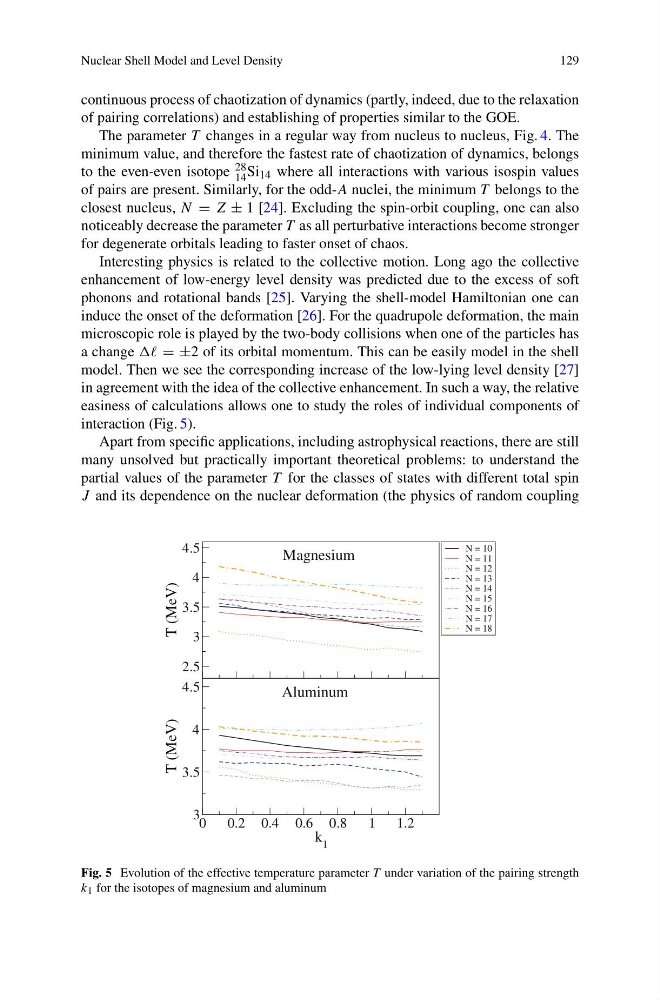
in agreement with the idea of the collective enhancement. In such a way, the relative
easiness of calculations allows one to study the roles of individual components of
interaction (Fig. 5).
Apart from specific applications, including astrophysical reactions, there are still
many unsolved but practically important theoretical problems: to understand the
partial values of the parameter T for the classes of states with different total spin
J and its dependence on the nuclear deformation (the physics of random coupling
2.5
3
3.5
4
4.5
T (MeV)
N = 10
N = 11
N = 12
N = 13
N = 14
N = 15
N = 16
N = 17
N = 18
0
0.2 0.4 0.6 0.8
1 1.2
k 1
3
3.5
4
4.5
T (MeV)
Magnesium
Aluminum
Fig. 5 Evolution of the effective temperature parameter T under variation of the pairing strength
k 1 for the isotopes of magnesium and aluminum
129
continuous process of chaotization of dynamics (partly, indeed, due to the relaxation
of pairing correlations) and establishing of properties similar to the GOE.
The parameter T changes in a regular way from nucleus to nucleus, Fig. 4. The
minimum value, and therefore the fastest rate of chaotization of dynamics, belongs
to the even-even isotope 28
14 Si 14 where all interactions with various isospin values
of pairs are present. Similarly, for the odd-A nuclei, the minimum T belongs to the
closest nucleus, N = Z ± 1 [24]. Excluding the spin-orbit coupling, one can also
noticeably decrease the parameter T as all perturbative interactions become stronger
for degenerate orbitals leading to faster onset of chaos.
Interesting physics is related to the collective motion. Long ago the collective
enhancement of low-energy level density was predicted due to the excess of soft
phonons and rotational bands [25]. Varying the shell-model Hamiltonian one can
induce the onset of the deformation [26]. For the quadrupole deformation, the main
microscopic role is played by the two-body collisions when one of the particles has
a change = ±2 of its orbital momentum. This can be easily model in the shell
model. Then we see the corresponding increase of the low-lying level density [27]
in agreement with the idea of the collective enhancement. In such a way, the relative
easiness of calculations allows one to study the roles of individual components of
interaction (Fig. 5).
Apart from specific applications, including astrophysical reactions, there are still
many unsolved but practically important theoretical problems: to understand the
partial values of the parameter T for the classes of states with different total spin
J and its dependence on the nuclear deformation (the physics of random coupling
2.5
3
3.5
4
4.5
T (MeV)
N = 10
N = 11
N = 12
N = 13
N = 14
N = 15
N = 16
N = 17
N = 18
0
0.2 0.4 0.6 0.8
1 1.2
k 1
3
3.5
4
4.5
T (MeV)
Magnesium
Aluminum
Fig. 5 Evolution of the effective temperature parameter T under variation of the pairing strength
k 1 for the isotopes of magnesium and aluminum