

126
V. Zelevinsky and S. Karampagia
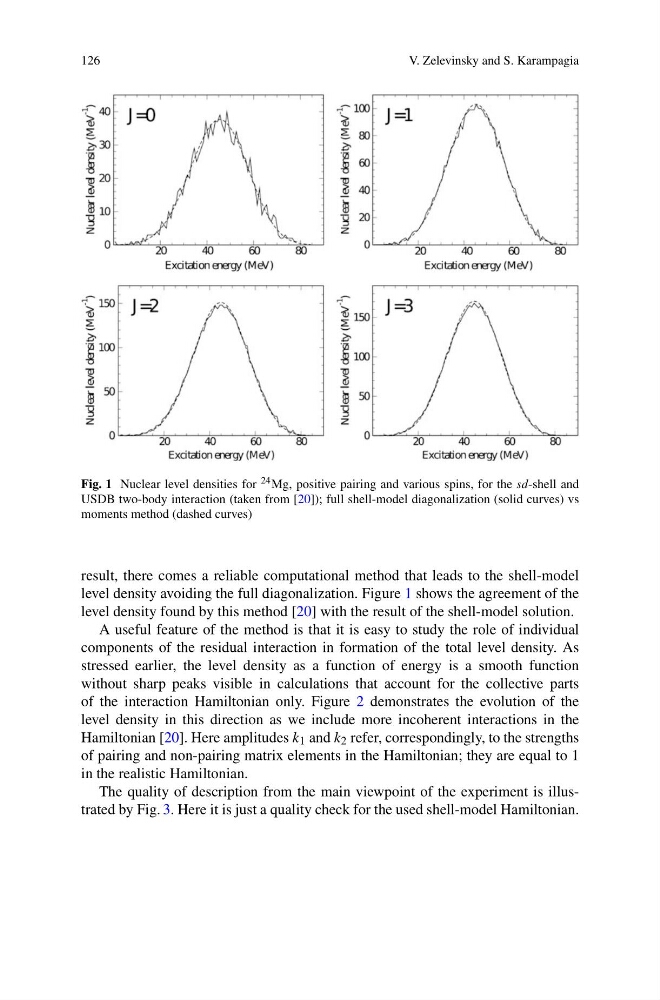
Fig. 1 Nuclear level densities for 24 Mg, positive pairing and various spins, for the sd-shell and
USDB two-body interaction (taken from [20]); full shell-model diagonalization (solid curves) vs
moments method (dashed curves)
result, there comes a reliable computational method that leads to the shell-model
level density avoiding the full diagonalization. Figure 1 shows the agreement of the
level density found by this method [20] with the result of the shell-model solution.
A useful feature of the method is that it is easy to study the role of individual
components of the residual interaction in formation of the total level density. As
stressed earlier, the level density as a function of energy is a smooth function
without sharp peaks visible in calculations that account for the collective parts
of the interaction Hamiltonian only. Figure 2 demonstrates the evolution of the
level density in this direction as we include more incoherent interactions in the
Hamiltonian [20]. Here amplitudes k 1 and k 2 refer, correspondingly, to the strengths
of pairing and non-pairing matrix elements in the Hamiltonian; they are equal to 1
in the realistic Hamiltonian.
The quality of description from the main viewpoint of the experiment is illustrated by Fig. 3. Here it is just a quality check for the used shell-model Hamiltonian.
V. Zelevinsky and S. Karampagia
Fig. 1 Nuclear level densities for 24 Mg, positive pairing and various spins, for the sd-shell and
USDB two-body interaction (taken from [20]); full shell-model diagonalization (solid curves) vs
moments method (dashed curves)
result, there comes a reliable computational method that leads to the shell-model
level density avoiding the full diagonalization. Figure 1 shows the agreement of the
level density found by this method [20] with the result of the shell-model solution.
A useful feature of the method is that it is easy to study the role of individual
components of the residual interaction in formation of the total level density. As
stressed earlier, the level density as a function of energy is a smooth function
without sharp peaks visible in calculations that account for the collective parts
of the interaction Hamiltonian only. Figure 2 demonstrates the evolution of the
level density in this direction as we include more incoherent interactions in the
Hamiltonian [20]. Here amplitudes k 1 and k 2 refer, correspondingly, to the strengths
of pairing and non-pairing matrix elements in the Hamiltonian; they are equal to 1
in the realistic Hamiltonian.
The quality of description from the main viewpoint of the experiment is illustrated by Fig. 3. Here it is just a quality check for the used shell-model Hamiltonian.