

104
Y. Alhassid
A mean-field theory provides the intrinsic level density ρ int (E x ). It has to be
augmented by collective enhancement factors (vibrational and rotational)
ρ(E x ) = K vib (E x )K rot (E x )ρ int (E x ),
(22)
where the factors K vib (E x ) and K rot (E x ) describe the enhancement of the density
due to vibrational and rotational collective states. The energy dependence of these
factors, and in particular, their decay with excitation energy E x , is one of the least
understood issues in studies of level densities, and are usually parameterized by
phenomenological expressions [18].
6.2 Combinatorial Methods
The combinatorial models are based on counting the number of ways to distribute
the nucleons among single-particle levels at a given total excitation energy [19–
22]. They are often combined with a mean-field theory such as the Hartree–
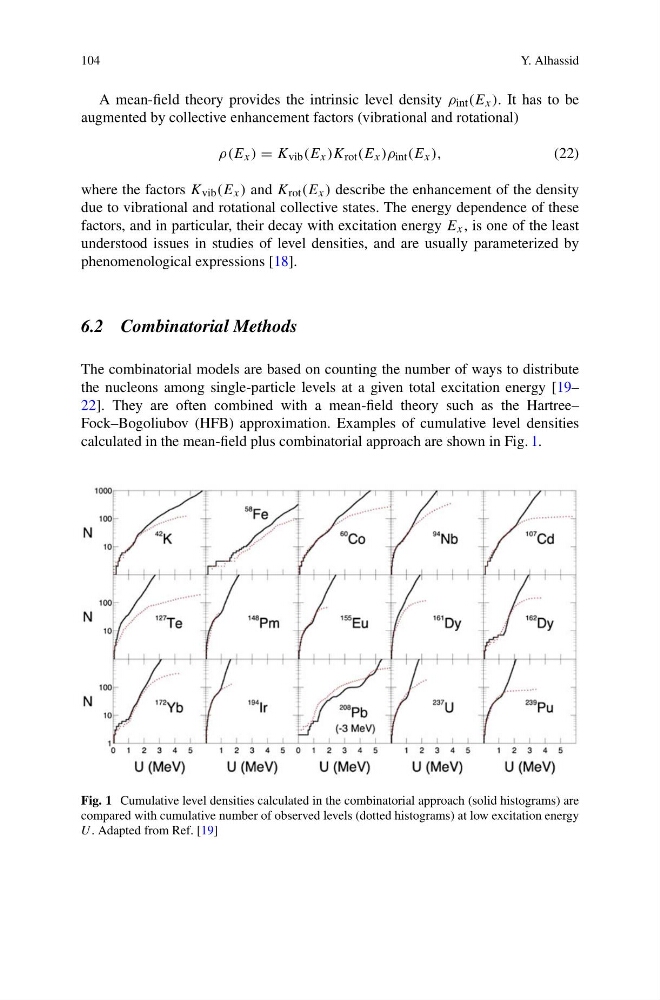
Fock–Bogoliubov (HFB) approximation. Examples of cumulative level densities
calculated in the mean-field plus combinatorial approach are shown in Fig. 1.
Fig. 1 Cumulative level densities calculated in the combinatorial approach (solid histograms) are
compared with cumulative number of observed levels (dotted histograms) at low excitation energy
U . Adapted from Ref. [19]
Y. Alhassid
A mean-field theory provides the intrinsic level density ρ int (E x ). It has to be
augmented by collective enhancement factors (vibrational and rotational)
ρ(E x ) = K vib (E x )K rot (E x )ρ int (E x ),
(22)
where the factors K vib (E x ) and K rot (E x ) describe the enhancement of the density
due to vibrational and rotational collective states. The energy dependence of these
factors, and in particular, their decay with excitation energy E x , is one of the least
understood issues in studies of level densities, and are usually parameterized by
phenomenological expressions [18].
6.2 Combinatorial Methods
The combinatorial models are based on counting the number of ways to distribute
the nucleons among single-particle levels at a given total excitation energy [19–
22]. They are often combined with a mean-field theory such as the Hartree–
Fock–Bogoliubov (HFB) approximation. Examples of cumulative level densities
calculated in the mean-field plus combinatorial approach are shown in Fig. 1.
Fig. 1 Cumulative level densities calculated in the combinatorial approach (solid histograms) are
compared with cumulative number of observed levels (dotted histograms) at low excitation energy
U . Adapted from Ref. [19]