

Nuclear Level Densities
103
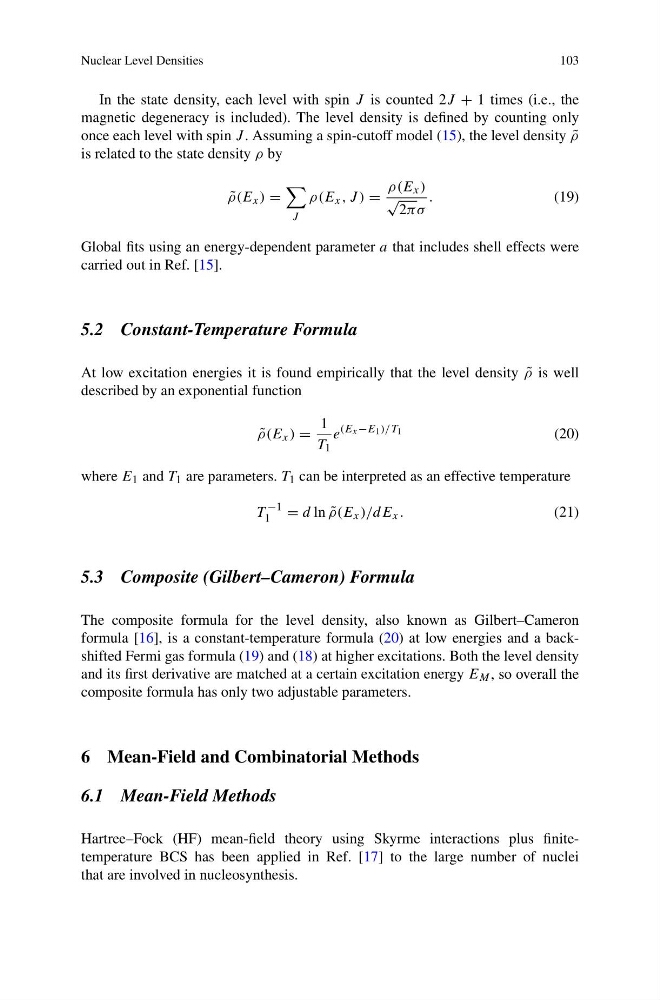
In the state density, each level with spin J is counted 2J + 1 times (i.e., the
magnetic degeneracy is included). The level density is defined by counting only
once each level with spin J . Assuming a spin-cutoff model (15), the level density ˜
ρ
is related to the state density ρ by
˜
ρ(E x ) =
J
ρ(E x , J ) =
ρ(E x )
√
2πσ
.
(19)
Global fits using an energy-dependent parameter a that includes shell effects were
carried out in Ref. [15].
5.2 Constant-Temperature Formula
At low excitation energies it is found empirically that the level density ˜
ρ is well
described by an exponential function
˜
ρ(E x ) =
1
T 1
e
(E x −E 1 )/T 1
(20)
where E 1 and T 1 are parameters. T 1 can be interpreted as an effective temperature
T
−1
1 = d ln ˜
ρ(E x )/dE x .
(21)
5.3 Composite (Gilbert–Cameron) Formula
The composite formula for the level density, also known as Gilbert–Cameron
formula [16], is a constant-temperature formula (20) at low energies and a backshifted Fermi gas formula (19) and (18) at higher excitations. Both the level density
and its first derivative are matched at a certain excitation energy E M , so overall the
composite formula has only two adjustable parameters.
6 Mean-Field and Combinatorial Methods
6.1 Mean-Field Methods
Hartree–Fock (HF) mean-field theory using Skyrme interactions plus finitetemperature BCS has been applied in Ref. [17] to the large number of nuclei
that are involved in nucleosynthesis.
103
In the state density, each level with spin J is counted 2J + 1 times (i.e., the
magnetic degeneracy is included). The level density is defined by counting only
once each level with spin J . Assuming a spin-cutoff model (15), the level density ˜
ρ
is related to the state density ρ by
˜
ρ(E x ) =
J
ρ(E x , J ) =
ρ(E x )
√
2πσ
.
(19)
Global fits using an energy-dependent parameter a that includes shell effects were
carried out in Ref. [15].
5.2 Constant-Temperature Formula
At low excitation energies it is found empirically that the level density ˜
ρ is well
described by an exponential function
˜
ρ(E x ) =
1
T 1
e
(E x −E 1 )/T 1
(20)
where E 1 and T 1 are parameters. T 1 can be interpreted as an effective temperature
T
−1
1 = d ln ˜
ρ(E x )/dE x .
(21)
5.3 Composite (Gilbert–Cameron) Formula
The composite formula for the level density, also known as Gilbert–Cameron
formula [16], is a constant-temperature formula (20) at low energies and a backshifted Fermi gas formula (19) and (18) at higher excitations. Both the level density
and its first derivative are matched at a certain excitation energy E M , so overall the
composite formula has only two adjustable parameters.
6 Mean-Field and Combinatorial Methods
6.1 Mean-Field Methods
Hartree–Fock (HF) mean-field theory using Skyrme interactions plus finitetemperature BCS has been applied in Ref. [17] to the large number of nuclei
that are involved in nucleosynthesis.