

3 Dynamics of Spray Granulation in Continuously …
83
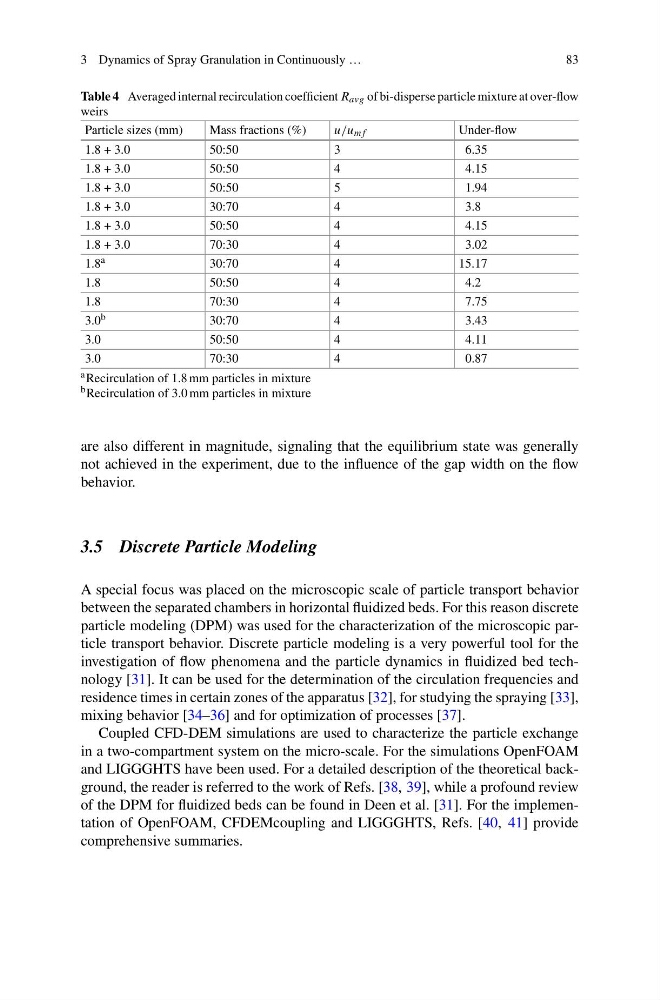
Table 4 Averaged internal recirculation coefficient R avg of bi-disperse particle mixture at over-flow
weirs
Particle sizes (mm)
Mass fractions (%)
u/u m f
Under-flow
1.8 + 3.0
50:50
3
6.35
1.8 + 3.0
50:50
4
4.15
1.8 + 3.0
50:50
5
1.94
1.8 + 3.0
30:70
4
3.8
1.8 + 3.0
50:50
4
4.15
1.8 + 3.0
70:30
4
3.02
1.8 a
30:70
4
15.17
1.8
50:50
4
4.2
1.8
70:30
4
7.75
3.0 b
30:70
4
3.43
3.0
50:50
4
4.11
3.0
70:30
4
0.87
a Recirculation of 1.8 mm particles in mixture
b Recirculation of 3.0 mm particles in mixture
are also different in magnitude, signaling that the equilibrium state was generally
not achieved in the experiment, due to the influence of the gap width on the flow
behavior.
3.5 Discrete Particle Modeling
A special focus was placed on the microscopic scale of particle transport behavior
between the separated chambers in horizontal fluidized beds. For this reason discrete
particle modeling (DPM) was used for the characterization of the microscopic particle transport behavior. Discrete particle modeling is a very powerful tool for the
investigation of flow phenomena and the particle dynamics in fluidized bed technology [31]. It can be used for the determination of the circulation frequencies and
residence times in certain zones of the apparatus [32], for studying the spraying [33],
mixing behavior [34–36] and for optimization of processes [37].
Coupled CFD-DEM simulations are used to characterize the particle exchange
in a two-compartment system on the micro-scale. For the simulations OpenFOAM
and LIGGGHTS have been used. For a detailed description of the theoretical background, the reader is referred to the work of Refs. [38, 39], while a profound review
of the DPM for fluidized beds can be found in Deen et al. [31]. For the implementation of OpenFOAM, CFDEMcoupling and LIGGGHTS, Refs. [40, 41] provide
comprehensive summaries.
83
Table 4 Averaged internal recirculation coefficient R avg of bi-disperse particle mixture at over-flow
weirs
Particle sizes (mm)
Mass fractions (%)
u/u m f
Under-flow
1.8 + 3.0
50:50
3
6.35
1.8 + 3.0
50:50
4
4.15
1.8 + 3.0
50:50
5
1.94
1.8 + 3.0
30:70
4
3.8
1.8 + 3.0
50:50
4
4.15
1.8 + 3.0
70:30
4
3.02
1.8 a
30:70
4
15.17
1.8
50:50
4
4.2
1.8
70:30
4
7.75
3.0 b
30:70
4
3.43
3.0
50:50
4
4.11
3.0
70:30
4
0.87
a Recirculation of 1.8 mm particles in mixture
b Recirculation of 3.0 mm particles in mixture
are also different in magnitude, signaling that the equilibrium state was generally
not achieved in the experiment, due to the influence of the gap width on the flow
behavior.
3.5 Discrete Particle Modeling
A special focus was placed on the microscopic scale of particle transport behavior
between the separated chambers in horizontal fluidized beds. For this reason discrete
particle modeling (DPM) was used for the characterization of the microscopic particle transport behavior. Discrete particle modeling is a very powerful tool for the
investigation of flow phenomena and the particle dynamics in fluidized bed technology [31]. It can be used for the determination of the circulation frequencies and
residence times in certain zones of the apparatus [32], for studying the spraying [33],
mixing behavior [34–36] and for optimization of processes [37].
Coupled CFD-DEM simulations are used to characterize the particle exchange
in a two-compartment system on the micro-scale. For the simulations OpenFOAM
and LIGGGHTS have been used. For a detailed description of the theoretical background, the reader is referred to the work of Refs. [38, 39], while a profound review
of the DPM for fluidized beds can be found in Deen et al. [31]. For the implementation of OpenFOAM, CFDEMcoupling and LIGGGHTS, Refs. [40, 41] provide
comprehensive summaries.