

3 Dynamics of Spray Granulation in Continuously …
79
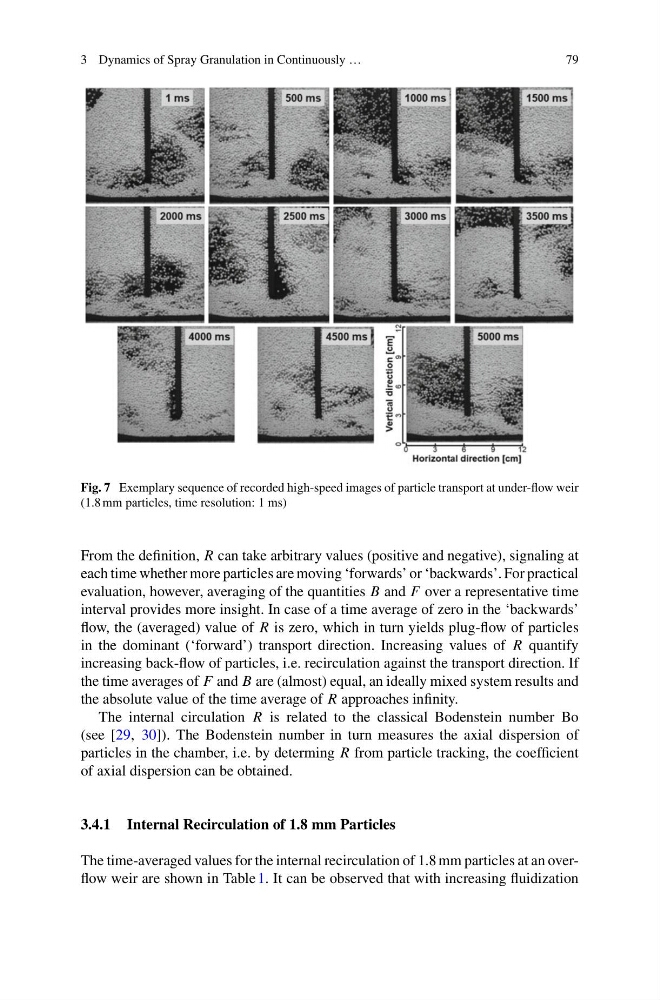
Fig. 7 Exemplary sequence of recorded high-speed images of particle transport at under-flow weir
(1.8 mm particles, time resolution: 1 ms)
From the definition, R can take arbitrary values (positive and negative), signaling at
each time whether more particles are moving ‘forwards’ or ‘backwards’. For practical
evaluation, however, averaging of the quantities B and F over a representative time
interval provides more insight. In case of a time average of zero in the ‘backwards’
flow, the (averaged) value of R is zero, which in turn yields plug-flow of particles
in the dominant (‘forward’) transport direction. Increasing values of R quantify
increasing back-flow of particles, i.e. recirculation against the transport direction. If
the time averages of F and B are (almost) equal, an ideally mixed system results and
the absolute value of the time average of R approaches infinity.
The internal circulation R is related to the classical Bodenstein number Bo
(see [29, 30]). The Bodenstein number in turn measures the axial dispersion of
particles in the chamber, i.e. by determing R from particle tracking, the coefficient
of axial dispersion can be obtained.
3.4.1 Internal Recirculation of 1.8 mm Particles
The time-averaged values for the internal recirculation of 1.8 mm particles at an overflow weir are shown in Table 1. It can be observed that with increasing fluidization
79
Fig. 7 Exemplary sequence of recorded high-speed images of particle transport at under-flow weir
(1.8 mm particles, time resolution: 1 ms)
From the definition, R can take arbitrary values (positive and negative), signaling at
each time whether more particles are moving ‘forwards’ or ‘backwards’. For practical
evaluation, however, averaging of the quantities B and F over a representative time
interval provides more insight. In case of a time average of zero in the ‘backwards’
flow, the (averaged) value of R is zero, which in turn yields plug-flow of particles
in the dominant (‘forward’) transport direction. Increasing values of R quantify
increasing back-flow of particles, i.e. recirculation against the transport direction. If
the time averages of F and B are (almost) equal, an ideally mixed system results and
the absolute value of the time average of R approaches infinity.
The internal circulation R is related to the classical Bodenstein number Bo
(see [29, 30]). The Bodenstein number in turn measures the axial dispersion of
particles in the chamber, i.e. by determing R from particle tracking, the coefficient
of axial dispersion can be obtained.
3.4.1 Internal Recirculation of 1.8 mm Particles
The time-averaged values for the internal recirculation of 1.8 mm particles at an overflow weir are shown in Table 1. It can be observed that with increasing fluidization