

3 Dynamics of Spray Granulation in Continuously …
77
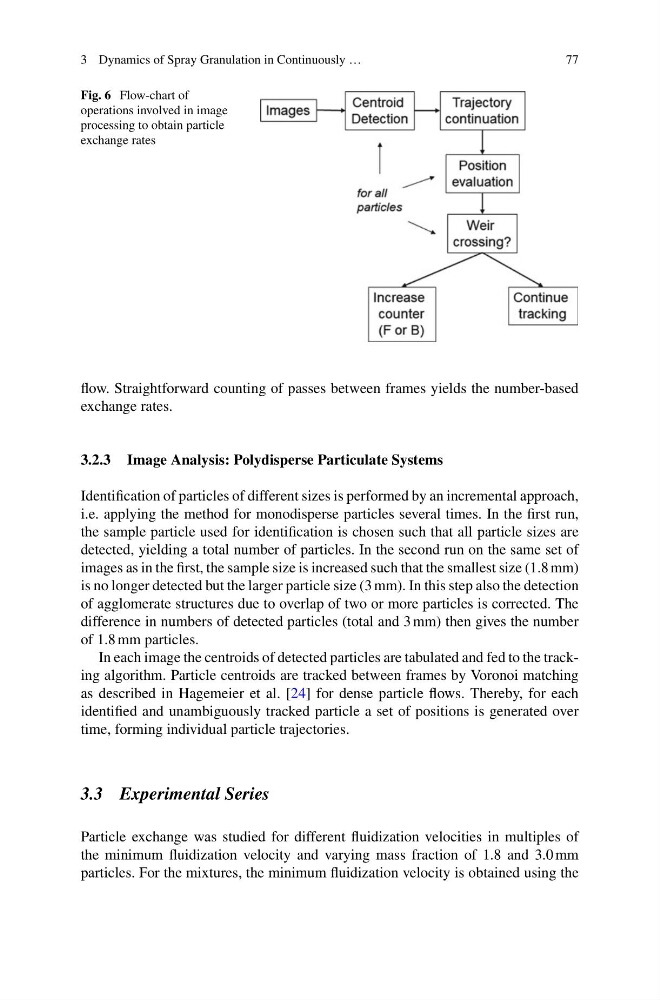
Fig. 6 Flow-chart of
operations involved in image
processing to obtain particle
exchange rates
flow. Straightforward counting of passes between frames yields the number-based
exchange rates.
3.2.3 Image Analysis: Polydisperse Particulate Systems
Identification of particles of different sizes is performed by an incremental approach,
i.e. applying the method for monodisperse particles several times. In the first run,
the sample particle used for identification is chosen such that all particle sizes are
detected, yielding a total number of particles. In the second run on the same set of
images as in the first, the sample size is increased such that the smallest size (1.8 mm)
is no longer detected but the larger particle size (3 mm). In this step also the detection
of agglomerate structures due to overlap of two or more particles is corrected. The
difference in numbers of detected particles (total and 3 mm) then gives the number
of 1.8 mm particles.
In each image the centroids of detected particles are tabulated and fed to the tracking algorithm. Particle centroids are tracked between frames by Voronoi matching
as described in Hagemeier et al. [24] for dense particle flows. Thereby, for each
identified and unambiguously tracked particle a set of positions is generated over
time, forming individual particle trajectories.
3.3 Experimental Series
Particle exchange was studied for different fluidization velocities in multiples of
the minimum fluidization velocity and varying mass fraction of 1.8 and 3.0 mm
particles. For the mixtures, the minimum fluidization velocity is obtained using the
77
Fig. 6 Flow-chart of
operations involved in image
processing to obtain particle
exchange rates
flow. Straightforward counting of passes between frames yields the number-based
exchange rates.
3.2.3 Image Analysis: Polydisperse Particulate Systems
Identification of particles of different sizes is performed by an incremental approach,
i.e. applying the method for monodisperse particles several times. In the first run,
the sample particle used for identification is chosen such that all particle sizes are
detected, yielding a total number of particles. In the second run on the same set of
images as in the first, the sample size is increased such that the smallest size (1.8 mm)
is no longer detected but the larger particle size (3 mm). In this step also the detection
of agglomerate structures due to overlap of two or more particles is corrected. The
difference in numbers of detected particles (total and 3 mm) then gives the number
of 1.8 mm particles.
In each image the centroids of detected particles are tabulated and fed to the tracking algorithm. Particle centroids are tracked between frames by Voronoi matching
as described in Hagemeier et al. [24] for dense particle flows. Thereby, for each
identified and unambiguously tracked particle a set of positions is generated over
time, forming individual particle trajectories.
3.3 Experimental Series
Particle exchange was studied for different fluidization velocities in multiples of
the minimum fluidization velocity and varying mass fraction of 1.8 and 3.0 mm
particles. For the mixtures, the minimum fluidization velocity is obtained using the