

76
C. Neugebauer et al.
x
y
z
x
y
Image
recording
Lens
Storage
Image
processing
Illuminated field of view
Particle
tracking
Particle
dynamics
Synchronization
Fluid flow
Light
source
Particles
Color classification
Particle segmentation
Particle pairing
Determination of collision events
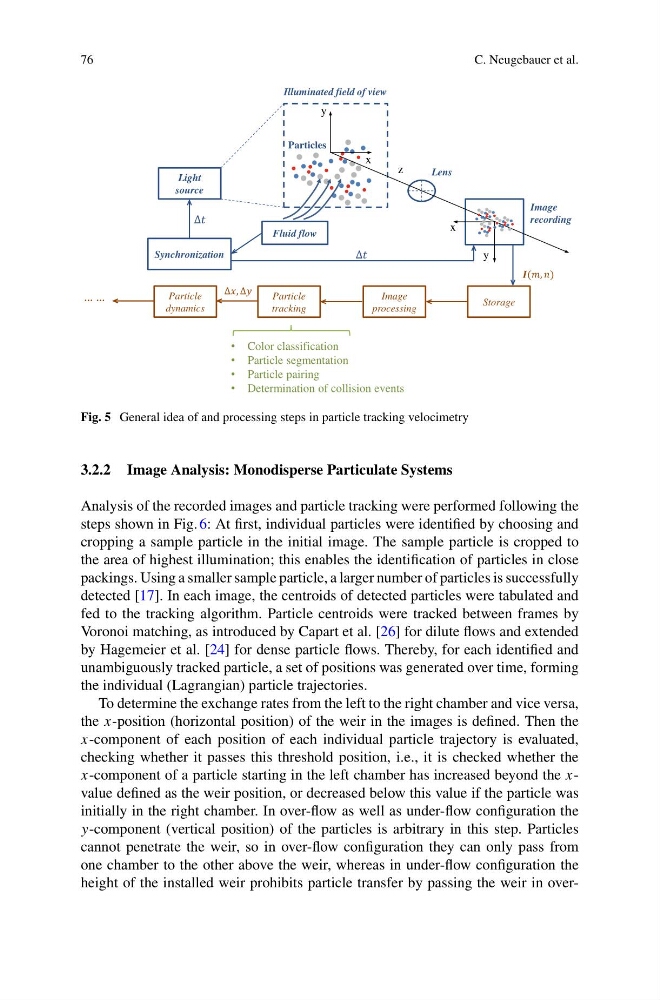
Fig. 5 General idea of and processing steps in particle tracking velocimetry
3.2.2 Image Analysis: Monodisperse Particulate Systems
Analysis of the recorded images and particle tracking were performed following the
steps shown in Fig. 6: At first, individual particles were identified by choosing and
cropping a sample particle in the initial image. The sample particle is cropped to
the area of highest illumination; this enables the identification of particles in close
packings. Using a smaller sample particle, a larger number of particles is successfully
detected [17]. In each image, the centroids of detected particles were tabulated and
fed to the tracking algorithm. Particle centroids were tracked between frames by
Voronoi matching, as introduced by Capart et al. [26] for dilute flows and extended
by Hagemeier et al. [24] for dense particle flows. Thereby, for each identified and
unambiguously tracked particle, a set of positions was generated over time, forming
the individual (Lagrangian) particle trajectories.
To determine the exchange rates from the left to the right chamber and vice versa,
the x-position (horizontal position) of the weir in the images is defined. Then the
x-component of each position of each individual particle trajectory is evaluated,
checking whether it passes this threshold position, i.e., it is checked whether the
x-component of a particle starting in the left chamber has increased beyond the xvalue defined as the weir position, or decreased below this value if the particle was
initially in the right chamber. In over-flow as well as under-flow configuration the
y-component (vertical position) of the particles is arbitrary in this step. Particles
cannot penetrate the weir, so in over-flow configuration they can only pass from
one chamber to the other above the weir, whereas in under-flow configuration the
height of the installed weir prohibits particle transfer by passing the weir in over-
C. Neugebauer et al.
x
y
z
x
y
Image
recording
Lens
Storage
Image
processing
Illuminated field of view
Particle
tracking
Particle
dynamics
Synchronization
Fluid flow
Light
source
Particles
Color classification
Particle segmentation
Particle pairing
Determination of collision events
Fig. 5 General idea of and processing steps in particle tracking velocimetry
3.2.2 Image Analysis: Monodisperse Particulate Systems
Analysis of the recorded images and particle tracking were performed following the
steps shown in Fig. 6: At first, individual particles were identified by choosing and
cropping a sample particle in the initial image. The sample particle is cropped to
the area of highest illumination; this enables the identification of particles in close
packings. Using a smaller sample particle, a larger number of particles is successfully
detected [17]. In each image, the centroids of detected particles were tabulated and
fed to the tracking algorithm. Particle centroids were tracked between frames by
Voronoi matching, as introduced by Capart et al. [26] for dilute flows and extended
by Hagemeier et al. [24] for dense particle flows. Thereby, for each identified and
unambiguously tracked particle, a set of positions was generated over time, forming
the individual (Lagrangian) particle trajectories.
To determine the exchange rates from the left to the right chamber and vice versa,
the x-position (horizontal position) of the weir in the images is defined. Then the
x-component of each position of each individual particle trajectory is evaluated,
checking whether it passes this threshold position, i.e., it is checked whether the
x-component of a particle starting in the left chamber has increased beyond the xvalue defined as the weir position, or decreased below this value if the particle was
initially in the right chamber. In over-flow as well as under-flow configuration the
y-component (vertical position) of the particles is arbitrary in this step. Particles
cannot penetrate the weir, so in over-flow configuration they can only pass from
one chamber to the other above the weir, whereas in under-flow configuration the
height of the installed weir prohibits particle transfer by passing the weir in over-