

3 Dynamics of Spray Granulation in Continuously …
71
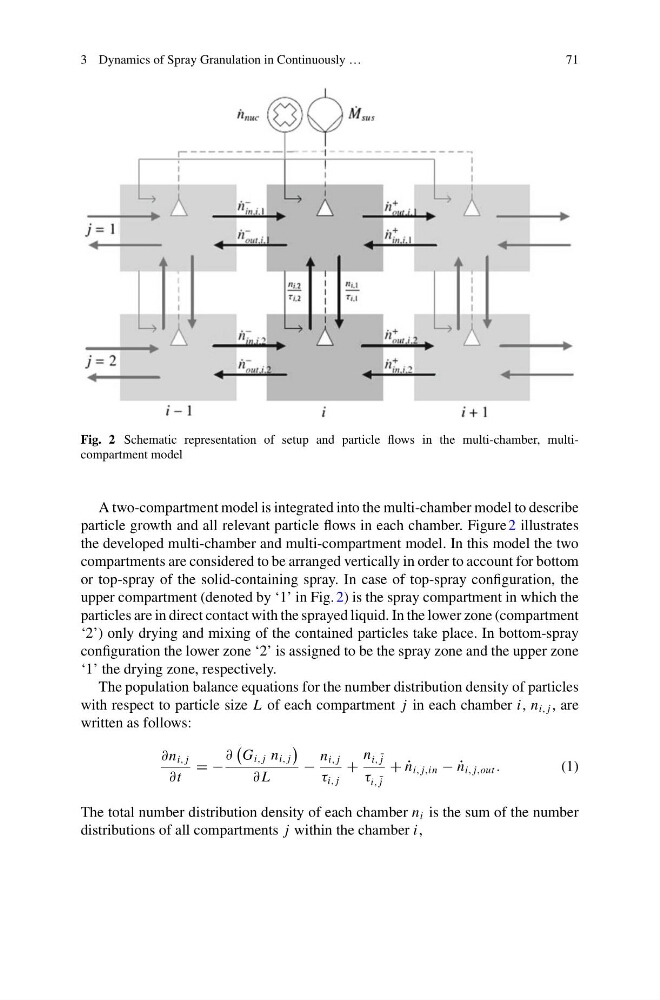
Fig. 2 Schematic representation of setup and particle flows in the multi-chamber, multicompartment model
A two-compartment model is integrated into the multi-chamber model to describe
particle growth and all relevant particle flows in each chamber. Figure 2 illustrates
the developed multi-chamber and multi-compartment model. In this model the two
compartments are considered to be arranged vertically in order to account for bottom
or top-spray of the solid-containing spray. In case of top-spray configuration, the
upper compartment (denoted by ‘1’ in Fig. 2) is the spray compartment in which the
particles are in direct contact with the sprayed liquid. In the lower zone (compartment
‘2’) only drying and mixing of the contained particles take place. In bottom-spray
configuration the lower zone ‘2’ is assigned to be the spray zone and the upper zone
‘1’ the drying zone, respectively.
The population balance equations for the number distribution density of particles
with respect to particle size L of each compartment j in each chamber i, n i, j , are
written as follows:
∂n i, j
∂t
= −
∂
G i, j n i, j
∂ L
−
n i, j
τ i, j
+
n i, ¯
j
τ i, ¯
j
+ ˙
n i, j,in − ˙
n i, j,out .
(1)
The total number distribution density of each chamber n i is the sum of the number
distributions of all compartments j within the chamber i,
71
Fig. 2 Schematic representation of setup and particle flows in the multi-chamber, multicompartment model
A two-compartment model is integrated into the multi-chamber model to describe
particle growth and all relevant particle flows in each chamber. Figure 2 illustrates
the developed multi-chamber and multi-compartment model. In this model the two
compartments are considered to be arranged vertically in order to account for bottom
or top-spray of the solid-containing spray. In case of top-spray configuration, the
upper compartment (denoted by ‘1’ in Fig. 2) is the spray compartment in which the
particles are in direct contact with the sprayed liquid. In the lower zone (compartment
‘2’) only drying and mixing of the contained particles take place. In bottom-spray
configuration the lower zone ‘2’ is assigned to be the spray zone and the upper zone
‘1’ the drying zone, respectively.
The population balance equations for the number distribution density of particles
with respect to particle size L of each compartment j in each chamber i, n i, j , are
written as follows:
∂n i, j
∂t
= −
∂
G i, j n i, j
∂ L
−
n i, j
τ i, j
+
n i, ¯
j
τ i, ¯
j
+ ˙
n i, j,in − ˙
n i, j,out .
(1)
The total number distribution density of each chamber n i is the sum of the number
distributions of all compartments j within the chamber i,