

614
V. Skorych et al.
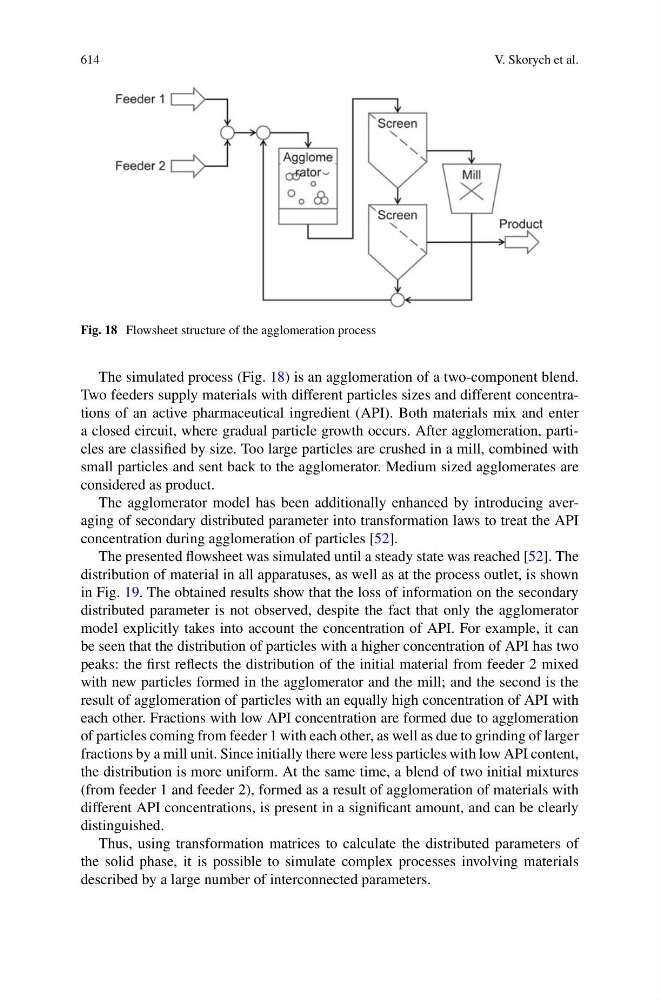
Fig. 18 Flowsheet structure of the agglomeration process
The simulated process (Fig. 18) is an agglomeration of a two-component blend.
Two feeders supply materials with different particles sizes and different concentrations of an active pharmaceutical ingredient (API). Both materials mix and enter
a closed circuit, where gradual particle growth occurs. After agglomeration, particles are classified by size. Too large particles are crushed in a mill, combined with
small particles and sent back to the agglomerator. Medium sized agglomerates are
considered as product.
The agglomerator model has been additionally enhanced by introducing averaging of secondary distributed parameter into transformation laws to treat the API
concentration during agglomeration of particles [52].
The presented flowsheet was simulated until a steady state was reached [52]. The
distribution of material in all apparatuses, as well as at the process outlet, is shown
in Fig. 19. The obtained results show that the loss of information on the secondary
distributed parameter is not observed, despite the fact that only the agglomerator
model explicitly takes into account the concentration of API. For example, it can
be seen that the distribution of particles with a higher concentration of API has two
peaks: the first reflects the distribution of the initial material from feeder 2 mixed
with new particles formed in the agglomerator and the mill; and the second is the
result of agglomeration of particles with an equally high concentration of API with
each other. Fractions with low API concentration are formed due to agglomeration
of particles coming from feeder 1 with each other, as well as due to grinding of larger
fractions by a mill unit. Since initially there were less particles with low API content,
the distribution is more uniform. At the same time, a blend of two initial mixtures
(from feeder 1 and feeder 2), formed as a result of agglomeration of materials with
different API concentrations, is present in a significant amount, and can be clearly
distinguished.
Thus, using transformation matrices to calculate the distributed parameters of
the solid phase, it is possible to simulate complex processes involving materials
described by a large number of interconnected parameters.