

17 A Framework for Dynamic Simulation of Interconnected …
593
The first step of topology analysis is aimed at solving the issue with recycle
streams. The flowsheet has to be converted to a sequential form, which can be easily handled by the sequential-modular algorithm [13]. To do so, all available recycle streams must be found and some predefined initial values must be set to them
[61]. This procedure is called tearing, and all found and initialized recycle flows are
referred to as tear streams. Often the set of possible tear streams in the flowsheet
is not unique, therefore, the algorithm for their selection can affect the rate of convergence, and, hence, the performance of the calculations. In Dyssol, the synthetic
method of Roach [48] was implemented, which is able to find a near-to-optimal set
of tear streams. This heuristic algorithm does not require preliminary decomposition
of graph or detection of strongly coupled components, so it can be used already at
the first step of topological analysis.
To come from the predefined initial values in the tear streams to the final solution, all units covered by a recycle loop must be calculated together iteratively until
convergence. Such groups of units are known as partitions, and the process of their
allocation is called partitioning. The main idea is to break the flowsheet into blocks
that are connected exclusively sequentially. To search for partitions in Dyssol, the
Tarjan algorithm for finding strongly connected components is used [58]. It takes
a directed graph as input, distributes units into partitions in accordance with existing recycling flows, and organizes partitions in the order that corresponds to the
calculation sequence. This method is a variation of the depth-first search algorithm
and works in linear time. The original Tarjan algorithm allocates units that do not
belong to any recirculation loop into partitions with one component. Therefore, it
was supplemented by an additional step, which combines such sequentially arranged
separate partitions into larger ones to simplify further calculations.
The last step in topological analysis is to determine the calculation sequence.
The proper arrangement of partitions is already known from the previous step. To
determine the order of units within them, the algorithm of simple topological sort
based on the depth-first search [59] is applied in Dyssol simulation system. It takes
a directed graph of a partition with preliminarily removed tear streams as input.
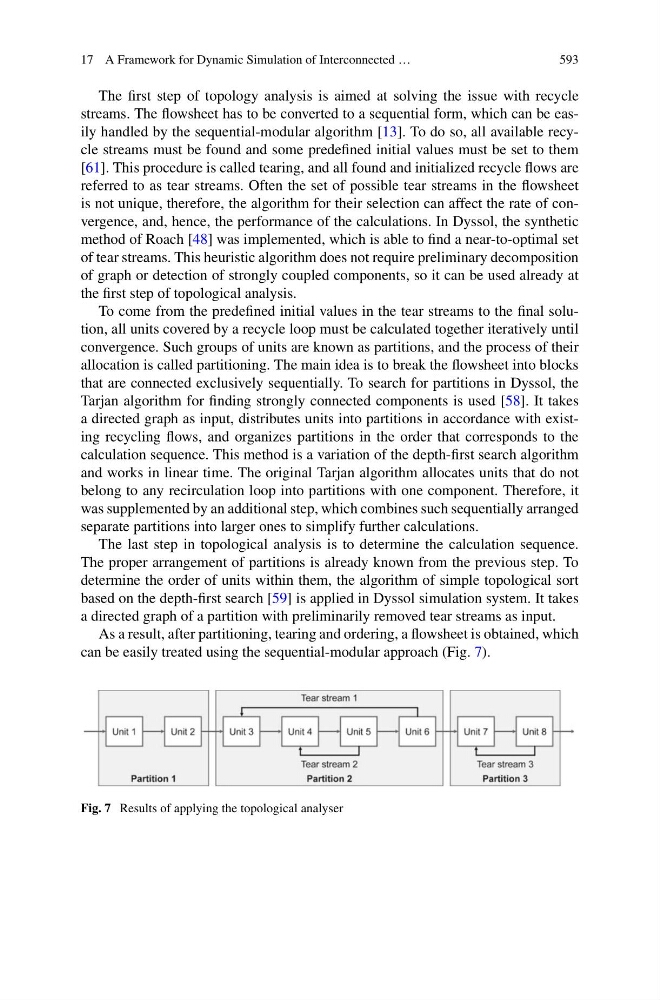
As a result, after partitioning, tearing and ordering, a flowsheet is obtained, which
can be easily treated using the sequential-modular approach (Fig. 7).
Fig. 7 Results of applying the topological analyser
593
The first step of topology analysis is aimed at solving the issue with recycle
streams. The flowsheet has to be converted to a sequential form, which can be easily handled by the sequential-modular algorithm [13]. To do so, all available recycle streams must be found and some predefined initial values must be set to them
[61]. This procedure is called tearing, and all found and initialized recycle flows are
referred to as tear streams. Often the set of possible tear streams in the flowsheet
is not unique, therefore, the algorithm for their selection can affect the rate of convergence, and, hence, the performance of the calculations. In Dyssol, the synthetic
method of Roach [48] was implemented, which is able to find a near-to-optimal set
of tear streams. This heuristic algorithm does not require preliminary decomposition
of graph or detection of strongly coupled components, so it can be used already at
the first step of topological analysis.
To come from the predefined initial values in the tear streams to the final solution, all units covered by a recycle loop must be calculated together iteratively until
convergence. Such groups of units are known as partitions, and the process of their
allocation is called partitioning. The main idea is to break the flowsheet into blocks
that are connected exclusively sequentially. To search for partitions in Dyssol, the
Tarjan algorithm for finding strongly connected components is used [58]. It takes
a directed graph as input, distributes units into partitions in accordance with existing recycling flows, and organizes partitions in the order that corresponds to the
calculation sequence. This method is a variation of the depth-first search algorithm
and works in linear time. The original Tarjan algorithm allocates units that do not
belong to any recirculation loop into partitions with one component. Therefore, it
was supplemented by an additional step, which combines such sequentially arranged
separate partitions into larger ones to simplify further calculations.
The last step in topological analysis is to determine the calculation sequence.
The proper arrangement of partitions is already known from the previous step. To
determine the order of units within them, the algorithm of simple topological sort
based on the depth-first search [59] is applied in Dyssol simulation system. It takes
a directed graph of a partition with preliminarily removed tear streams as input.
As a result, after partitioning, tearing and ordering, a flowsheet is obtained, which
can be easily treated using the sequential-modular approach (Fig. 7).
Fig. 7 Results of applying the topological analyser