

592
V. Skorych et al.
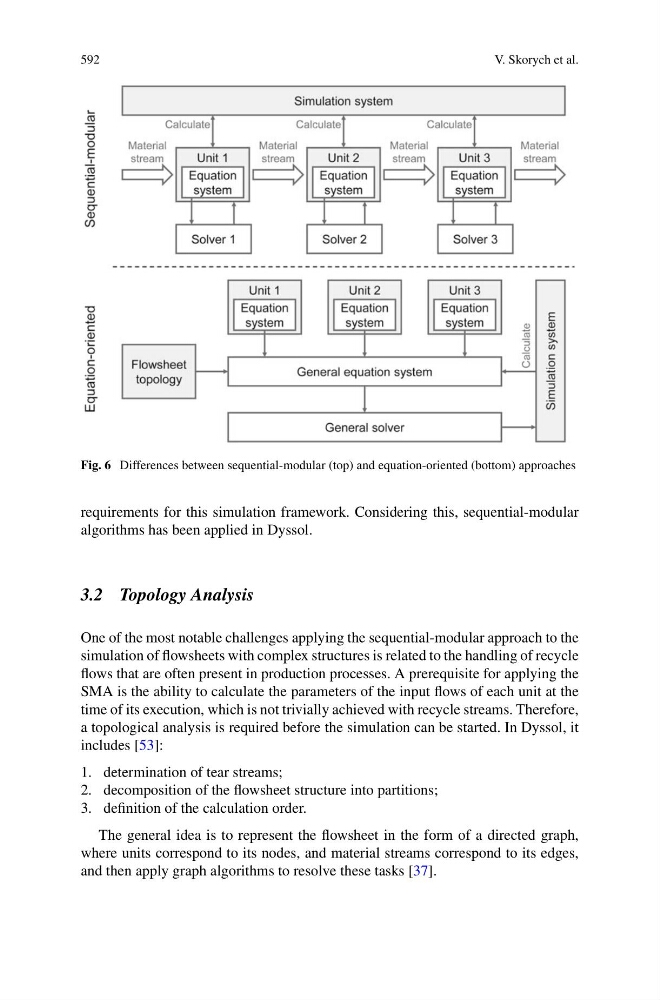
Fig. 6 Differences between sequential-modular (top) and equation-oriented (bottom) approaches
requirements for this simulation framework. Considering this, sequential-modular
algorithms has been applied in Dyssol.
3.2 Topology Analysis
One of the most notable challenges applying the sequential-modular approach to the
simulation of flowsheets with complex structures is related to the handling of recycle
flows that are often present in production processes. A prerequisite for applying the
SMA is the ability to calculate the parameters of the input flows of each unit at the
time of its execution, which is not trivially achieved with recycle streams. Therefore,
a topological analysis is required before the simulation can be started. In Dyssol, it
includes [53]:
1. determination of tear streams;
2. decomposition of the flowsheet structure into partitions;
3. definition of the calculation order.
The general idea is to represent the flowsheet in the form of a directed graph,
where units correspond to its nodes, and material streams correspond to its edges,
and then apply graph algorithms to resolve these tasks [37].
V. Skorych et al.
Fig. 6 Differences between sequential-modular (top) and equation-oriented (bottom) approaches
requirements for this simulation framework. Considering this, sequential-modular
algorithms has been applied in Dyssol.
3.2 Topology Analysis
One of the most notable challenges applying the sequential-modular approach to the
simulation of flowsheets with complex structures is related to the handling of recycle
flows that are often present in production processes. A prerequisite for applying the
SMA is the ability to calculate the parameters of the input flows of each unit at the
time of its execution, which is not trivially achieved with recycle streams. Therefore,
a topological analysis is required before the simulation can be started. In Dyssol, it
includes [53]:
1. determination of tear streams;
2. decomposition of the flowsheet structure into partitions;
3. definition of the calculation order.
The general idea is to represent the flowsheet in the form of a directed graph,
where units correspond to its nodes, and material streams correspond to its edges,
and then apply graph algorithms to resolve these tasks [37].