

590
V. Skorych et al.
3 Simulation Algorithm
Steady-state models do not have an internal state, so their output depends only on
the input parameters. At the same time, dynamic models are characterized by the
accumulation of material; therefore, their output streams additionally depend on
their internal state at each moment of time. For the modelling algorithm, the main
difference between them is that dynamic units are calculated at certain time intervals,
while steady-state ones are processed at individual points in time. Thus, the use of
steady-state units in a dynamic simulation system is straightforward and implies the
consistent application of the model’s algorithm to all input time points within the
considered time interval.
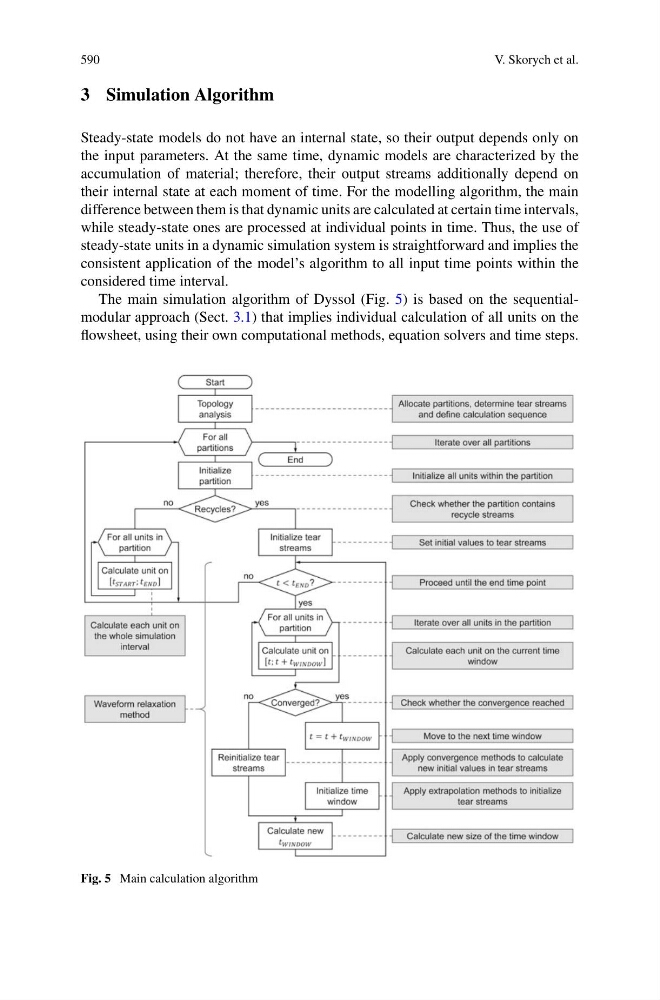
The main simulation algorithm of Dyssol (Fig. 5) is based on the sequentialmodular approach (Sect. 3.1) that implies individual calculation of all units on the
flowsheet, using their own computational methods, equation solvers and time steps.
Fig. 5 Main calculation algorithm
V. Skorych et al.
3 Simulation Algorithm
Steady-state models do not have an internal state, so their output depends only on
the input parameters. At the same time, dynamic models are characterized by the
accumulation of material; therefore, their output streams additionally depend on
their internal state at each moment of time. For the modelling algorithm, the main
difference between them is that dynamic units are calculated at certain time intervals,
while steady-state ones are processed at individual points in time. Thus, the use of
steady-state units in a dynamic simulation system is straightforward and implies the
consistent application of the model’s algorithm to all input time points within the
considered time interval.
The main simulation algorithm of Dyssol (Fig. 5) is based on the sequentialmodular approach (Sect. 3.1) that implies individual calculation of all units on the
flowsheet, using their own computational methods, equation solvers and time steps.
Fig. 5 Main calculation algorithm