

588
V. Skorych et al.
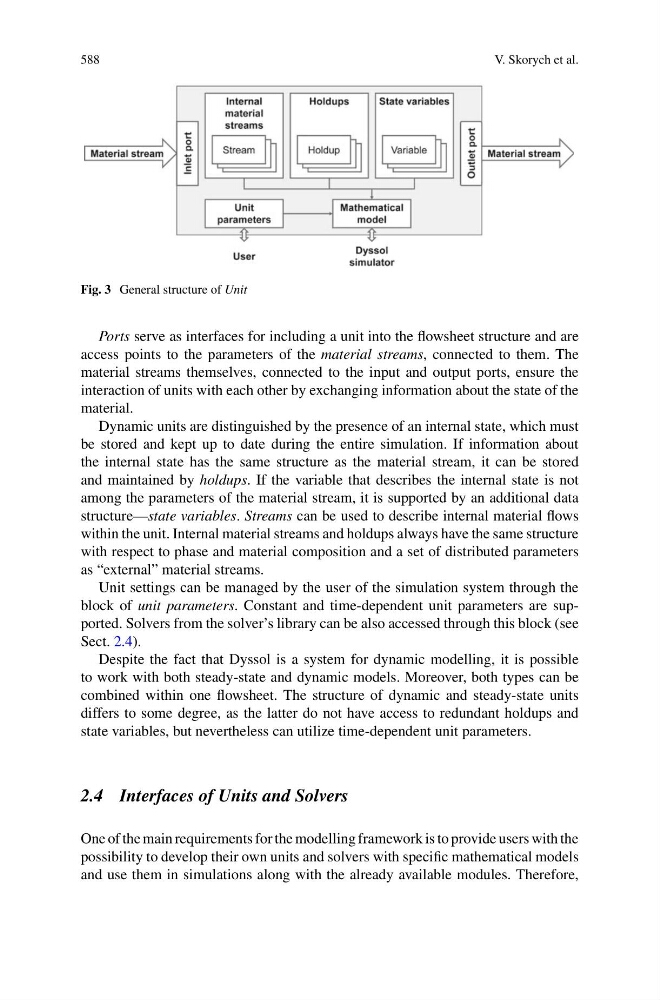
Fig. 3 General structure of Unit
Ports serve as interfaces for including a unit into the flowsheet structure and are
access points to the parameters of the material streams, connected to them. The
material streams themselves, connected to the input and output ports, ensure the
interaction of units with each other by exchanging information about the state of the
material.
Dynamic units are distinguished by the presence of an internal state, which must
be stored and kept up to date during the entire simulation. If information about
the internal state has the same structure as the material stream, it can be stored
and maintained by holdups. If the variable that describes the internal state is not
among the parameters of the material stream, it is supported by an additional data
structure—state variables. Streams can be used to describe internal material flows
within the unit. Internal material streams and holdups always have the same structure
with respect to phase and material composition and a set of distributed parameters
as “external” material streams.
Unit settings can be managed by the user of the simulation system through the
block of unit parameters. Constant and time-dependent unit parameters are supported. Solvers from the solver’s library can be also accessed through this block (see
Sect. 2.4).
Despite the fact that Dyssol is a system for dynamic modelling, it is possible
to work with both steady-state and dynamic models. Moreover, both types can be
combined within one flowsheet. The structure of dynamic and steady-state units
differs to some degree, as the latter do not have access to redundant holdups and
state variables, but nevertheless can utilize time-dependent unit parameters.
2.4 Interfaces of Units and Solvers
One of the main requirements for the modelling framework is to provide users with the
possibility to develop their own units and solvers with specific mathematical models
and use them in simulations along with the already available modules. Therefore,
V. Skorych et al.
Fig. 3 General structure of Unit
Ports serve as interfaces for including a unit into the flowsheet structure and are
access points to the parameters of the material streams, connected to them. The
material streams themselves, connected to the input and output ports, ensure the
interaction of units with each other by exchanging information about the state of the
material.
Dynamic units are distinguished by the presence of an internal state, which must
be stored and kept up to date during the entire simulation. If information about
the internal state has the same structure as the material stream, it can be stored
and maintained by holdups. If the variable that describes the internal state is not
among the parameters of the material stream, it is supported by an additional data
structure—state variables. Streams can be used to describe internal material flows
within the unit. Internal material streams and holdups always have the same structure
with respect to phase and material composition and a set of distributed parameters
as “external” material streams.
Unit settings can be managed by the user of the simulation system through the
block of unit parameters. Constant and time-dependent unit parameters are supported. Solvers from the solver’s library can be also accessed through this block (see
Sect. 2.4).
Despite the fact that Dyssol is a system for dynamic modelling, it is possible
to work with both steady-state and dynamic models. Moreover, both types can be
combined within one flowsheet. The structure of dynamic and steady-state units
differs to some degree, as the latter do not have access to redundant holdups and
state variables, but nevertheless can utilize time-dependent unit parameters.
2.4 Interfaces of Units and Solvers
One of the main requirements for the modelling framework is to provide users with the
possibility to develop their own units and solvers with specific mathematical models
and use them in simulations along with the already available modules. Therefore,