

2 Dynamic Modelling of Reactive Fluidized Bed Systems Using …
51
freeboard :
dC f,l
dh
=
r g,l − C f,l
du
dh
u
(21)
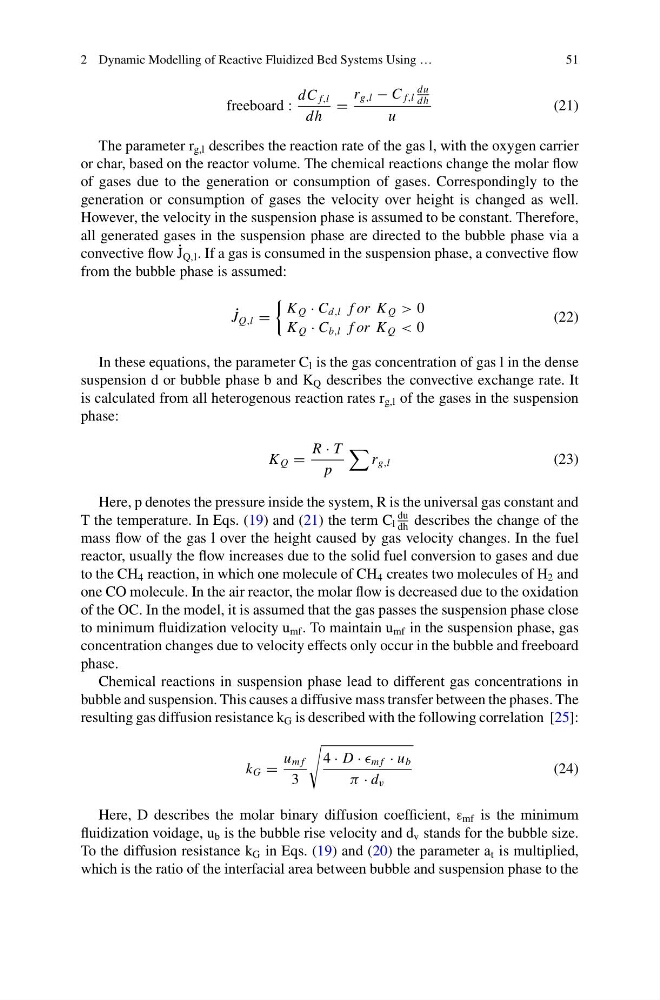
The parameter r g,l describes the reaction rate of the gas l, with the oxygen carrier
or char, based on the reactor volume. The chemical reactions change the molar flow
of gases due to the generation or consumption of gases. Correspondingly to the
generation or consumption of gases the velocity over height is changed as well.
However, the velocity in the suspension phase is assumed to be constant. Therefore,
all generated gases in the suspension phase are directed to the bubble phase via a
convective flow ˙
J Q,l . If a gas is consumed in the suspension phase, a convective flow
from the bubble phase is assumed:
˙
J Q,l =
K Q · C d,l f or K Q > 0
K Q · C b,l f or K Q < 0
(22)
In these equations, the parameter C l is the gas concentration of gas l in the dense
suspension d or bubble phase b and K Q describes the convective exchange rate. It
is calculated from all heterogenous reaction rates r g,l of the gases in the suspension
phase:
K Q =
R · T
p
r g,l
(23)
Here, p denotes the pressure inside the system, R is the universal gas constant and
T the temperature. In Eqs. (19) and (21) the term C l
du
dh
describes the change of the
mass flow of the gas l over the height caused by gas velocity changes. In the fuel
reactor, usually the flow increases due to the solid fuel conversion to gases and due
to the CH 4 reaction, in which one molecule of CH 4 creates two molecules of H 2 and
one CO molecule. In the air reactor, the molar flow is decreased due to the oxidation
of the OC. In the model, it is assumed that the gas passes the suspension phase close
to minimum fluidization velocity u mf . To maintain u mf in the suspension phase, gas
concentration changes due to velocity effects only occur in the bubble and freeboard
phase.
Chemical reactions in suspension phase lead to different gas concentrations in
bubble and suspension. This causes a diffusive mass transfer between the phases. The
resulting gas diffusion resistance k G is described with the following correlation [25]:
k G =
u m f
3
4 · D · m f · u b
π · d v
(24)
Here, D describes the molar binary diffusion coefficient, ε mf is the minimum
fluidization voidage, u b is the bubble rise velocity and d v stands for the bubble size.
To the diffusion resistance k G in Eqs. (19) and (20) the parameter a t is multiplied,
which is the ratio of the interfacial area between bubble and suspension phase to the
51
freeboard :
dC f,l
dh
=
r g,l − C f,l
du
dh
u
(21)
The parameter r g,l describes the reaction rate of the gas l, with the oxygen carrier
or char, based on the reactor volume. The chemical reactions change the molar flow
of gases due to the generation or consumption of gases. Correspondingly to the
generation or consumption of gases the velocity over height is changed as well.
However, the velocity in the suspension phase is assumed to be constant. Therefore,
all generated gases in the suspension phase are directed to the bubble phase via a
convective flow ˙
J Q,l . If a gas is consumed in the suspension phase, a convective flow
from the bubble phase is assumed:
˙
J Q,l =
K Q · C d,l f or K Q > 0
K Q · C b,l f or K Q < 0
(22)
In these equations, the parameter C l is the gas concentration of gas l in the dense
suspension d or bubble phase b and K Q describes the convective exchange rate. It
is calculated from all heterogenous reaction rates r g,l of the gases in the suspension
phase:
K Q =
R · T
p
r g,l
(23)
Here, p denotes the pressure inside the system, R is the universal gas constant and
T the temperature. In Eqs. (19) and (21) the term C l
du
dh
describes the change of the
mass flow of the gas l over the height caused by gas velocity changes. In the fuel
reactor, usually the flow increases due to the solid fuel conversion to gases and due
to the CH 4 reaction, in which one molecule of CH 4 creates two molecules of H 2 and
one CO molecule. In the air reactor, the molar flow is decreased due to the oxidation
of the OC. In the model, it is assumed that the gas passes the suspension phase close
to minimum fluidization velocity u mf . To maintain u mf in the suspension phase, gas
concentration changes due to velocity effects only occur in the bubble and freeboard
phase.
Chemical reactions in suspension phase lead to different gas concentrations in
bubble and suspension. This causes a diffusive mass transfer between the phases. The
resulting gas diffusion resistance k G is described with the following correlation [25]:
k G =
u m f
3
4 · D · m f · u b
π · d v
(24)
Here, D describes the molar binary diffusion coefficient, ε mf is the minimum
fluidization voidage, u b is the bubble rise velocity and d v stands for the bubble size.
To the diffusion resistance k G in Eqs. (19) and (20) the parameter a t is multiplied,
which is the ratio of the interfacial area between bubble and suspension phase to the