

16 Modeling, Simulation and Optimization of Process Chains
553
q t (t, x) + ∇ x ·
G
u G (t), W q (t), t, x
q(t, x)
= u in (t)q in (x) − u out (t)q(t, x)
q(0, x) = u 0 q 0 (x)
W q (t) :=
γ ( y)q(t, y) d y
⎫
⎪ ⎪ ⎪ ⎪ ⎬
⎪ ⎪ ⎪ ⎪ ⎭
(1)
For (t, x) ∈ (0, t f ) × with := {x ∈ R
n
: x ≥ x min } and x min ∈ R
n . Throughout
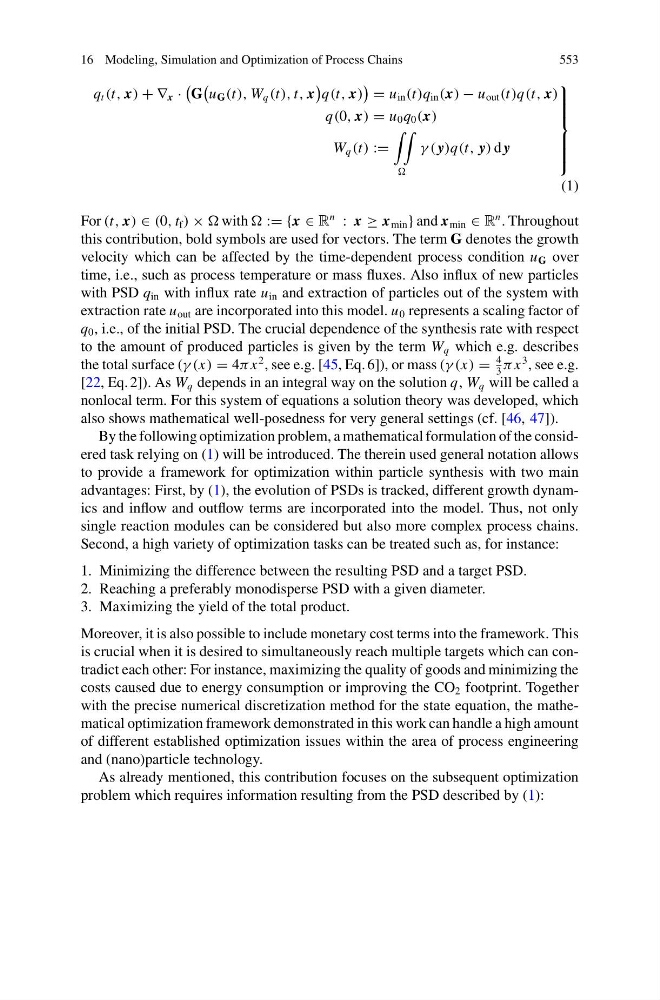
this contribution, bold symbols are used for vectors. The term G denotes the growth
velocity which can be affected by the time-dependent process condition u G over
time, i.e., such as process temperature or mass fluxes. Also influx of new particles
with PSD q in with influx rate u in and extraction of particles out of the system with
extraction rate u out are incorporated into this model. u 0 represents a scaling factor of
q 0 , i.e., of the initial PSD. The crucial dependence of the synthesis rate with respect
to the amount of produced particles is given by the term W q which e.g. describes
the total surface (γ (x) = 4π x
2 , see e.g. [45, Eq. 6]), or mass (γ (x) =
4
3
π x
3 , see e.g.
[22, Eq. 2]). As W q depends in an integral way on the solution q, W q will be called a
nonlocal term. For this system of equations a solution theory was developed, which
also shows mathematical well-posedness for very general settings (cf. [46, 47]).
By the following optimization problem, a mathematical formulation of the considered task relying on (1) will be introduced. The therein used general notation allows
to provide a framework for optimization within particle synthesis with two main
advantages: First, by (1), the evolution of PSDs is tracked, different growth dynamics and inflow and outflow terms are incorporated into the model. Thus, not only
single reaction modules can be considered but also more complex process chains.
Second, a high variety of optimization tasks can be treated such as, for instance:
1. Minimizing the difference between the resulting PSD and a target PSD.
2. Reaching a preferably monodisperse PSD with a given diameter.
3. Maximizing the yield of the total product.
Moreover, it is also possible to include monetary cost terms into the framework. This
is crucial when it is desired to simultaneously reach multiple targets which can contradict each other: For instance, maximizing the quality of goods and minimizing the
costs caused due to energy consumption or improving the CO 2 footprint. Together
with the precise numerical discretization method for the state equation, the mathematical optimization framework demonstrated in this work can handle a high amount
of different established optimization issues within the area of process engineering
and (nano)particle technology.
As already mentioned, this contribution focuses on the subsequent optimization
problem which requires information resulting from the PSD described by (1):
553
q t (t, x) + ∇ x ·
G
u G (t), W q (t), t, x
q(t, x)
= u in (t)q in (x) − u out (t)q(t, x)
q(0, x) = u 0 q 0 (x)
W q (t) :=
γ ( y)q(t, y) d y
⎫
⎪ ⎪ ⎪ ⎪ ⎬
⎪ ⎪ ⎪ ⎪ ⎭
(1)
For (t, x) ∈ (0, t f ) × with := {x ∈ R
n
: x ≥ x min } and x min ∈ R
n . Throughout
this contribution, bold symbols are used for vectors. The term G denotes the growth
velocity which can be affected by the time-dependent process condition u G over
time, i.e., such as process temperature or mass fluxes. Also influx of new particles
with PSD q in with influx rate u in and extraction of particles out of the system with
extraction rate u out are incorporated into this model. u 0 represents a scaling factor of
q 0 , i.e., of the initial PSD. The crucial dependence of the synthesis rate with respect
to the amount of produced particles is given by the term W q which e.g. describes
the total surface (γ (x) = 4π x
2 , see e.g. [45, Eq. 6]), or mass (γ (x) =
4
3
π x
3 , see e.g.
[22, Eq. 2]). As W q depends in an integral way on the solution q, W q will be called a
nonlocal term. For this system of equations a solution theory was developed, which
also shows mathematical well-posedness for very general settings (cf. [46, 47]).
By the following optimization problem, a mathematical formulation of the considered task relying on (1) will be introduced. The therein used general notation allows
to provide a framework for optimization within particle synthesis with two main
advantages: First, by (1), the evolution of PSDs is tracked, different growth dynamics and inflow and outflow terms are incorporated into the model. Thus, not only
single reaction modules can be considered but also more complex process chains.
Second, a high variety of optimization tasks can be treated such as, for instance:
1. Minimizing the difference between the resulting PSD and a target PSD.
2. Reaching a preferably monodisperse PSD with a given diameter.
3. Maximizing the yield of the total product.
Moreover, it is also possible to include monetary cost terms into the framework. This
is crucial when it is desired to simultaneously reach multiple targets which can contradict each other: For instance, maximizing the quality of goods and minimizing the
costs caused due to energy consumption or improving the CO 2 footprint. Together
with the precise numerical discretization method for the state equation, the mathematical optimization framework demonstrated in this work can handle a high amount
of different established optimization issues within the area of process engineering
and (nano)particle technology.
As already mentioned, this contribution focuses on the subsequent optimization
problem which requires information resulting from the PSD described by (1):