

536
G. Kotalczyk and F. E. Kruis
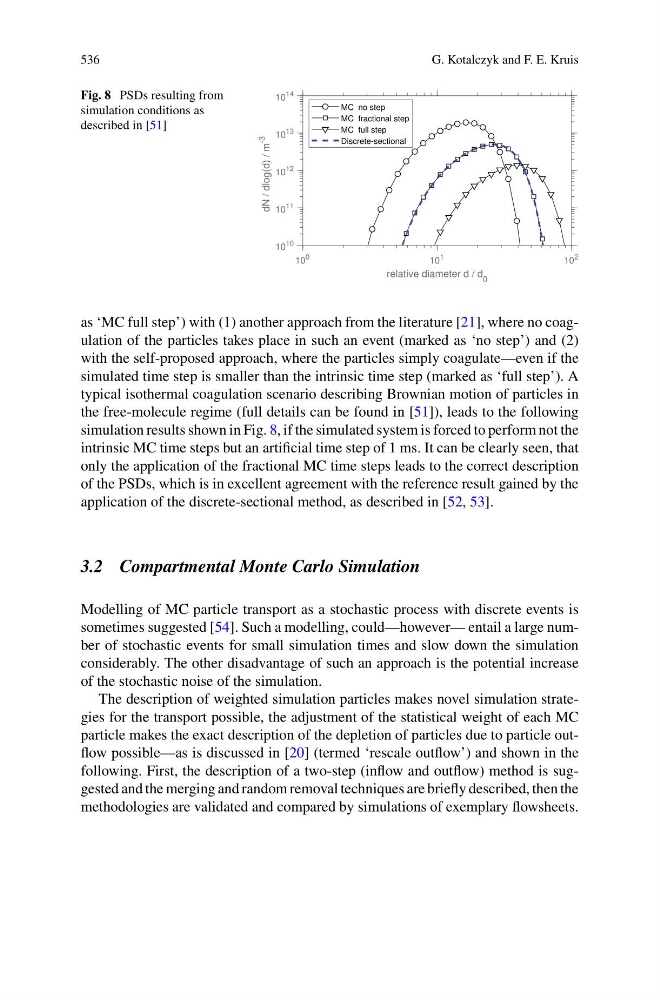
Fig. 8 PSDs resulting from
simulation conditions as
described in [51]
as ‘MC full step’) with (1) another approach from the literature [21], where no coagulation of the particles takes place in such an event (marked as ‘no step’) and (2)
with the self-proposed approach, where the particles simply coagulate—even if the
simulated time step is smaller than the intrinsic time step (marked as ‘full step’). A
typical isothermal coagulation scenario describing Brownian motion of particles in
the free-molecule regime (full details can be found in [51]), leads to the following
simulation results shown in Fig. 8, if the simulated system is forced to perform not the
intrinsic MC time steps but an artificial time step of 1 ms. It can be clearly seen, that
only the application of the fractional MC time steps leads to the correct description
of the PSDs, which is in excellent agreement with the reference result gained by the
application of the discrete-sectional method, as described in [52, 53].
3.2 Compartmental Monte Carlo Simulation
Modelling of MC particle transport as a stochastic process with discrete events is
sometimes suggested [54]. Such a modelling, could—however— entail a large number of stochastic events for small simulation times and slow down the simulation
considerably. The other disadvantage of such an approach is the potential increase
of the stochastic noise of the simulation.
The description of weighted simulation particles makes novel simulation strategies for the transport possible, the adjustment of the statistical weight of each MC
particle makes the exact description of the depletion of particles due to particle outflow possible—as is discussed in [20] (termed ‘rescale outflow’) and shown in the
following. First, the description of a two-step (inflow and outflow) method is suggested and the merging and random removal techniques are briefly described, then the
methodologies are validated and compared by simulations of exemplary flowsheets.
G. Kotalczyk and F. E. Kruis
Fig. 8 PSDs resulting from
simulation conditions as
described in [51]
as ‘MC full step’) with (1) another approach from the literature [21], where no coagulation of the particles takes place in such an event (marked as ‘no step’) and (2)
with the self-proposed approach, where the particles simply coagulate—even if the
simulated time step is smaller than the intrinsic time step (marked as ‘full step’). A
typical isothermal coagulation scenario describing Brownian motion of particles in
the free-molecule regime (full details can be found in [51]), leads to the following
simulation results shown in Fig. 8, if the simulated system is forced to perform not the
intrinsic MC time steps but an artificial time step of 1 ms. It can be clearly seen, that
only the application of the fractional MC time steps leads to the correct description
of the PSDs, which is in excellent agreement with the reference result gained by the
application of the discrete-sectional method, as described in [52, 53].
3.2 Compartmental Monte Carlo Simulation
Modelling of MC particle transport as a stochastic process with discrete events is
sometimes suggested [54]. Such a modelling, could—however— entail a large number of stochastic events for small simulation times and slow down the simulation
considerably. The other disadvantage of such an approach is the potential increase
of the stochastic noise of the simulation.
The description of weighted simulation particles makes novel simulation strategies for the transport possible, the adjustment of the statistical weight of each MC
particle makes the exact description of the depletion of particles due to particle outflow possible—as is discussed in [20] (termed ‘rescale outflow’) and shown in the
following. First, the description of a two-step (inflow and outflow) method is suggested and the merging and random removal techniques are briefly described, then the
methodologies are validated and compared by simulations of exemplary flowsheets.