

522
G. Kotalczyk and F. E. Kruis
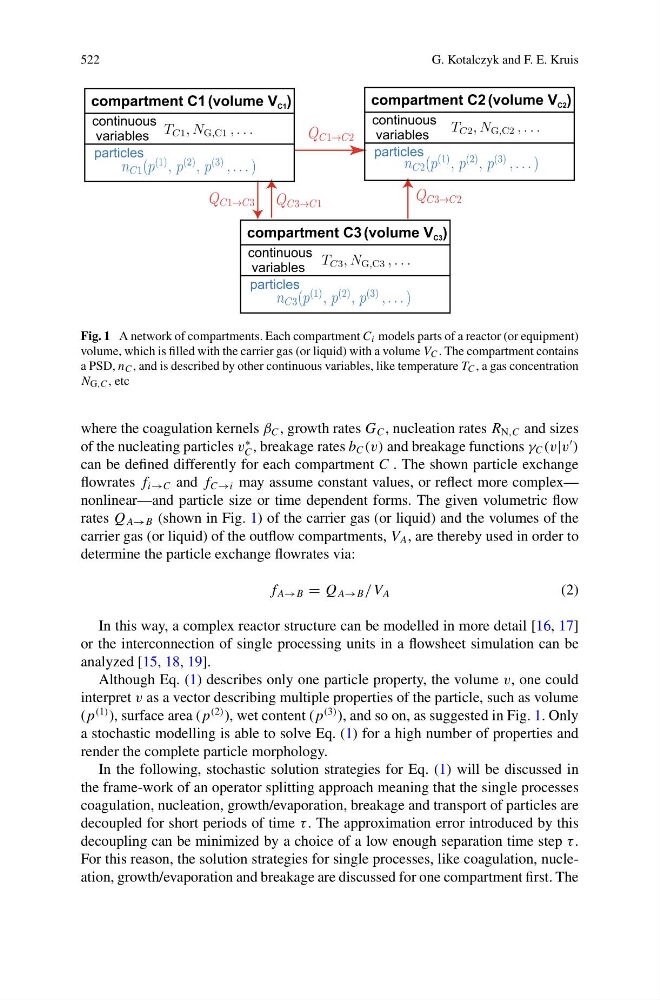
Fig. 1 A network of compartments. Each compartment C i models parts of a reactor (or equipment)
volume, which is filled with the carrier gas (or liquid) with a volume V C . The compartment contains
a PSD, n C , and is described by other continuous variables, like temperature T C , a gas concentration
N G,C , etc
where the coagulation kernels β C , growth rates G C , nucleation rates R N,C and sizes
of the nucleating particles v
∗
C , breakage rates b C (v) and breakage functions γ C (v|v
)
can be defined differently for each compartment C . The shown particle exchange
flowrates f i→C and f C→i may assume constant values, or reflect more complex—
nonlinear—and particle size or time dependent forms. The given volumetric flow
rates Q A→B (shown in Fig. 1) of the carrier gas (or liquid) and the volumes of the
carrier gas (or liquid) of the outflow compartments, V A , are thereby used in order to
determine the particle exchange flowrates via:
f A→B = Q A→B /V A
(2)
In this way, a complex reactor structure can be modelled in more detail [16, 17]
or the interconnection of single processing units in a flowsheet simulation can be
analyzed [15, 18, 19].
Although Eq. (1) describes only one particle property, the volume v, one could
interpret v as a vector describing multiple properties of the particle, such as volume
( p
(1) ), surface area ( p
(2) ), wet content ( p
(3) ), and so on, as suggested in Fig. 1. Only
a stochastic modelling is able to solve Eq. (1) for a high number of properties and
render the complete particle morphology.
In the following, stochastic solution strategies for Eq. (1) will be discussed in
the frame-work of an operator splitting approach meaning that the single processes
coagulation, nucleation, growth/evaporation, breakage and transport of particles are
decoupled for short periods of time τ . The approximation error introduced by this
decoupling can be minimized by a choice of a low enough separation time step τ .
For this reason, the solution strategies for single processes, like coagulation, nucleation, growth/evaporation and breakage are discussed for one compartment first. The
G. Kotalczyk and F. E. Kruis
Fig. 1 A network of compartments. Each compartment C i models parts of a reactor (or equipment)
volume, which is filled with the carrier gas (or liquid) with a volume V C . The compartment contains
a PSD, n C , and is described by other continuous variables, like temperature T C , a gas concentration
N G,C , etc
where the coagulation kernels β C , growth rates G C , nucleation rates R N,C and sizes
of the nucleating particles v
∗
C , breakage rates b C (v) and breakage functions γ C (v|v
)
can be defined differently for each compartment C . The shown particle exchange
flowrates f i→C and f C→i may assume constant values, or reflect more complex—
nonlinear—and particle size or time dependent forms. The given volumetric flow
rates Q A→B (shown in Fig. 1) of the carrier gas (or liquid) and the volumes of the
carrier gas (or liquid) of the outflow compartments, V A , are thereby used in order to
determine the particle exchange flowrates via:
f A→B = Q A→B /V A
(2)
In this way, a complex reactor structure can be modelled in more detail [16, 17]
or the interconnection of single processing units in a flowsheet simulation can be
analyzed [15, 18, 19].
Although Eq. (1) describes only one particle property, the volume v, one could
interpret v as a vector describing multiple properties of the particle, such as volume
( p
(1) ), surface area ( p
(2) ), wet content ( p
(3) ), and so on, as suggested in Fig. 1. Only
a stochastic modelling is able to solve Eq. (1) for a high number of properties and
render the complete particle morphology.
In the following, stochastic solution strategies for Eq. (1) will be discussed in
the frame-work of an operator splitting approach meaning that the single processes
coagulation, nucleation, growth/evaporation, breakage and transport of particles are
decoupled for short periods of time τ . The approximation error introduced by this
decoupling can be minimized by a choice of a low enough separation time step τ .
For this reason, the solution strategies for single processes, like coagulation, nucleation, growth/evaporation and breakage are discussed for one compartment first. The