

46
L. Lindmüller et al.
a · u = 2, . . . , 12 for turbulent beds
(7)
In Eq. (5), c v,i,∞ describes the solids concentration above the transport disengagement height, which is calculated from:
c v,i,∞ =
G s,i,∞
ρ s · u
(8)
The solids circulation rate G s,i,∞ for every size fraction i is calculated from an
elutriation rate K i,∞ for each particle class fraction i and the mass of particles in each
respective class Q 3,i :
G s,i,∞ = Q 3,i · K i,∞
(9)
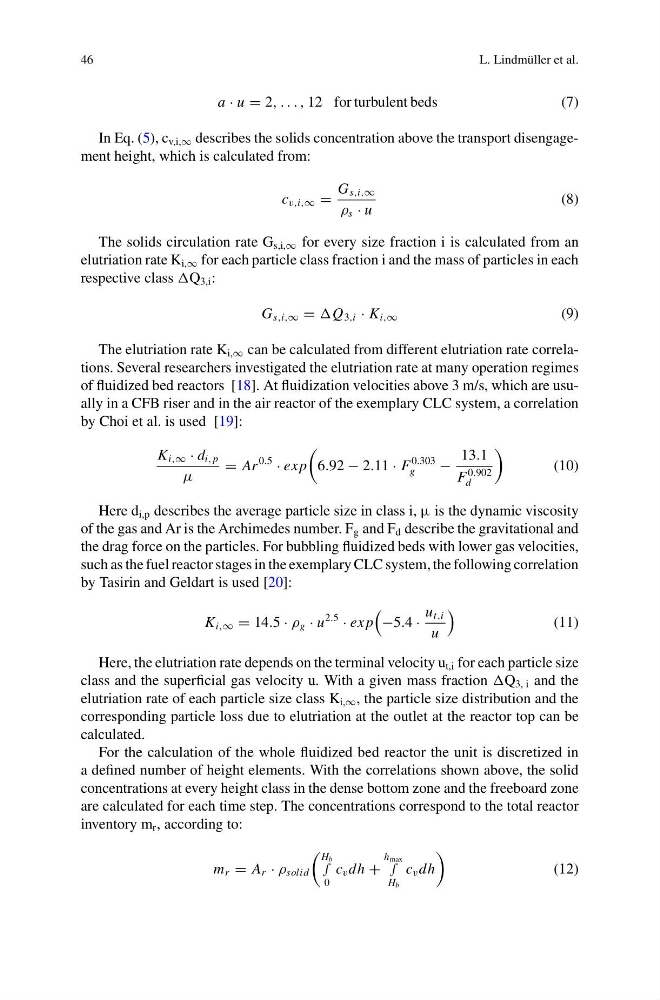
The elutriation rate K i,∞ can be calculated from different elutriation rate correlations. Several researchers investigated the elutriation rate at many operation regimes
of fluidized bed reactors [18]. At fluidization velocities above 3 m/s, which are usually in a CFB riser and in the air reactor of the exemplary CLC system, a correlation
by Choi et al. is used [19]:
K i,∞ · d i, p
μ
= Ar
0.5
· ex p
6.92 − 2.11 · F
0.303
g
−
13.1
F
0.902
d
(10)
Here d i,p describes the average particle size in class i, μ is the dynamic viscosity
of the gas and Ar is the Archimedes number. F g and F d describe the gravitational and
the drag force on the particles. For bubbling fluidized beds with lower gas velocities,
such as the fuel reactor stages in the exemplary CLC system, the following correlation
by Tasirin and Geldart is used [20]:
K i,∞ = 14.5 · ρ g · u
2.5
· ex p
−5.4 ·
u t,i
u
(11)
Here, the elutriation rate depends on the terminal velocity u t,i for each particle size
class and the superficial gas velocity u. With a given mass fraction Q 3, i and the
elutriation rate of each particle size class K i,∞ , the particle size distribution and the
corresponding particle loss due to elutriation at the outlet at the reactor top can be
calculated.
For the calculation of the whole fluidized bed reactor the unit is discretized in
a defined number of height elements. With the correlations shown above, the solid
concentrations at every height class in the dense bottom zone and the freeboard zone
are calculated for each time step. The concentrations correspond to the total reactor
inventory m r , according to:
m r = A r · ρ solid
H b
∫
0
c v dh +
h max
∫
H b
c v dh
(12)
L. Lindmüller et al.
a · u = 2, . . . , 12 for turbulent beds
(7)
In Eq. (5), c v,i,∞ describes the solids concentration above the transport disengagement height, which is calculated from:
c v,i,∞ =
G s,i,∞
ρ s · u
(8)
The solids circulation rate G s,i,∞ for every size fraction i is calculated from an
elutriation rate K i,∞ for each particle class fraction i and the mass of particles in each
respective class Q 3,i :
G s,i,∞ = Q 3,i · K i,∞
(9)
The elutriation rate K i,∞ can be calculated from different elutriation rate correlations. Several researchers investigated the elutriation rate at many operation regimes
of fluidized bed reactors [18]. At fluidization velocities above 3 m/s, which are usually in a CFB riser and in the air reactor of the exemplary CLC system, a correlation
by Choi et al. is used [19]:
K i,∞ · d i, p
μ
= Ar
0.5
· ex p
6.92 − 2.11 · F
0.303
g
−
13.1
F
0.902
d
(10)
Here d i,p describes the average particle size in class i, μ is the dynamic viscosity
of the gas and Ar is the Archimedes number. F g and F d describe the gravitational and
the drag force on the particles. For bubbling fluidized beds with lower gas velocities,
such as the fuel reactor stages in the exemplary CLC system, the following correlation
by Tasirin and Geldart is used [20]:
K i,∞ = 14.5 · ρ g · u
2.5
· ex p
−5.4 ·
u t,i
u
(11)
Here, the elutriation rate depends on the terminal velocity u t,i for each particle size
class and the superficial gas velocity u. With a given mass fraction Q 3, i and the
elutriation rate of each particle size class K i,∞ , the particle size distribution and the
corresponding particle loss due to elutriation at the outlet at the reactor top can be
calculated.
For the calculation of the whole fluidized bed reactor the unit is discretized in
a defined number of height elements. With the correlations shown above, the solid
concentrations at every height class in the dense bottom zone and the freeboard zone
are calculated for each time step. The concentrations correspond to the total reactor
inventory m r , according to:
m r = A r · ρ solid
H b
∫
0
c v dh +
h max
∫
H b
c v dh
(12)