

500
R. Ahrens et al.
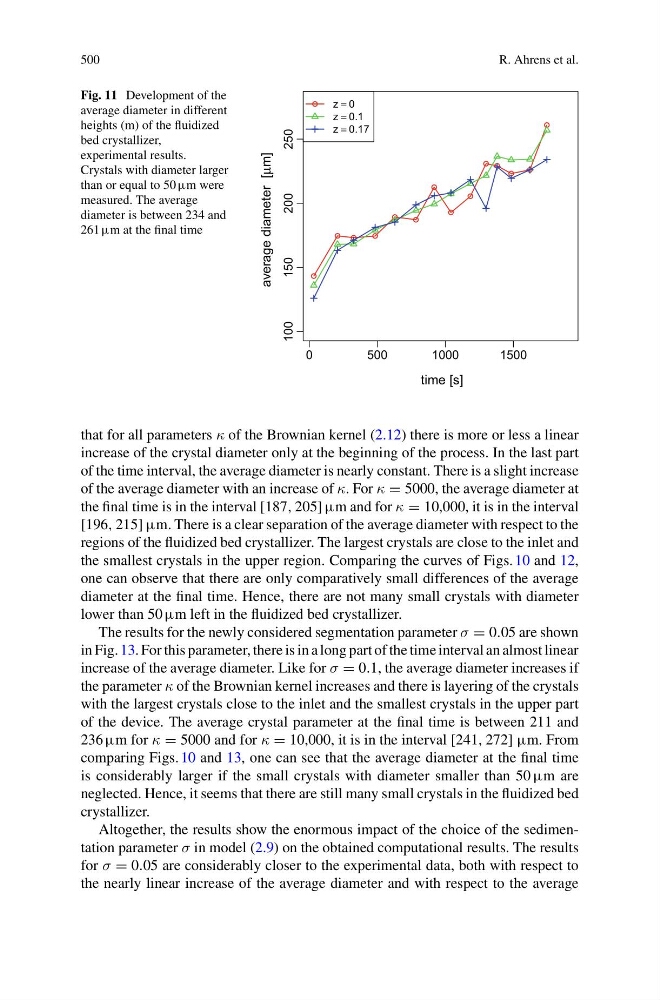
Fig. 11 Development of the
average diameter in different
heights (m) of the fluidized
bed crystallizer,
experimental results.
Crystals with diameter larger
than or equal to 50 μm were
measured. The average
diameter is between 234 and
261 μm at the final time
0
500
1000
1500
100
150
200
250
time [s]
average diameter [μm]
●
z = 0
z = 0.1
z = 0.17
●
●
●
●
●
●
●
●
●
● ●
●
●
●
that for all parameters κ of the Brownian kernel (2.12) there is more or less a linear
increase of the crystal diameter only at the beginning of the process. In the last part
of the time interval, the average diameter is nearly constant. There is a slight increase
of the average diameter with an increase of κ. For κ = 5000, the average diameter at
the final time is in the interval [187, 205] μm and for κ = 10,000, it is in the interval
[196, 215] μm. There is a clear separation of the average diameter with respect to the
regions of the fluidized bed crystallizer. The largest crystals are close to the inlet and
the smallest crystals in the upper region. Comparing the curves of Figs. 10 and 12,
one can observe that there are only comparatively small differences of the average
diameter at the final time. Hence, there are not many small crystals with diameter
lower than 50 μm left in the fluidized bed crystallizer.
The results for the newly considered segmentation parameter σ = 0.05 are shown
in Fig. 13. For this parameter, there is in a long part of the time interval an almost linear
increase of the average diameter. Like for σ = 0.1, the average diameter increases if
the parameter κ of the Brownian kernel increases and there is layering of the crystals
with the largest crystals close to the inlet and the smallest crystals in the upper part
of the device. The average crystal parameter at the final time is between 211 and
236 μm for κ = 5000 and for κ = 10,000, it is in the interval [241, 272] μm. From
comparing Figs. 10 and 13, one can see that the average diameter at the final time
is considerably larger if the small crystals with diameter smaller than 50 μm are
neglected. Hence, it seems that there are still many small crystals in the fluidized bed
crystallizer.
Altogether, the results show the enormous impact of the choice of the sedimentation parameter σ in model (2.9) on the obtained computational results. The results
for σ = 0.05 are considerably closer to the experimental data, both with respect to
the nearly linear increase of the average diameter and with respect to the average
R. Ahrens et al.
Fig. 11 Development of the
average diameter in different
heights (m) of the fluidized
bed crystallizer,
experimental results.
Crystals with diameter larger
than or equal to 50 μm were
measured. The average
diameter is between 234 and
261 μm at the final time
0
500
1000
1500
100
150
200
250
time [s]
average diameter [μm]
●
z = 0
z = 0.1
z = 0.17
●
●
●
●
●
●
●
●
●
● ●
●
●
●
that for all parameters κ of the Brownian kernel (2.12) there is more or less a linear
increase of the crystal diameter only at the beginning of the process. In the last part
of the time interval, the average diameter is nearly constant. There is a slight increase
of the average diameter with an increase of κ. For κ = 5000, the average diameter at
the final time is in the interval [187, 205] μm and for κ = 10,000, it is in the interval
[196, 215] μm. There is a clear separation of the average diameter with respect to the
regions of the fluidized bed crystallizer. The largest crystals are close to the inlet and
the smallest crystals in the upper region. Comparing the curves of Figs. 10 and 12,
one can observe that there are only comparatively small differences of the average
diameter at the final time. Hence, there are not many small crystals with diameter
lower than 50 μm left in the fluidized bed crystallizer.
The results for the newly considered segmentation parameter σ = 0.05 are shown
in Fig. 13. For this parameter, there is in a long part of the time interval an almost linear
increase of the average diameter. Like for σ = 0.1, the average diameter increases if
the parameter κ of the Brownian kernel increases and there is layering of the crystals
with the largest crystals close to the inlet and the smallest crystals in the upper part
of the device. The average crystal parameter at the final time is between 211 and
236 μm for κ = 5000 and for κ = 10,000, it is in the interval [241, 272] μm. From
comparing Figs. 10 and 13, one can see that the average diameter at the final time
is considerably larger if the small crystals with diameter smaller than 50 μm are
neglected. Hence, it seems that there are still many small crystals in the fluidized bed
crystallizer.
Altogether, the results show the enormous impact of the choice of the sedimentation parameter σ in model (2.9) on the obtained computational results. The results
for σ = 0.05 are considerably closer to the experimental data, both with respect to
the nearly linear increase of the average diameter and with respect to the average