

498
R. Ahrens et al.
For the sedimentation, the model (2.9) was utilized. A brief numerical study in [6]
showed that one has to choose the scaling factor in this model rather small. Otherwise,
too many crystals would leave through the inlet of the domain due to sedimentation,
compare Sect. 2.4.1. In [6], σ = 0.1 was used. In this section, also results obtained
with σ = 0.05 are presented to continue the study with respect to the scaling factor.
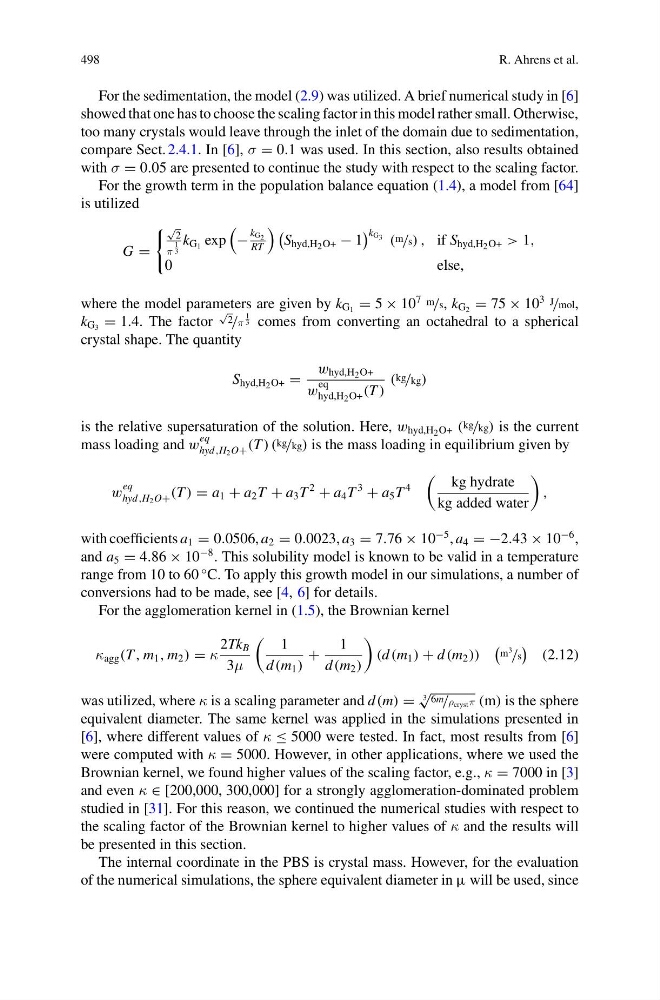
For the growth term in the population balance equation (1.4), a model from [64]
is utilized
G =
√
2
π
1
3
k G 1 exp
−
k G 2
RT
S hyd,H 2 O+ − 1
k G 3 ( m /s) , if S hyd,H 2 O+ > 1,
0
e l s e ,
where the model parameters are given by k G 1 = 5 × 10
7 m /s, k G 2 = 75 × 10
3 J /mol,
k G 3 = 1.4. The factor
√
2 /π
1
3 comes from converting an octahedral to a spherical
crystal shape. The quantity
S hyd,H 2 O+ =
w hyd,H 2 O+
w
eq
hyd,H 2 O+ (T )
( kg /kg)
is the relative supersaturation of the solution. Here, w hyd,H 2 O+ ( kg /kg) is the current
mass loading and w
eq
hyd ,H 2 O+ (T ) ( kg /kg) is the mass loading in equilibrium given by
w
eq
hyd ,H 2 O+ (T ) = a 1 + a 2 T + a 3 T
2
+ a 4 T
3
+ a 5 T
4
kg hydrate
kg added water
,
with coefficients a 1 = 0.0506, a 2 = 0.0023, a 3 = 7.76 × 10
−5 , a 4 = −2.43 × 10
−6 ,
and a 5 = 4.86 × 10
−8 . This solubility model is known to be valid in a temperature
range from 10 to 60
◦ C. To apply this growth model in our simulations, a number of
conversions had to be made, see [4, 6] for details.
For the agglomeration kernel in (1.5), the Brownian kernel
κ agg (T , m 1 , m 2 ) = κ
2Tk B
3μ
1
d (m 1 )
+
1
d (m 2 )
(d (m 1 ) + d (m 2 ))
m
3
/s
(2.12)
was utilized, where κ is a scaling parameter and d (m) =
3
√
6m /ρ cryst π (m) is the sphere
equivalent diameter. The same kernel was applied in the simulations presented in
[6], where different values of κ ≤ 5000 were tested. In fact, most results from [6]
were computed with κ = 5000. However, in other applications, where we used the
Brownian kernel, we found higher values of the scaling factor, e.g., κ = 7000 in [3]
and even κ ∈ [200,000, 300,000] for a strongly agglomeration-dominated problem
studied in [31]. For this reason, we continued the numerical studies with respect to
the scaling factor of the Brownian kernel to higher values of κ and the results will
be presented in this section.
The internal coordinate in the PBS is crystal mass. However, for the evaluation
of the numerical simulations, the sphere equivalent diameter in μ will be used, since
R. Ahrens et al.
For the sedimentation, the model (2.9) was utilized. A brief numerical study in [6]
showed that one has to choose the scaling factor in this model rather small. Otherwise,
too many crystals would leave through the inlet of the domain due to sedimentation,
compare Sect. 2.4.1. In [6], σ = 0.1 was used. In this section, also results obtained
with σ = 0.05 are presented to continue the study with respect to the scaling factor.
For the growth term in the population balance equation (1.4), a model from [64]
is utilized
G =
√
2
π
1
3
k G 1 exp
−
k G 2
RT
S hyd,H 2 O+ − 1
k G 3 ( m /s) , if S hyd,H 2 O+ > 1,
0
e l s e ,
where the model parameters are given by k G 1 = 5 × 10
7 m /s, k G 2 = 75 × 10
3 J /mol,
k G 3 = 1.4. The factor
√
2 /π
1
3 comes from converting an octahedral to a spherical
crystal shape. The quantity
S hyd,H 2 O+ =
w hyd,H 2 O+
w
eq
hyd,H 2 O+ (T )
( kg /kg)
is the relative supersaturation of the solution. Here, w hyd,H 2 O+ ( kg /kg) is the current
mass loading and w
eq
hyd ,H 2 O+ (T ) ( kg /kg) is the mass loading in equilibrium given by
w
eq
hyd ,H 2 O+ (T ) = a 1 + a 2 T + a 3 T
2
+ a 4 T
3
+ a 5 T
4
kg hydrate
kg added water
,
with coefficients a 1 = 0.0506, a 2 = 0.0023, a 3 = 7.76 × 10
−5 , a 4 = −2.43 × 10
−6 ,
and a 5 = 4.86 × 10
−8 . This solubility model is known to be valid in a temperature
range from 10 to 60
◦ C. To apply this growth model in our simulations, a number of
conversions had to be made, see [4, 6] for details.
For the agglomeration kernel in (1.5), the Brownian kernel
κ agg (T , m 1 , m 2 ) = κ
2Tk B
3μ
1
d (m 1 )
+
1
d (m 2 )
(d (m 1 ) + d (m 2 ))
m
3
/s
(2.12)
was utilized, where κ is a scaling parameter and d (m) =
3
√
6m /ρ cryst π (m) is the sphere
equivalent diameter. The same kernel was applied in the simulations presented in
[6], where different values of κ ≤ 5000 were tested. In fact, most results from [6]
were computed with κ = 5000. However, in other applications, where we used the
Brownian kernel, we found higher values of the scaling factor, e.g., κ = 7000 in [3]
and even κ ∈ [200,000, 300,000] for a strongly agglomeration-dominated problem
studied in [31]. For this reason, we continued the numerical studies with respect to
the scaling factor of the Brownian kernel to higher values of κ and the results will
be presented in this section.
The internal coordinate in the PBS is crystal mass. However, for the evaluation
of the numerical simulations, the sphere equivalent diameter in μ will be used, since