

14 Numerical Methods for Coupled Population Balance Systems …
493
START
Compute velocity field
Interpolate data from SPS code
Compute temperature and concentration
CFD
Transport of crystals
Assign crystals to cells
Perform Markov jumps in each cell separately
SPS
t ← t + Δt
t < tstop
END
Assign interpolated CFD
data to SPS code
No
Yes
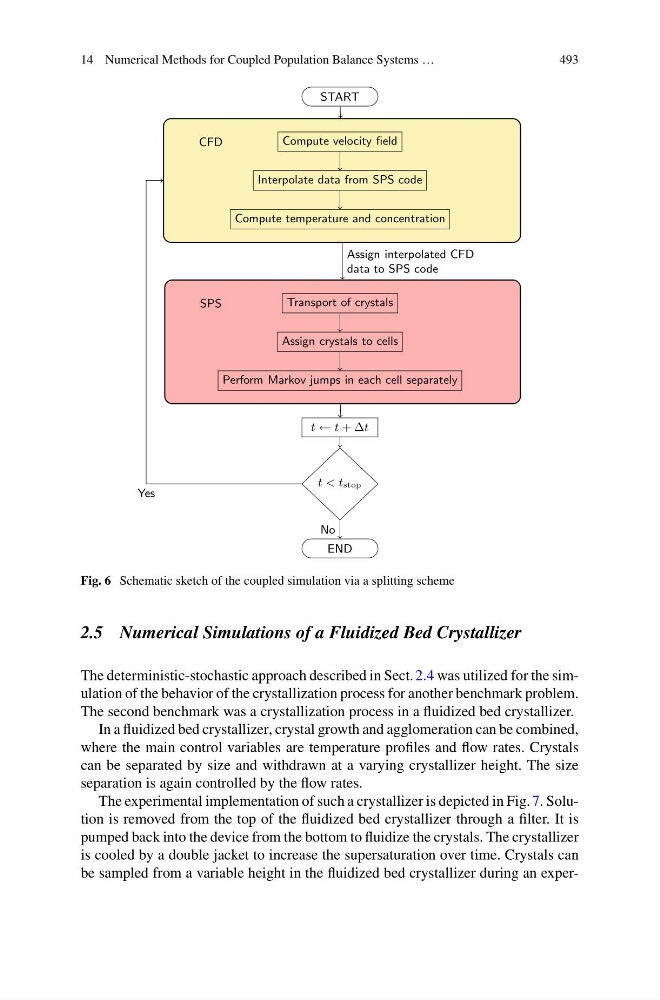
Fig. 6 Schematic sketch of the coupled simulation via a splitting scheme
2.5 Numerical Simulations of a Fluidized Bed Crystallizer
The deterministic-stochastic approach described in Sect. 2.4 was utilized for the simulation of the behavior of the crystallization process for another benchmark problem.
The second benchmark was a crystallization process in a fluidized bed crystallizer.
In a fluidized bed crystallizer, crystal growth and agglomeration can be combined,
where the main control variables are temperature profiles and flow rates. Crystals
can be separated by size and withdrawn at a varying crystallizer height. The size
separation is again controlled by the flow rates.
The experimental implementation of such a crystallizer is depicted in Fig. 7. Solution is removed from the top of the fluidized bed crystallizer through a filter. It is
pumped back into the device from the bottom to fluidize the crystals. The crystallizer
is cooled by a double jacket to increase the supersaturation over time. Crystals can
be sampled from a variable height in the fluidized bed crystallizer during an exper-
493
START
Compute velocity field
Interpolate data from SPS code
Compute temperature and concentration
CFD
Transport of crystals
Assign crystals to cells
Perform Markov jumps in each cell separately
SPS
t ← t + Δt
t < tstop
END
Assign interpolated CFD
data to SPS code
No
Yes
Fig. 6 Schematic sketch of the coupled simulation via a splitting scheme
2.5 Numerical Simulations of a Fluidized Bed Crystallizer
The deterministic-stochastic approach described in Sect. 2.4 was utilized for the simulation of the behavior of the crystallization process for another benchmark problem.
The second benchmark was a crystallization process in a fluidized bed crystallizer.
In a fluidized bed crystallizer, crystal growth and agglomeration can be combined,
where the main control variables are temperature profiles and flow rates. Crystals
can be separated by size and withdrawn at a varying crystallizer height. The size
separation is again controlled by the flow rates.
The experimental implementation of such a crystallizer is depicted in Fig. 7. Solution is removed from the top of the fluidized bed crystallizer through a filter. It is
pumped back into the device from the bottom to fluidize the crystals. The crystallizer
is cooled by a double jacket to increase the supersaturation over time. Crystals can
be sampled from a variable height in the fluidized bed crystallizer during an exper-