

482
R. Ahrens et al.
Numerically, the solution of the full model of the form (1.1)–(1.6) is expensive due
to the mutual coupling of the equations. Hence, the model is reduced and assumptions
are made for a dynamic simulation with reasonable computation times:
(a) It is assumed that the energy balance (1.2) can be neglected when a temperature
profile is given.
(b) The momentum balance (1.1) is neglected.
(c) Only one spatial coordinate is considered, which is the z-coordinate along the
tube axis.
(d) A low suspension density and moderate cooling are applied experimentally to
suppress nucleation, breakage, and agglomeration.
(e) Crystal growth is size-independent.
The reduced population balance equation (PBE) is
∂ t f + u · ∇f + G(c, T )∇ int · f = 0 in (0, t end ) × Ω × Ω int .
(2.1)
For the continuous phase, there are two balance equations, since potash alum crystallizes as dodecahydrate under consumption of water from the solution. The diffusion
term in (1.3) is replaced by a dispersion term of the same structure, but of a different
value for the coefficient D c . The crystal growth rate depends on the supersaturation of the continuous phase and thereby on the local temperature T (t, z). The local
temperature can be set by external cooling and it can vary dynamically.
The reduced PBS consisting of (1.3) and (2.1) was discretized in space z and in
the internal size coordinate x via a finite volume method. The derived differential
algebraic equation system was solved with the Matlab-ode23 solver, which is
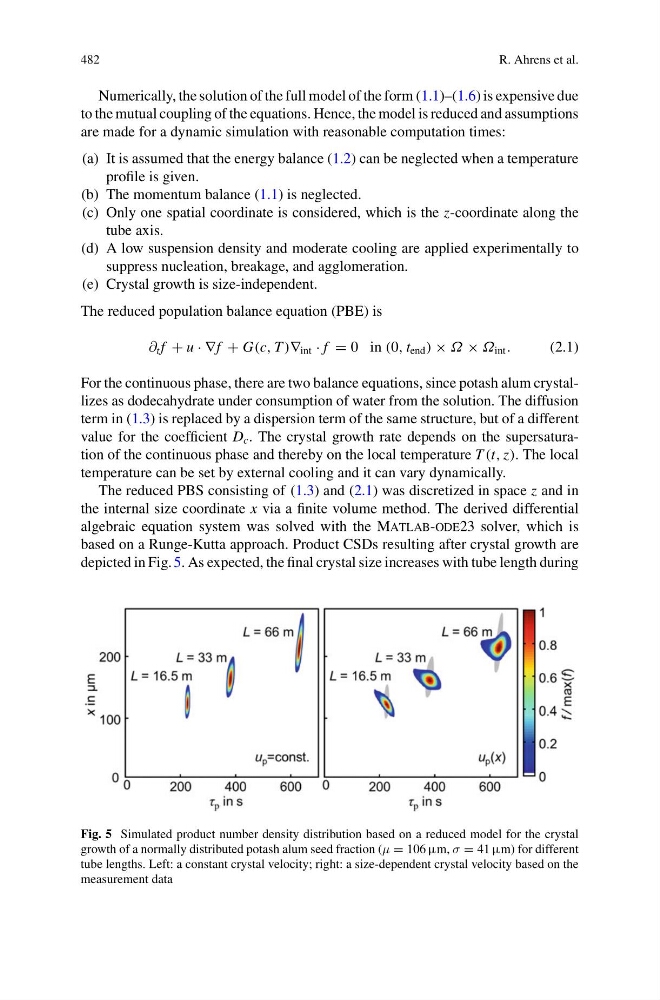
based on a Runge-Kutta approach. Product CSDs resulting after crystal growth are
depicted in Fig. 5. As expected, the final crystal size increases with tube length during
Fig. 5 Simulated product number density distribution based on a reduced model for the crystal
growth of a normally distributed potash alum seed fraction (μ = 106 μm, σ = 41 μm) for different
tube lengths. Left: a constant crystal velocity; right: a size-dependent crystal velocity based on the
measurement data
R. Ahrens et al.
Numerically, the solution of the full model of the form (1.1)–(1.6) is expensive due
to the mutual coupling of the equations. Hence, the model is reduced and assumptions
are made for a dynamic simulation with reasonable computation times:
(a) It is assumed that the energy balance (1.2) can be neglected when a temperature
profile is given.
(b) The momentum balance (1.1) is neglected.
(c) Only one spatial coordinate is considered, which is the z-coordinate along the
tube axis.
(d) A low suspension density and moderate cooling are applied experimentally to
suppress nucleation, breakage, and agglomeration.
(e) Crystal growth is size-independent.
The reduced population balance equation (PBE) is
∂ t f + u · ∇f + G(c, T )∇ int · f = 0 in (0, t end ) × Ω × Ω int .
(2.1)
For the continuous phase, there are two balance equations, since potash alum crystallizes as dodecahydrate under consumption of water from the solution. The diffusion
term in (1.3) is replaced by a dispersion term of the same structure, but of a different
value for the coefficient D c . The crystal growth rate depends on the supersaturation of the continuous phase and thereby on the local temperature T (t, z). The local
temperature can be set by external cooling and it can vary dynamically.
The reduced PBS consisting of (1.3) and (2.1) was discretized in space z and in
the internal size coordinate x via a finite volume method. The derived differential
algebraic equation system was solved with the Matlab-ode23 solver, which is
based on a Runge-Kutta approach. Product CSDs resulting after crystal growth are
depicted in Fig. 5. As expected, the final crystal size increases with tube length during
Fig. 5 Simulated product number density distribution based on a reduced model for the crystal
growth of a normally distributed potash alum seed fraction (μ = 106 μm, σ = 41 μm) for different
tube lengths. Left: a constant crystal velocity; right: a size-dependent crystal velocity based on the
measurement data