

14 Numerical Methods for Coupled Population Balance Systems …
481
the measured sizes, it can be assumed that very small crystals follow the fluid flow,
as shown in Fig. 2.
The crystal residence time depends on the process parameters. Crystallization
experiments in HCTs show that crystals of different size have different velocities in
HCTs. Large crystals are faster than small crystals. Size-dependent residence times
can be used to separate crystals of certain sizes in batch or periodic operation.
2.2.3 Crystal Growth
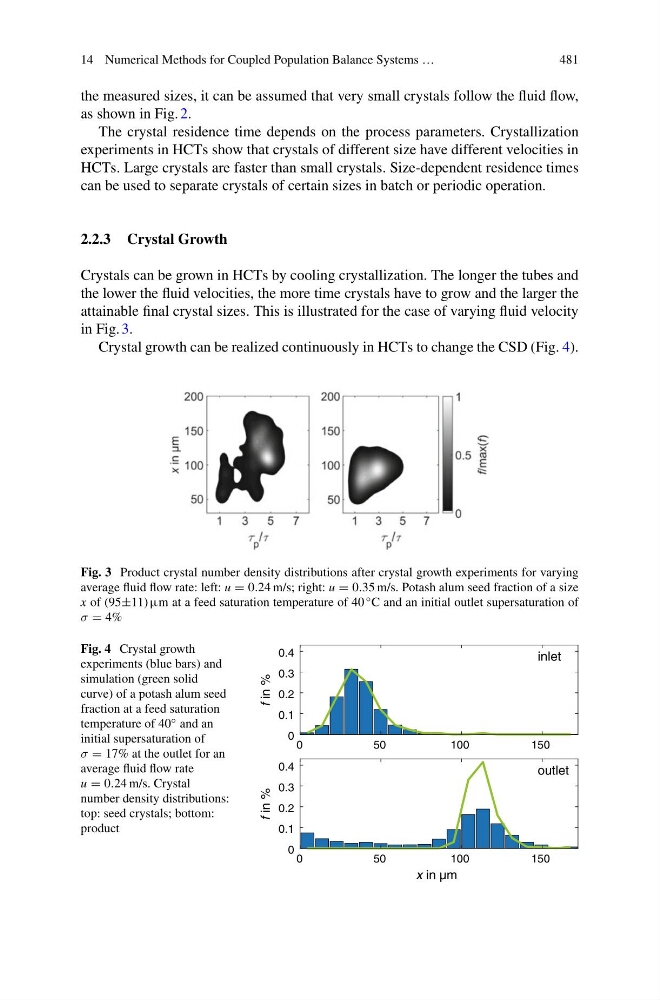
Crystals can be grown in HCTs by cooling crystallization. The longer the tubes and
the lower the fluid velocities, the more time crystals have to grow and the larger the
attainable final crystal sizes. This is illustrated for the case of varying fluid velocity
in Fig. 3.
Crystal growth can be realized continuously in HCTs to change the CSD (Fig. 4).
Fig. 3 Product crystal number density distributions after crystal growth experiments for varying
average fluid flow rate: left: u = 0.24 m/s; right: u = 0.35 m/s. Potash alum seed fraction of a size
x of (95±11) μm at a feed saturation temperature of 40 ◦ C and an initial outlet supersaturation of
σ = 4%
Fig. 4 Crystal growth
experiments (blue bars) and
simulation (green solid
curve) of a potash alum seed
fraction at a feed saturation
temperature of 40 ◦ and an
initial supersaturation of
σ = 17% at the outlet for an
average fluid flow rate
u = 0.24 m/s. Crystal
number density distributions:
top: seed crystals; bottom:
product
inlet
0
50
100
150
0
0.1
0.2
0.3
0.4
f in %
outlet
0
50
100
150
x in µm
0
0.1
0.2
0.3
0.4
f in %
481
the measured sizes, it can be assumed that very small crystals follow the fluid flow,
as shown in Fig. 2.
The crystal residence time depends on the process parameters. Crystallization
experiments in HCTs show that crystals of different size have different velocities in
HCTs. Large crystals are faster than small crystals. Size-dependent residence times
can be used to separate crystals of certain sizes in batch or periodic operation.
2.2.3 Crystal Growth
Crystals can be grown in HCTs by cooling crystallization. The longer the tubes and
the lower the fluid velocities, the more time crystals have to grow and the larger the
attainable final crystal sizes. This is illustrated for the case of varying fluid velocity
in Fig. 3.
Crystal growth can be realized continuously in HCTs to change the CSD (Fig. 4).
Fig. 3 Product crystal number density distributions after crystal growth experiments for varying
average fluid flow rate: left: u = 0.24 m/s; right: u = 0.35 m/s. Potash alum seed fraction of a size
x of (95±11) μm at a feed saturation temperature of 40 ◦ C and an initial outlet supersaturation of
σ = 4%
Fig. 4 Crystal growth
experiments (blue bars) and
simulation (green solid
curve) of a potash alum seed
fraction at a feed saturation
temperature of 40 ◦ and an
initial supersaturation of
σ = 17% at the outlet for an
average fluid flow rate
u = 0.24 m/s. Crystal
number density distributions:
top: seed crystals; bottom:
product
inlet
0
50
100
150
0
0.1
0.2
0.3
0.4
f in %
outlet
0
50
100
150
x in µm
0
0.1
0.2
0.3
0.4
f in %