

462
S. Schiele et al.
With the 2D approach a compromise was made between the complex and simple
approach. A 2D population balance is more complex to solve than a 1D one, but
still leads to a manageable computational effort. The corresponding 2D population
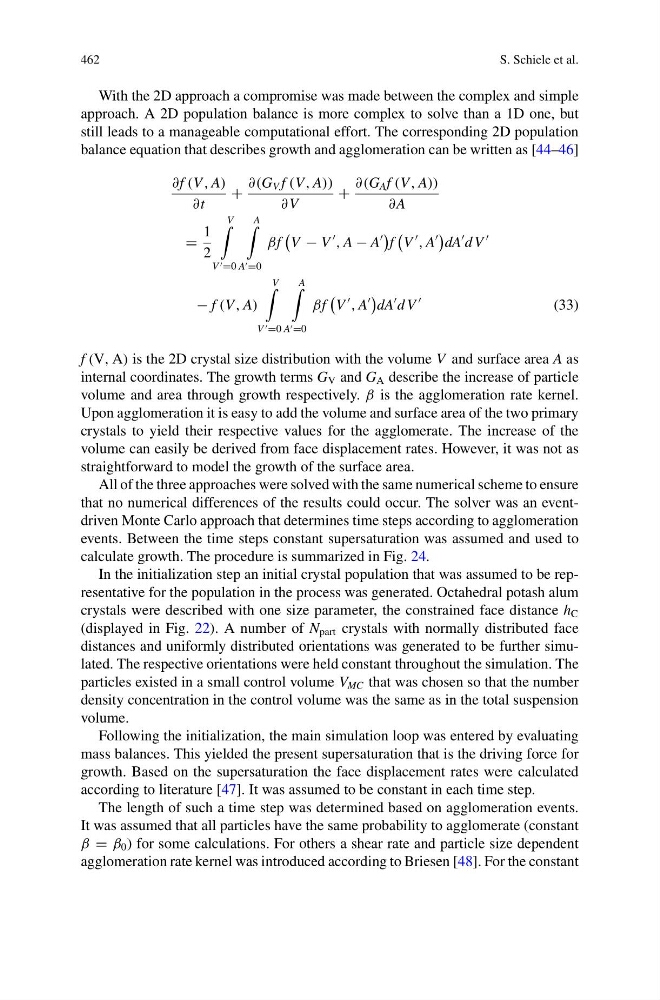
balance equation that describes growth and agglomeration can be written as [44–46]
∂f (V, A)
∂t
+
∂(G V f (V, A))
∂ V
+
∂(G A f (V, A))
∂A
=
1
2
V
V =0
A
A =0
βf
V − V
, A − A
f
V
, A
dA
d V
− f (V, A)
V
V =0
A
A =0
βf
V
, A
dA
d V
(33)
f (V, A) is the 2D crystal size distribution with the volume V and surface area A as
internal coordinates. The growth terms G V and G A describe the increase of particle
volume and area through growth respectively. β is the agglomeration rate kernel.
Upon agglomeration it is easy to add the volume and surface area of the two primary
crystals to yield their respective values for the agglomerate. The increase of the
volume can easily be derived from face displacement rates. However, it was not as
straightforward to model the growth of the surface area.
All of the three approaches were solved with the same numerical scheme to ensure
that no numerical differences of the results could occur. The solver was an eventdriven Monte Carlo approach that determines time steps according to agglomeration
events. Between the time steps constant supersaturation was assumed and used to
calculate growth. The procedure is summarized in Fig. 24.
In the initialization step an initial crystal population that was assumed to be representative for the population in the process was generated. Octahedral potash alum
crystals were described with one size parameter, the constrained face distance h C
(displayed in Fig. 22). A number of N part crystals with normally distributed face
distances and uniformly distributed orientations was generated to be further simulated. The respective orientations were held constant throughout the simulation. The
particles existed in a small control volume V MC that was chosen so that the number
density concentration in the control volume was the same as in the total suspension
volume.
Following the initialization, the main simulation loop was entered by evaluating
mass balances. This yielded the present supersaturation that is the driving force for
growth. Based on the supersaturation the face displacement rates were calculated
according to literature [47]. It was assumed to be constant in each time step.
The length of such a time step was determined based on agglomeration events.
It was assumed that all particles have the same probability to agglomerate (constant
β = β 0 ) for some calculations. For others a shear rate and particle size dependent
agglomeration rate kernel was introduced according to Briesen [48]. For the constant
S. Schiele et al.
With the 2D approach a compromise was made between the complex and simple
approach. A 2D population balance is more complex to solve than a 1D one, but
still leads to a manageable computational effort. The corresponding 2D population
balance equation that describes growth and agglomeration can be written as [44–46]
∂f (V, A)
∂t
+
∂(G V f (V, A))
∂ V
+
∂(G A f (V, A))
∂A
=
1
2
V
V =0
A
A =0
βf
V − V
, A − A
f
V
, A
dA
d V
− f (V, A)
V
V =0
A
A =0
βf
V
, A
dA
d V
(33)
f (V, A) is the 2D crystal size distribution with the volume V and surface area A as
internal coordinates. The growth terms G V and G A describe the increase of particle
volume and area through growth respectively. β is the agglomeration rate kernel.
Upon agglomeration it is easy to add the volume and surface area of the two primary
crystals to yield their respective values for the agglomerate. The increase of the
volume can easily be derived from face displacement rates. However, it was not as
straightforward to model the growth of the surface area.
All of the three approaches were solved with the same numerical scheme to ensure
that no numerical differences of the results could occur. The solver was an eventdriven Monte Carlo approach that determines time steps according to agglomeration
events. Between the time steps constant supersaturation was assumed and used to
calculate growth. The procedure is summarized in Fig. 24.
In the initialization step an initial crystal population that was assumed to be representative for the population in the process was generated. Octahedral potash alum
crystals were described with one size parameter, the constrained face distance h C
(displayed in Fig. 22). A number of N part crystals with normally distributed face
distances and uniformly distributed orientations was generated to be further simulated. The respective orientations were held constant throughout the simulation. The
particles existed in a small control volume V MC that was chosen so that the number
density concentration in the control volume was the same as in the total suspension
volume.
Following the initialization, the main simulation loop was entered by evaluating
mass balances. This yielded the present supersaturation that is the driving force for
growth. Based on the supersaturation the face displacement rates were calculated
according to literature [47]. It was assumed to be constant in each time step.
The length of such a time step was determined based on agglomeration events.
It was assumed that all particles have the same probability to agglomerate (constant
β = β 0 ) for some calculations. For others a shear rate and particle size dependent
agglomeration rate kernel was introduced according to Briesen [48]. For the constant