

458
S. Schiele et al.
Even though only growth was considered in this model equation, its solution is not
trivial.
Because growth rates depend on the supersaturation which is again dependent on
the volume of the crystals, a solution of the problem involved the evaluation of the
integral for the total volume of the population. The integral for the volume can be
generalized for any geometric property of the crystals μ and can be written as
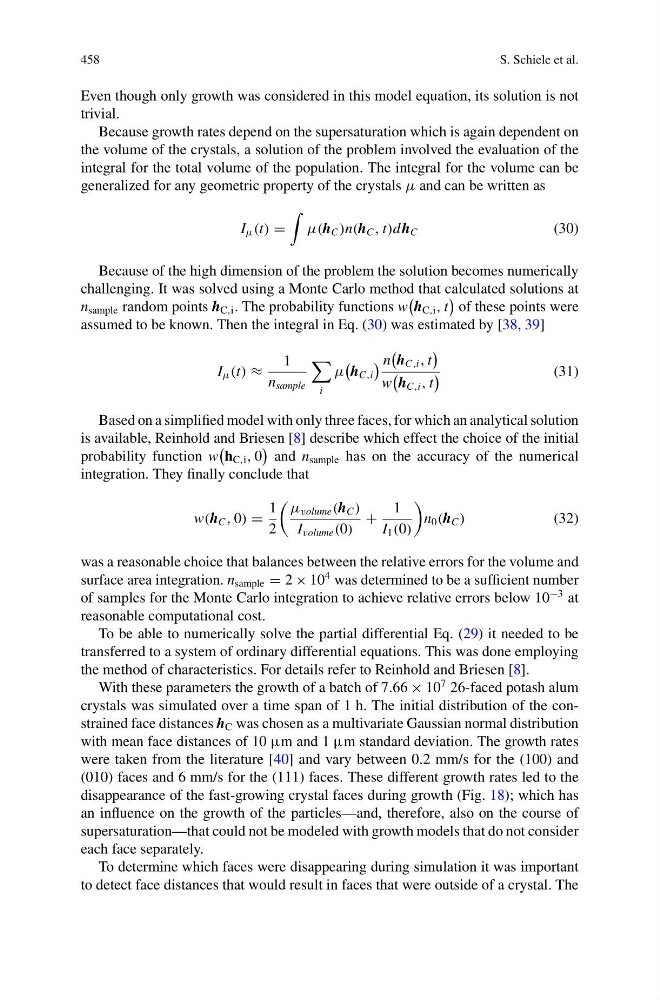
I μ (t) =
μ(h C )n(h C , t)d h C
(30)
Because of the high dimension of the problem the solution becomes numerically
challenging. It was solved using a Monte Carlo method that calculated solutions at
n sample random points h C,i . The probability functions w
h C,i , t
of these points were
assumed to be known. Then the integral in Eq. (30) was estimated by [38, 39]
I μ (t) ≈
1
n sample
i
μ
h C,i
n
h C,i , t
w
h C,i , t
(31)
Based on a simplified model with only three faces, for which an analytical solution
is available, Reinhold and Briesen [8] describe which effect the choice of the initial
probability function w
h C,i , 0
and n sample has on the accuracy of the numerical
integration. They finally conclude that
w(h C , 0) =
1
2
μ volume (h C )
I volume (0)
+
1
I 1 (0)
n 0 (h C )
(32)
was a reasonable choice that balances between the relative errors for the volume and
surface area integration. n sample = 2 × 10
4 was determined to be a sufficient number
of samples for the Monte Carlo integration to achieve relative errors below 10
−3 at
reasonable computational cost.
To be able to numerically solve the partial differential Eq. (29) it needed to be
transferred to a system of ordinary differential equations. This was done employing
the method of characteristics. For details refer to Reinhold and Briesen [8].
With these parameters the growth of a batch of 7.66 × 10
7 26-faced potash alum
crystals was simulated over a time span of 1 h. The initial distribution of the constrained face distances h C was chosen as a multivariate Gaussian normal distribution
with mean face distances of 10 μm and 1 μm standard deviation. The growth rates
were taken from the literature [40] and vary between 0.2 mm/s for the (100) and
(010) faces and 6 mm/s for the (111) faces. These different growth rates led to the
disappearance of the fast-growing crystal faces during growth (Fig. 18); which has
an influence on the growth of the particles—and, therefore, also on the course of
supersaturation—that could not be modeled with growth models that do not consider
each face separately.
To determine which faces were disappearing during simulation it was important
to detect face distances that would result in faces that were outside of a crystal. The
S. Schiele et al.
Even though only growth was considered in this model equation, its solution is not
trivial.
Because growth rates depend on the supersaturation which is again dependent on
the volume of the crystals, a solution of the problem involved the evaluation of the
integral for the total volume of the population. The integral for the volume can be
generalized for any geometric property of the crystals μ and can be written as
I μ (t) =
μ(h C )n(h C , t)d h C
(30)
Because of the high dimension of the problem the solution becomes numerically
challenging. It was solved using a Monte Carlo method that calculated solutions at
n sample random points h C,i . The probability functions w
h C,i , t
of these points were
assumed to be known. Then the integral in Eq. (30) was estimated by [38, 39]
I μ (t) ≈
1
n sample
i
μ
h C,i
n
h C,i , t
w
h C,i , t
(31)
Based on a simplified model with only three faces, for which an analytical solution
is available, Reinhold and Briesen [8] describe which effect the choice of the initial
probability function w
h C,i , 0
and n sample has on the accuracy of the numerical
integration. They finally conclude that
w(h C , 0) =
1
2
μ volume (h C )
I volume (0)
+
1
I 1 (0)
n 0 (h C )
(32)
was a reasonable choice that balances between the relative errors for the volume and
surface area integration. n sample = 2 × 10
4 was determined to be a sufficient number
of samples for the Monte Carlo integration to achieve relative errors below 10
−3 at
reasonable computational cost.
To be able to numerically solve the partial differential Eq. (29) it needed to be
transferred to a system of ordinary differential equations. This was done employing
the method of characteristics. For details refer to Reinhold and Briesen [8].
With these parameters the growth of a batch of 7.66 × 10
7 26-faced potash alum
crystals was simulated over a time span of 1 h. The initial distribution of the constrained face distances h C was chosen as a multivariate Gaussian normal distribution
with mean face distances of 10 μm and 1 μm standard deviation. The growth rates
were taken from the literature [40] and vary between 0.2 mm/s for the (100) and
(010) faces and 6 mm/s for the (111) faces. These different growth rates led to the
disappearance of the fast-growing crystal faces during growth (Fig. 18); which has
an influence on the growth of the particles—and, therefore, also on the course of
supersaturation—that could not be modeled with growth models that do not consider
each face separately.
To determine which faces were disappearing during simulation it was important
to detect face distances that would result in faces that were outside of a crystal. The