

456
S. Schiele et al.
bubbles were used. The training sets were also varied in total number of images
between 27 and 1800.
The training sets were then used to train DFA and ANN classifiers. For evaluation of the performance of the classifiers, two quality criteria were introduced. The
first one was the performance index PI All which represents the fraction of correctly
classified objects. The aim was to reach values above 0.9. The second value was the
error made in the degree of agglomeration Ag. Since the test sets were made of the
same number of agglomerated crystals and single crystals, the value for each test set
was known to be Ag = 0.5. The error in degree of agglomeration δAg made by the
classifier was therefore defined as:
δAg =
Ag classifier − 0.5
0.5
(28)
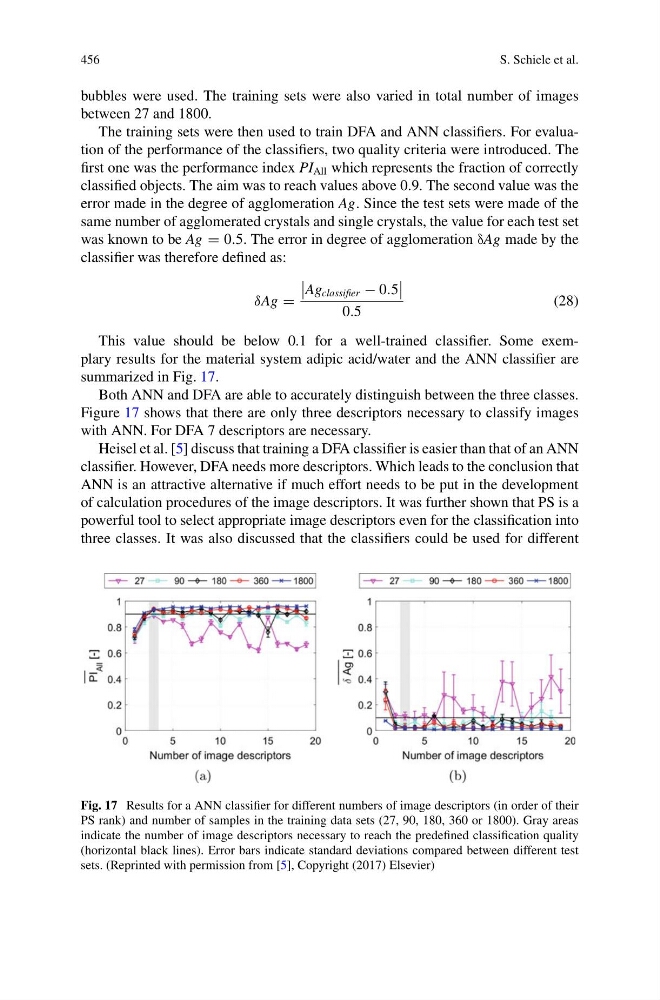
This value should be below 0.1 for a well-trained classifier. Some exemplary results for the material system adipic acid/water and the ANN classifier are
summarized in Fig. 17.
Both ANN and DFA are able to accurately distinguish between the three classes.
Figure 17 shows that there are only three descriptors necessary to classify images
with ANN. For DFA 7 descriptors are necessary.
Heisel et al. [5] discuss that training a DFA classifier is easier than that of an ANN
classifier. However, DFA needs more descriptors. Which leads to the conclusion that
ANN is an attractive alternative if much effort needs to be put in the development
of calculation procedures of the image descriptors. It was further shown that PS is a
powerful tool to select appropriate image descriptors even for the classification into
three classes. It was also discussed that the classifiers could be used for different
Fig. 17 Results for a ANN classifier for different numbers of image descriptors (in order of their
PS rank) and number of samples in the training data sets (27, 90, 180, 360 or 1800). Gray areas
indicate the number of image descriptors necessary to reach the predefined classification quality
(horizontal black lines). Error bars indicate standard deviations compared between different test
sets. (Reprinted with permission from [5], Copyright (2017) Elsevier)
S. Schiele et al.
bubbles were used. The training sets were also varied in total number of images
between 27 and 1800.
The training sets were then used to train DFA and ANN classifiers. For evaluation of the performance of the classifiers, two quality criteria were introduced. The
first one was the performance index PI All which represents the fraction of correctly
classified objects. The aim was to reach values above 0.9. The second value was the
error made in the degree of agglomeration Ag. Since the test sets were made of the
same number of agglomerated crystals and single crystals, the value for each test set
was known to be Ag = 0.5. The error in degree of agglomeration δAg made by the
classifier was therefore defined as:
δAg =
Ag classifier − 0.5
0.5
(28)
This value should be below 0.1 for a well-trained classifier. Some exemplary results for the material system adipic acid/water and the ANN classifier are
summarized in Fig. 17.
Both ANN and DFA are able to accurately distinguish between the three classes.
Figure 17 shows that there are only three descriptors necessary to classify images
with ANN. For DFA 7 descriptors are necessary.
Heisel et al. [5] discuss that training a DFA classifier is easier than that of an ANN
classifier. However, DFA needs more descriptors. Which leads to the conclusion that
ANN is an attractive alternative if much effort needs to be put in the development
of calculation procedures of the image descriptors. It was further shown that PS is a
powerful tool to select appropriate image descriptors even for the classification into
three classes. It was also discussed that the classifiers could be used for different
Fig. 17 Results for a ANN classifier for different numbers of image descriptors (in order of their
PS rank) and number of samples in the training data sets (27, 90, 180, 360 or 1800). Gray areas
indicate the number of image descriptors necessary to reach the predefined classification quality
(horizontal black lines). Error bars indicate standard deviations compared between different test
sets. (Reprinted with permission from [5], Copyright (2017) Elsevier)