

454
S. Schiele et al.
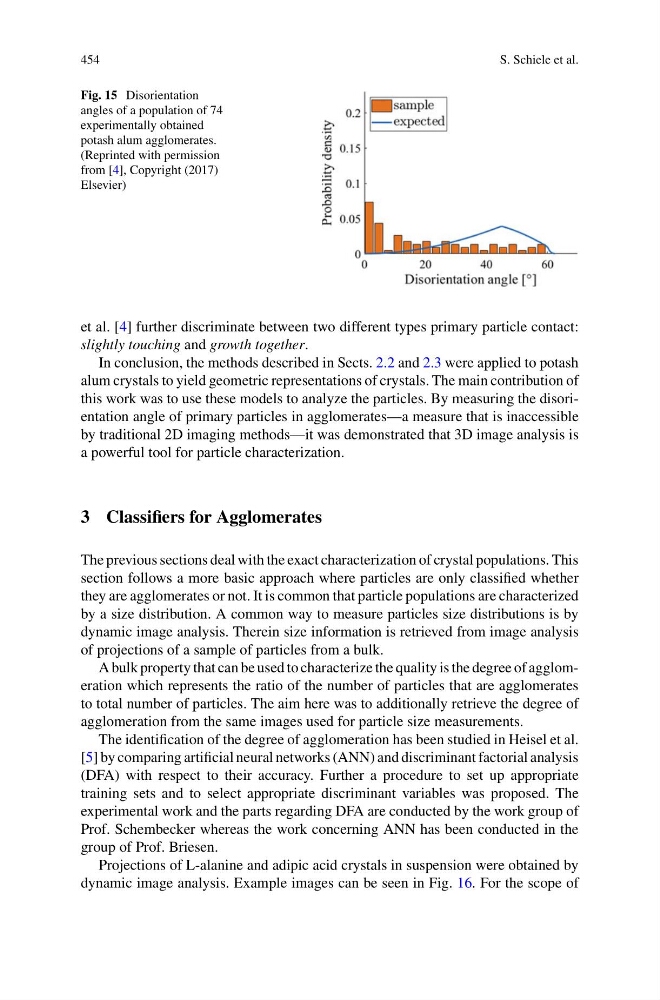
Fig. 15 Disorientation
angles of a population of 74
experimentally obtained
potash alum agglomerates.
(Reprinted with permission
from [4], Copyright (2017)
Elsevier)
et al. [4] further discriminate between two different types primary particle contact:
slightly touching and growth together.
In conclusion, the methods described in Sects. 2.2 and 2.3 were applied to potash
alum crystals to yield geometric representations of crystals. The main contribution of
this work was to use these models to analyze the particles. By measuring the disorientation angle of primary particles in agglomerates—a measure that is inaccessible
by traditional 2D imaging methods—it was demonstrated that 3D image analysis is
a powerful tool for particle characterization.
3 Classifiers for Agglomerates
The previous sections deal with the exact characterization of crystal populations. This
section follows a more basic approach where particles are only classified whether
they are agglomerates or not. It is common that particle populations are characterized
by a size distribution. A common way to measure particles size distributions is by
dynamic image analysis. Therein size information is retrieved from image analysis
of projections of a sample of particles from a bulk.
A bulk property that can be used to characterize the quality is the degree of agglomeration which represents the ratio of the number of particles that are agglomerates
to total number of particles. The aim here was to additionally retrieve the degree of
agglomeration from the same images used for particle size measurements.
The identification of the degree of agglomeration has been studied in Heisel et al.
[5] by comparing artificial neural networks (ANN) and discriminant factorial analysis
(DFA) with respect to their accuracy. Further a procedure to set up appropriate
training sets and to select appropriate discriminant variables was proposed. The
experimental work and the parts regarding DFA are conducted by the work group of
Prof. Schembecker whereas the work concerning ANN has been conducted in the
group of Prof. Briesen.
Projections of L-alanine and adipic acid crystals in suspension were obtained by
dynamic image analysis. Example images can be seen in Fig. 16. For the scope of
S. Schiele et al.
Fig. 15 Disorientation
angles of a population of 74
experimentally obtained
potash alum agglomerates.
(Reprinted with permission
from [4], Copyright (2017)
Elsevier)
et al. [4] further discriminate between two different types primary particle contact:
slightly touching and growth together.
In conclusion, the methods described in Sects. 2.2 and 2.3 were applied to potash
alum crystals to yield geometric representations of crystals. The main contribution of
this work was to use these models to analyze the particles. By measuring the disorientation angle of primary particles in agglomerates—a measure that is inaccessible
by traditional 2D imaging methods—it was demonstrated that 3D image analysis is
a powerful tool for particle characterization.
3 Classifiers for Agglomerates
The previous sections deal with the exact characterization of crystal populations. This
section follows a more basic approach where particles are only classified whether
they are agglomerates or not. It is common that particle populations are characterized
by a size distribution. A common way to measure particles size distributions is by
dynamic image analysis. Therein size information is retrieved from image analysis
of projections of a sample of particles from a bulk.
A bulk property that can be used to characterize the quality is the degree of agglomeration which represents the ratio of the number of particles that are agglomerates
to total number of particles. The aim here was to additionally retrieve the degree of
agglomeration from the same images used for particle size measurements.
The identification of the degree of agglomeration has been studied in Heisel et al.
[5] by comparing artificial neural networks (ANN) and discriminant factorial analysis
(DFA) with respect to their accuracy. Further a procedure to set up appropriate
training sets and to select appropriate discriminant variables was proposed. The
experimental work and the parts regarding DFA are conducted by the work group of
Prof. Schembecker whereas the work concerning ANN has been conducted in the
group of Prof. Briesen.
Projections of L-alanine and adipic acid crystals in suspension were obtained by
dynamic image analysis. Example images can be seen in Fig. 16. For the scope of