

2 Dynamic Modelling of Reactive Fluidized Bed Systems Using …
39
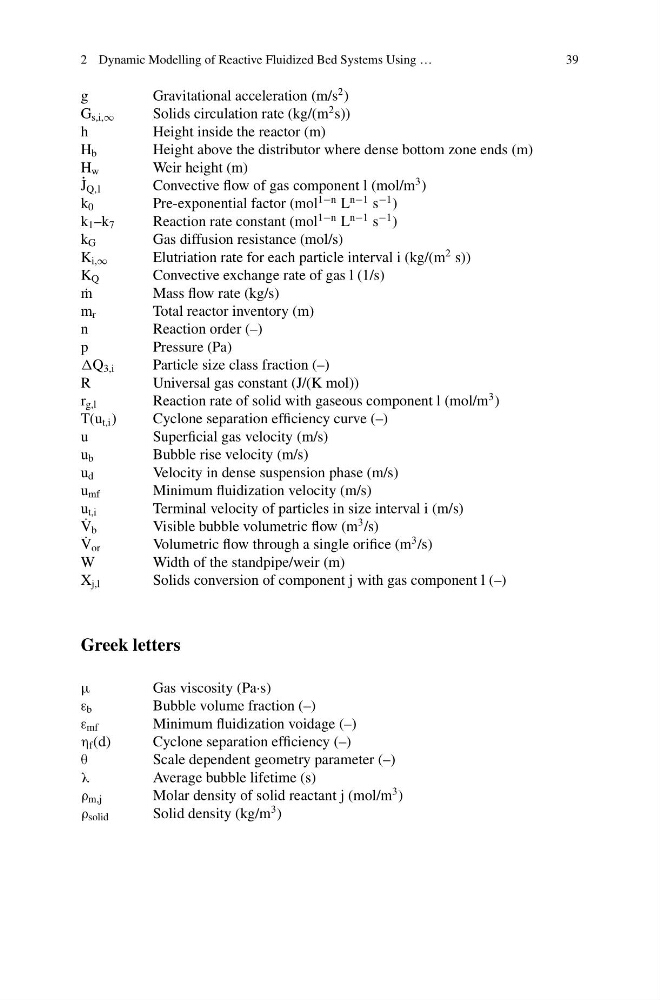
g
Gravitational acceleration (m/s
2 )
G s,i,∞
Solids circulation rate (kg/(m
2 s))
h
Height inside the reactor (m)
H b
Height above the distributor where dense bottom zone ends (m)
H w
Weir height (m)
˙
J Q,l
Convective flow of gas component l (mol/m
3 )
k 0
Pre-exponential factor (mol
1−n L
n−1 s
−1 )
k 1 –k 7
Reaction rate constant (mol
1−n L
n−1 s
−1 )
k G
Gas diffusion resistance (mol/s)
K i,∞
Elutriation rate for each particle interval i (kg/(m
2 s))
K Q
Convective exchange rate of gas l (1/s)
˙
m
Mass flow rate (kg/s)
m r
Total reactor inventory (m)
n
Reaction order (–)
p
Pressure (Pa)
Q 3,i
Particle size class fraction (–)
R
Universal gas constant (J/(K mol))
r g,l
Reaction rate of solid with gaseous component l (mol/m
3 )
T(u t,i )
Cyclone separation efficiency curve (–)
u
Superficial gas velocity (m/s)
u b
Bubble rise velocity (m/s)
u d
Velocity in dense suspension phase (m/s)
u mf
Minimum fluidization velocity (m/s)
u t,i
Terminal velocity of particles in size interval i (m/s)
˙
V b
Visible bubble volumetric flow (m
3 /s)
˙
V or
Volumetric flow through a single orifice (m
3 /s)
W
Width of the standpipe/weir (m)
X j,l
Solids conversion of component j with gas component l (–)
Greek letters
μ
Gas viscosity (Pa·s)
ε b
Bubble volume fraction (–)
ε mf
Minimum fluidization voidage (–)
η f (d)
Cyclone separation efficiency (–)
θ
Scale dependent geometry parameter (–)
λ
Average bubble lifetime (s)
ρ m,j
Molar density of solid reactant j (mol/m
3 )
ρ solid
Solid density (kg/m
3 )
39
g
Gravitational acceleration (m/s
2 )
G s,i,∞
Solids circulation rate (kg/(m
2 s))
h
Height inside the reactor (m)
H b
Height above the distributor where dense bottom zone ends (m)
H w
Weir height (m)
˙
J Q,l
Convective flow of gas component l (mol/m
3 )
k 0
Pre-exponential factor (mol
1−n L
n−1 s
−1 )
k 1 –k 7
Reaction rate constant (mol
1−n L
n−1 s
−1 )
k G
Gas diffusion resistance (mol/s)
K i,∞
Elutriation rate for each particle interval i (kg/(m
2 s))
K Q
Convective exchange rate of gas l (1/s)
˙
m
Mass flow rate (kg/s)
m r
Total reactor inventory (m)
n
Reaction order (–)
p
Pressure (Pa)
Q 3,i
Particle size class fraction (–)
R
Universal gas constant (J/(K mol))
r g,l
Reaction rate of solid with gaseous component l (mol/m
3 )
T(u t,i )
Cyclone separation efficiency curve (–)
u
Superficial gas velocity (m/s)
u b
Bubble rise velocity (m/s)
u d
Velocity in dense suspension phase (m/s)
u mf
Minimum fluidization velocity (m/s)
u t,i
Terminal velocity of particles in size interval i (m/s)
˙
V b
Visible bubble volumetric flow (m
3 /s)
˙
V or
Volumetric flow through a single orifice (m
3 /s)
W
Width of the standpipe/weir (m)
X j,l
Solids conversion of component j with gas component l (–)
Greek letters
μ
Gas viscosity (Pa·s)
ε b
Bubble volume fraction (–)
ε mf
Minimum fluidization voidage (–)
η f (d)
Cyclone separation efficiency (–)
θ
Scale dependent geometry parameter (–)
λ
Average bubble lifetime (s)
ρ m,j
Molar density of solid reactant j (mol/m
3 )
ρ solid
Solid density (kg/m
3 )